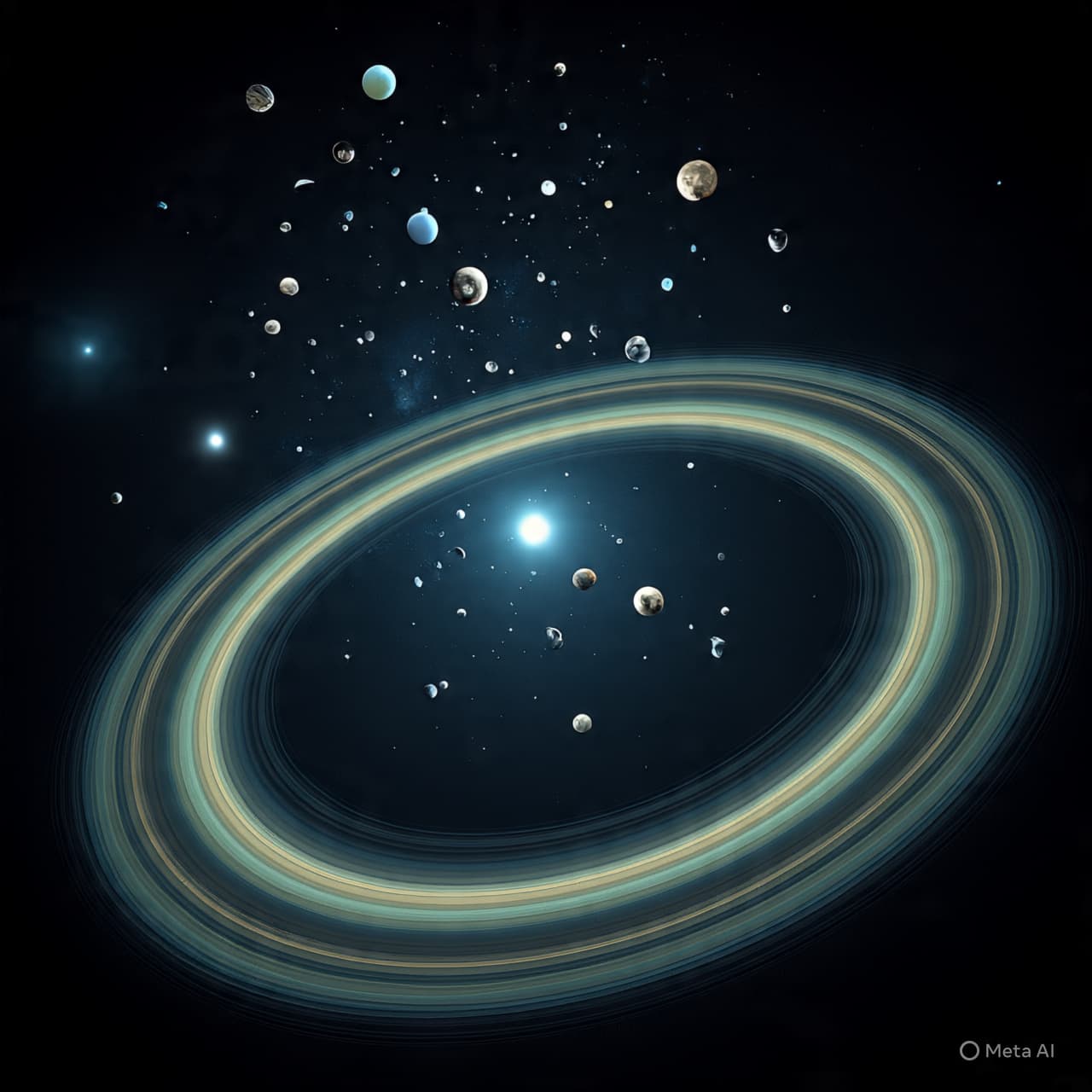
The vastness around Saturn carries a strange serenity — a golden planet surrounded by rings that glimmer like distant firelight in the cold of space. Yet beneath this calm, recent science sketches a tale far more violent than the silent beauty suggests. In the swirling ballet of celestial mechanics, Saturn’s largest moon, Titan, may not be a relic of gentle accretion but the surviving child of cosmic upheaval. Rather than forming quietly from a disk of gas and dust around its parent planet, Titan might have been born from a colossal collision between two ancient moons, their remnants shaping much of what we observe today.
Researchers have developed detailed computer simulations exploring how such a dramatic coupling might have unfolded. In this scenario, a proto‑Titan — a moon perhaps resembling Jupiter’s battered Callisto, cratered and unadorned by atmosphere — collided headlong with a smaller companion sometimes dubbed proto‑Hyperion. The energy released in such an event would have been immense, resurfacing the newly formed Titan and erasing many of the impact scars that might otherwise have marred its face. The resulting object, now encased in a thick, hazy atmosphere, emerged with an orbit gently nudged by that violent past, its eccentric path around Saturn only slowly circularizing under the tug of tidal forces.
This hypothesized collision doesn’t just help explain Titan’s smooth curves and odd orbit, however. It reaches outward to other mysteries of the Saturnian system — the surprising youth of the planet’s iconic rings, and the curious tilts and motions of more distant moons like Iapetus. After the merger, simulations suggest Titan’s altered path through space could have stirred up smaller satellites, nudging them into collisions that shattered them into debris. Much of this material, shepherded by gravity, would re‑coalesce into moonlets; a portion, scattered inward, could have drifted toward Saturn to become the broad, bright rings admired for centuries.
One surviving hint of this ancient turmoil might be Hyperion itself. Locked today in a delicate orbital resonance with Titan, the sponge‑like moon sits as a possible fragment of those chaotic times — a second‑generation inhabitant of the Saturn system, assembled from the very rubble forged in the giant impact. The simulations even trace how proto‑Hyperion’s influence could have tilted Iapetus’s orbit, leaving dynamical fingerprints detectable billions of years after the event.
This reconstruction of the past not only links disparate features of the Saturnian system into a unified narrative but also places our understanding of planetary formation into a broader context of motion and collision. If Titan’s origin is indeed the fruit of a violent merger, then moons everywhere may carry the echoes of ancient catastrophes — stories of destruction woven into their mass and orbit, waiting to be read by missions and instruments sensitive to the subtle whispers of cosmic history.
In straight news language: new research suggests Saturn’s largest moon, Titan, may have formed from a giant collision between two earlier moons, rather than through gradual accretion. Simulations indicate that this moon‑moon impact could also have triggered orbital shifts among other satellites and contributed to the formation of Saturn’s rings. These findings help explain several features of the Saturnian system, including Titan’s orbit, the presence of Hyperion, and the relatively young age of the rings, and may be tested by future missions such as NASA’s Dragonfly probe.
AI Image Disclaimer Visuals are AI‑generated and serve as conceptual representations.
Sources (Media Names Only) SpaceDaily SETI Institute News GeekSpin Phys.org EurekAlert
Published by Banx Network. This article is part of the Banx decentralized media programme, powered by the BXE token on the XRP Ledger.