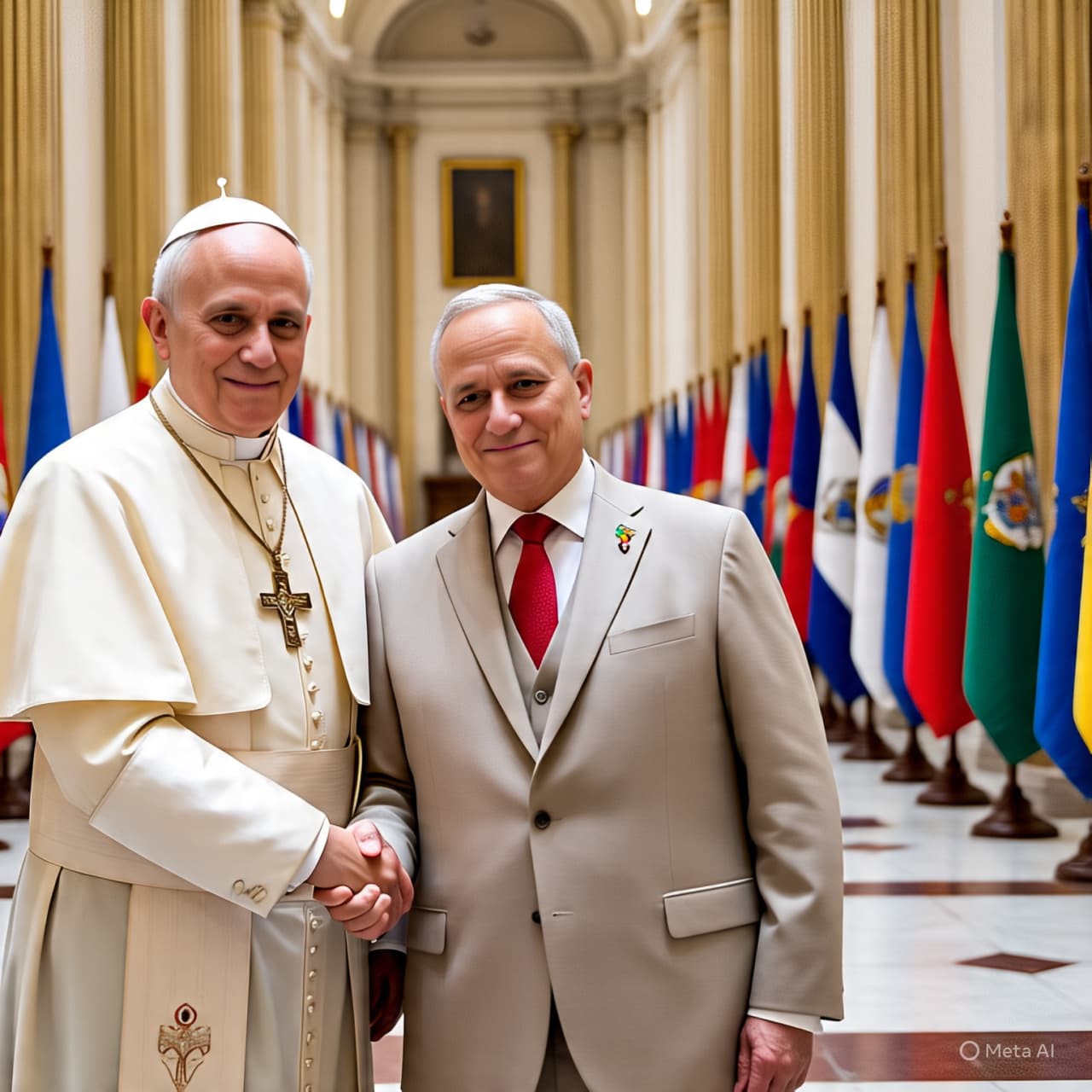
There is a soft stirring in the air at Ankara’s Presidential Palace — a rustle not of wind or flags, but of history, faith, and fragile hope. Under the calm November sky, two leaders from vastly different realms meet: a pontiff whose robes speak of centuries-old spiritual roots, and a president whose voice echoes power in a turbulent world. Their handshake, brief yet laden with symbolism, offers more than protocol — it offers possibility.
Pope Leo XIV arrived in Türkiye for his first overseas trip as pontiff, landing in Ankara and soon after meeting Recep Tayyip Erdoğan. In a speech to authorities, civil-society representatives and the diplomatic corps, Pope Leo urged Türkiye to embrace its unique capacity to build bridges — not just among lands, but among people of faith, history and destiny.
He described Türkiye as a land “inextricably linked to the origins of Christianity,” yet also as a place where Muslims, Christians, Jews — all children of Abraham — might recognize difference not as division, but as the foundation of fraternity. He said that in a world increasingly torn by “conflict, polarization and a temptation to might-makes-right,” societies need the courage to choose dialogue, mercy and solidarity instead of fear and fragmentation.
For his part, President Erdoğan responded by emphasizing the importance of justice and peace — notably in the context of international conflicts. He praised the Pope’s “astute stance” on the Palestinian issue, echoing calls for a fair resolution and protection of Jerusalem’s historic and religious status. Erdoğan framed Türkiye’s identity as a bridge between East and West — a country where cultural and religious differences should be treated not as fault lines, but as sources of enrichment.
Beyond formalities and headlines, the meeting carries deeper resonance. In a moment when global crises — conflicts overseas, migration, refugee flows — strain old certainties, the Pope’s journey to Türkiye arrives not with condemnation, but with an open hand: an encouragement toward empathy, coexistence, and shared humanity.
For Türkiye’s Christian minorities, and for all who believe in peaceful co-existence across faiths, the visit may offer a renewal of hope. For the world, it signals that even in a time of division — when media magnifies difference, and geopolitics amplifies fear — there remains room for dialogue, for reconciliation, and for bridges built on respect.
As the sun set over Ankara’s domes and minarets, the gesture lingered: not a promise, but an invitation. An invitation to try again — to listen, to understand, to build.
AI image disclaimer : Visuals are created with AI tools and are intended for symbolic representation, not real photographs.
Sources : Vatican News Catholic News Agency The National Reuters ANSA
Published by Banx Network. This article is part of the Banx decentralized media programme, powered by the BXE token on the XRP Ledger.