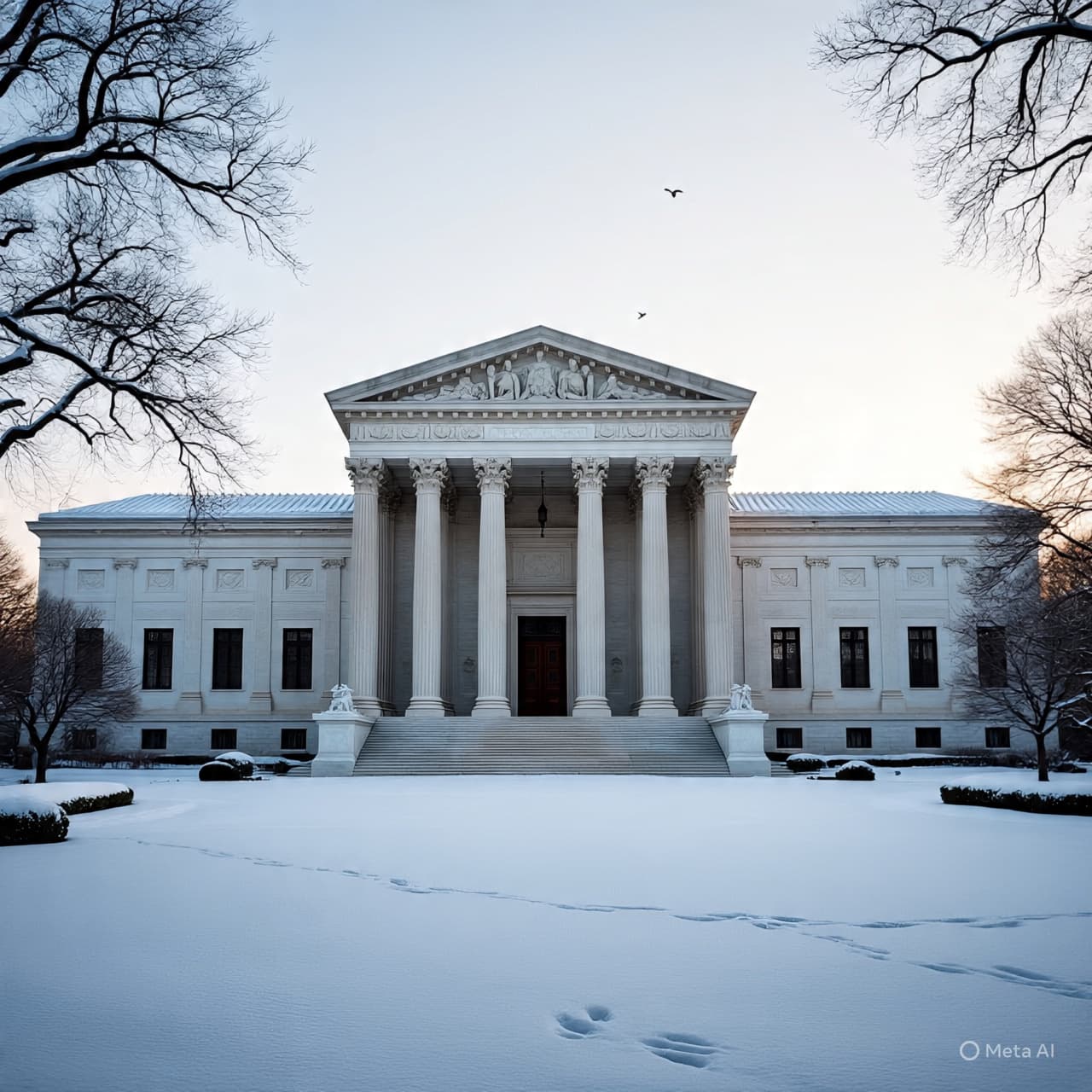
There are moments in a nation’s story when vast forces converge in places unseen by most — not upon battlefields or in crowded chambers, but within marble halls where light strikes quietly across polished benches. In these corridors, the question of who holds a powerful lever — the decision over a currency’s ebb and flow — passes almost without fanfare into the hands of nine individuals clothed in black robes. Yet the implications reach into living rooms and markets alike, touching the cost of homes, the price of bread, and the heartbeat of labor.
Such a moment has come into focus as the Supreme Court prepares to weigh a case that probes the limits of presidential authority over the Federal Reserve, the central bank designed by Congress to stand at arm’s length from immediate political influence. At its core is a dispute over President Donald Trump’s attempt to remove Federal Reserve Governor Lisa Cook, a legal battle now unfolding and set for argument before the justices in early 2026. The question is narrow in form but wide in consequence: does the president have the legal authority to dismiss a sitting Fed governor outside the “for cause” protections embedded in law?
The Federal Reserve weaves through the American economic story like a river through a plainscape — often unnoticed until drought or flood. Since its founding in 1913, Congress has crafted a structure meant to shelter monetary policy from transient winds of political preference, insulating governors and its leadership from abrupt shifts in power. This insulation was deliberate, intended to allow the Fed to navigate the long arc of inflation, employment, and financial stability without bending to the immediacy of electoral pressures.
Yet the current case tests that design. In August 2025, Mr. Trump wrote to Governor Cook asserting she should be removed and citing alleged misconduct she denies. A federal judge issued a preliminary injunction keeping her in place while her lawsuit proceeds, and the administration appealed that decision. The Supreme Court’s handling of the appeal, and ultimately of the underlying constitutional question, will reveal how deeply the judiciary will uphold the boundaries Congress set between presidential oversight and the Fed’s operational autonomy.
The justices’ past gestures offer quiet but telling signals. In a related dispute over independent agency authority, the Supreme Court allowed the president to remove members of several federal boards, while signaling that the Federal Reserve’s unique quasi-public structure sets it apart from other agencies. In that ruling, the court acknowledged concerns that unchecked removal power could undermine the Fed’s independence — a principle many economists view as essential to market confidence and long-term economic stability.
Beyond the courtroom, former policymakers, central bankers, and financial leaders have urged the justices to preserve the institution’s insulation from direct political intervention. Their arguments emphasize that central bank independence is not a matter of tradition alone, but a structural safeguard relied upon by investors, governments, and households across the global economy.
At the same time, the court’s recent record reflects a willingness to revisit long-standing limits on executive authority, particularly where independent agencies are concerned. This tension — between precedent and reinterpretation — leaves the outcome uncertain, with implications extending well beyond the present administration.
In practical terms, the Supreme Court is being asked to decide whether a president may remove a Federal Reserve governor without cause. The ruling, expected by mid-2026, will clarify whether the protections written into law remain firm, or whether presidential authority may reach further into the institution that steers U.S. monetary policy.
AI Image Disclaimer Illustrations were created using AI tools and are not real photographs.
Sources (Media Names Only) Reuters Associated Press Bloomberg Financial Times
Published by Banx Network. This article is part of the Banx decentralized media programme, powered by the BXE token on the XRP Ledger.