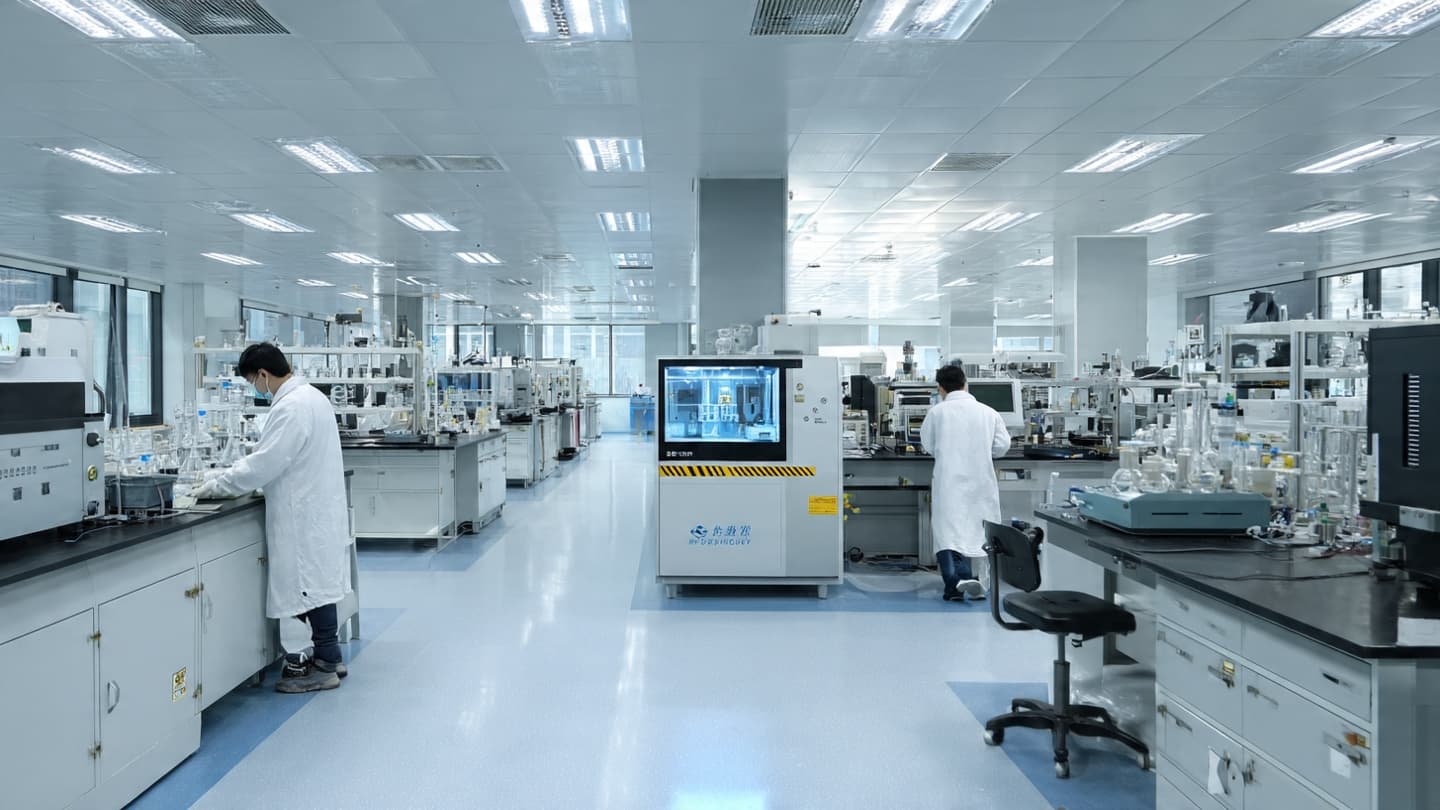
Inside a laboratory, discovery has traditionally moved at the pace of hands, instruments and repeated experiments. A material is proposed, tested, measured and modified, sometimes through hundreds of cycles. In Anhui, Chinese researchers are now adding another participant to that process: artificial intelligence.
An AI-powered laboratory in Hefei, Anhui province, is being used to accelerate the discovery of new materials by combining machine learning with automated laboratory equipment. Reuters footage from the facility shows researchers working with systems designed to shorten the path from prediction to experiment.
Materials science sits beneath much of modern technology. Batteries, semiconductors, solar cells, medical devices and industrial equipment all depend on materials with particular physical and chemical properties. Finding better materials can therefore influence many industries simultaneously.
The traditional process can be slow because the number of possible combinations is enormous. Researchers may know what properties they want but still have to test many candidate materials before finding one that performs well. AI can examine large datasets and identify patterns that might be difficult for humans to recognize.
The laboratory approach goes further than simply asking an algorithm for a prediction. Automated equipment can produce candidate materials, test them and feed the results back into the system. The cycle allows researchers to combine computation and physical experimentation in a more continuous process.
China has invested heavily in both artificial intelligence and advanced manufacturing, creating an environment where such systems can develop alongside large industrial supply chains. The combination is particularly important for technologies where materials performance can determine whether a product is commercially viable.
The implications reach into energy research. Better materials could improve batteries, solar technologies and other energy systems. Even small improvements in efficiency, durability or production cost can become significant when multiplied across millions of devices.
The same approach could also support medical research and electronics. Materials with improved conductivity, strength, heat resistance or biological compatibility can open possibilities in fields that appear distant from one another but share the same scientific foundation.
Automation does not remove the need for scientists. Instead, it changes where their time may be spent. Researchers can focus more heavily on designing experiments, interpreting results and deciding which questions deserve attention, while machines handle repetitive laboratory processes.
The Hefei laboratory represents a broader shift toward what is sometimes described as autonomous or self-driving science. The idea is still developing, but the principle is straightforward: computers identify promising possibilities, machines test them and the results help guide the next experiment.
In that cycle, the laboratory becomes less like a static room filled with equipment and more like a continuously moving system. China's AI-powered materials research offers an early glimpse of that future, where the boundary between computation and physical experimentation becomes increasingly difficult to see.
SEO-friendly Slug china-ai-powered-lab-material-discovery-anhui-science
Hashtags #China #ArtificialIntelligence #AI #Science #MaterialsScience #Research #Technology
Image Disclaimer Illustrations were created with AI tools to represent the research environment conceptually and are not photographs of the actual laboratory.
Sources Reuters
Published by Banx Network. This article is part of the Banx decentralized media programme, powered by the BXE token on the XRP Ledger.