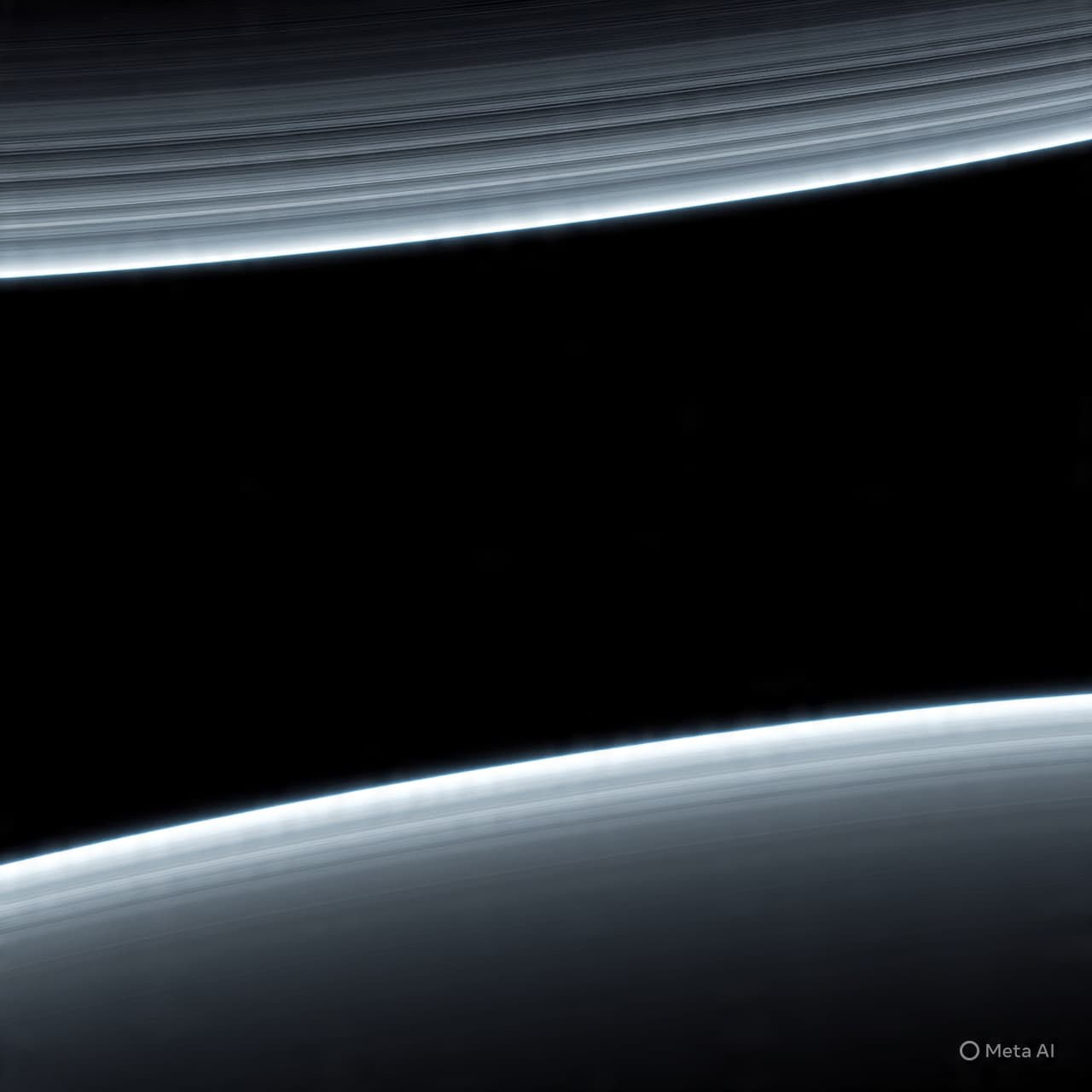
There are ways of seeing that depend not on distance, but on how one chooses to look. A single object, unchanged in its place, can appear differently when viewed through another lens, another wavelength, another moment in time. In the long orbit of observation, understanding often comes not from a single image, but from the quiet alignment of many.
So it is with Saturn, the ringed planet that has long held the attention of observers both on Earth and beyond it. Now, through the combined perspectives of the James Webb Space Telescope and the Hubble Space Telescope, a more layered portrait has begun to emerge—one that moves between wavelengths, revealing details that neither instrument could fully capture alone.
Each telescope brings with it a different way of seeing. Hubble Space Telescope observes in visible and ultraviolet light, tracing the contours of Saturn’s atmosphere and the structure of its rings as they reflect sunlight. In these images, the planet appears familiar: bands of cloud, subtle storms, and the bright geometry of rings that encircle it with near symmetry.
James Webb Space Telescope, by contrast, looks into the infrared, where heat and composition begin to define the view. In this spectrum, Saturn’s atmosphere reveals different layers—regions of varying temperature, clouds that absorb or emit radiation in distinct ways. The rings, too, shift in appearance, their brightness and structure changing depending on how they interact with infrared light.
When these perspectives are brought together, the result is not merely a sharper image, but a deeper one. Features seen faintly in one wavelength become clearer in another. Atmospheric dynamics—storms, jet streams, seasonal changes—can be traced with greater continuity. The interplay of light and matter becomes more apparent, each wavelength contributing a piece to a broader understanding.
The work sits within the evolving field of planetary science, where multi-wavelength observation has become essential. Planets are not static bodies; they are systems of motion, shaped by energy, chemistry, and time. To observe them fully requires attention to these layers, to the ways in which light interacts differently across the spectrum.
There is also a sense of continuity in this collaboration. Hubble Space Telescope, launched decades ago, continues to offer clarity in visible light, while James Webb Space Telescope extends observation into ranges previously inaccessible with such precision. Together, they form a kind of dialogue across generations of technology, each contributing to a shared view of the same distant world.
Saturn itself remains unchanged in its orbit, its rings continuing their slow and intricate motion. Yet through these combined observations, its presence becomes more detailed, more nuanced—less a single image and more a composite of perspectives.
NASA and collaborating scientists report that combined observations from the Webb and Hubble telescopes have provided new multi-wavelength views of Saturn, revealing additional details about its atmosphere and ring structure. The data will support ongoing studies of planetary dynamics and seasonal changes within the Saturn system.
AI Image Disclaimer
These illustrations are AI-generated for conceptual visualization and are not actual telescope images.
Sources
NASA ESA Space.com Scientific American Nature
Published by Banx Network. This article is part of the Banx decentralized media programme, powered by the BXE token on the XRP Ledger.