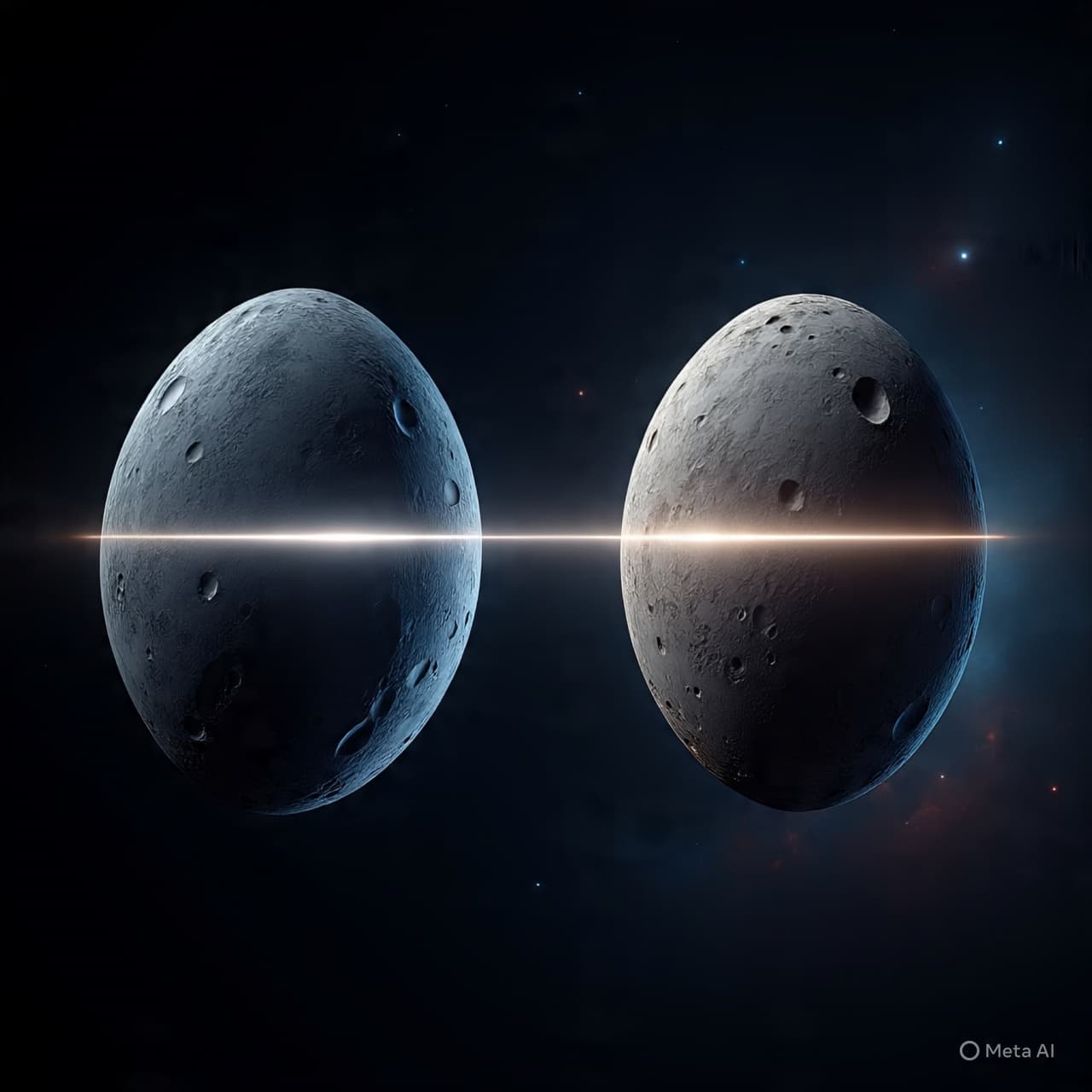
In the quiet reaches beyond Neptune, where the Sun’s light is a distant glow and the ancient remnants of the solar system drift in slow orbit, there exist strange little worlds that seem to wear the universe’s version of a hat and scarf. To the casual observer, these distant objects — shaped like two spheres joined together — evoke playful images of snowmen carved not from snow, but from ice and dust. Yet closer study reveals that behind this whimsical resemblance lies a complex choreography of physics, one that physicists have long sought to truly understand. The shapes we call “space snowmen” are not mere curiosities; they are chapters in a deep story about how matter gathers under gravity’s embrace in the most distant reaches of our cosmic neighborhood.
These peculiar bodies, formally known as contact binaries, are found in the Kuiper Belt — a vast ring of icy remnants from the solar system’s birth. About one in ten such objects exhibit this bilobate form, reminiscent of a snowman with a larger “body” and a smaller “head.” Among the most famous is Arrokoth, the reddish, two‑lobed object imaged up close by NASA’s New Horizons spacecraft in 2019, revealing surface textures and shapes that defied simple explanations. Scientists initially wondered whether gentle collisions between ancient objects could account for these shapes, but the physics involved proved elusive.
Recent research offers a more sophisticated understanding. A team at Michigan State University developed the first computer simulations capable of naturally forming these snowman‑like shapes through a process known as gravitational collapse. This process occurs when a rotating cloud of tiny icy planetesimals — the foundational building blocks of planets and dwarfs — collapses inward under its own gravity faster than it disperses, allowing objects to coalesce gently rather than violently. Instead of treating colliding bodies as soft masses merging into single spheres, the new model lets individual particles retain structural strength and settle against one another, preserving the two‑lobe shape seen in real objects.
In the team’s simulations, clouds of hundreds of thousands of particles were allowed to interact over time, drawing closer under mutual gravitational pull. The unexpected result was that many clouds naturally produced contact binaries — two round lobes in quiet contact, much like familiar winter figures without hats or scarves. These gentle unions suggest that the snowman‑like shape can arise not from rare cosmic accidents but as a natural outcome of early solar system dynamics, providing a tangible link between millennia‑old physics and the objects we observe today.
Yet, as elegant as the theory may seem, it is not a perfect reproduction of reality. In the simulations, only a fraction of initial planetesimals produced contact binaries, indicating that other factors may also play a role in their formation. Researchers acknowledge that further refinement of the models is needed, including a closer match to observational data from missions like New Horizons and future Kuiper Belt explorations. Nonetheless, the new work represents a meaningful step toward unraveling a mystery that has persisted since these distant objects were first seen.
In the vastness where sunlight is faint and silence prevails for billions of miles, these cosmic snowmen remind us that much of the universe’s story is written in subtle forms and forces, shaped by gravity’s unending influence. They are not simply shaped by chance, nor are they fashioned by magic; rather, they are sculpted by the slow, persistent dance of matter and motion that has governed our solar system since its earliest days.
AI Image Disclaimer “Visuals are created with AI tools and are not real photographs.”
Sources Gizmodo Phys.org MSU Today Discover Magazine Royal Astronomical Society
Published by Banx Network. This article is part of the Banx decentralized media programme, powered by the BXE token on the XRP Ledger.