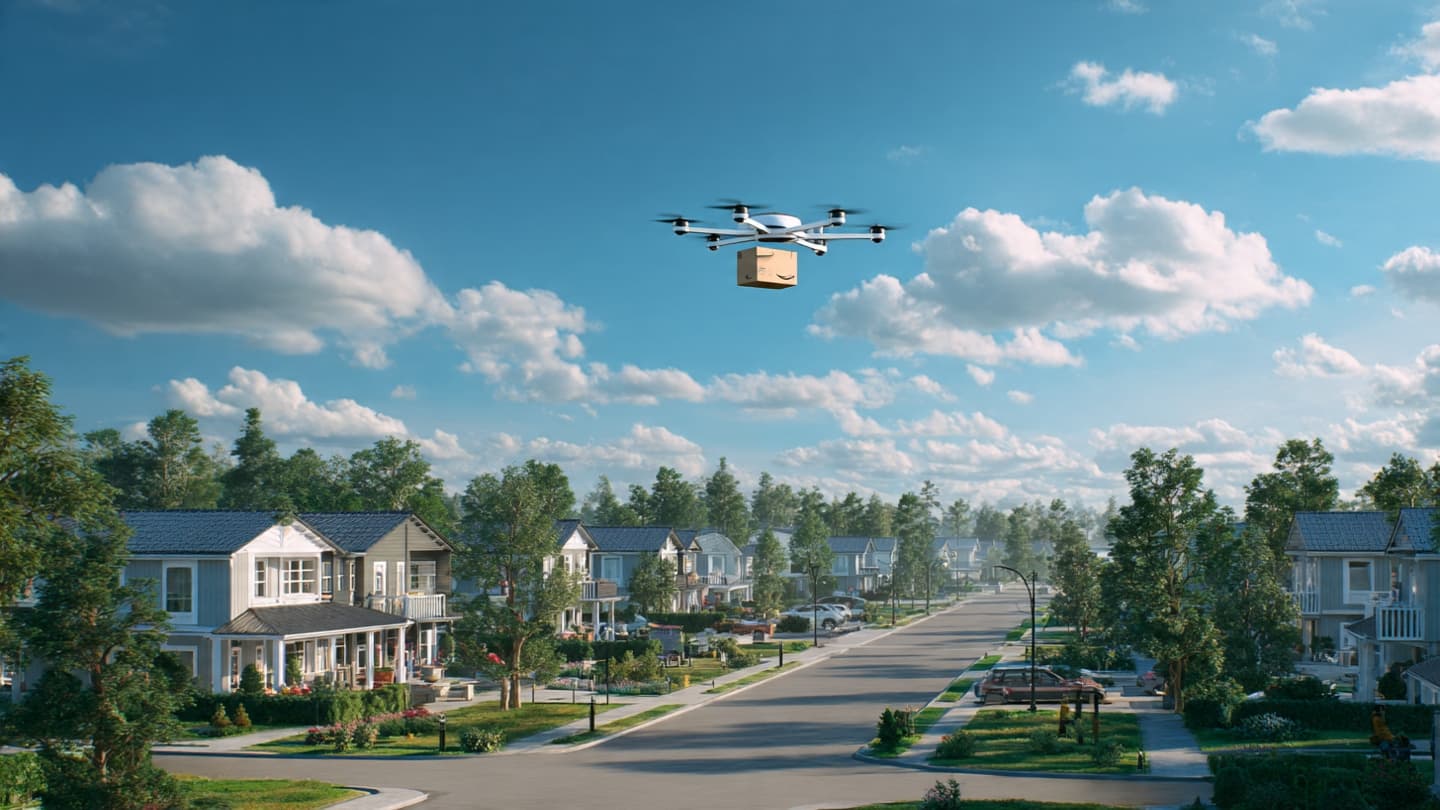
There is something quietly strange about watching a package arrive without the familiar sound of a delivery van. Above the roofs and streets, a small aircraft crosses the sky, carrying an object ordered only moments before. What once belonged mostly to science fiction is gradually becoming part of Amazon’s delivery experiment in the United States.
Amazon announced that its Prime Air drone-delivery service is expected to expand to nearly 500 cities and towns across the United States by the end of 2026. The company currently operates from 11 drone hubs, making the planned expansion a substantial increase in the scale of the service.
The service uses Amazon’s MK30 delivery drone, which is designed to carry eligible packages weighing up to five pounds. Rather than landing at a customer's property, the aircraft can hover and lower the package to a designated delivery area, allowing the drone to return to its operating base.
Each current drone hub can serve customers within a radius of roughly 7.5 miles. Amazon has already operated Prime Air in locations including College Station, Texas, and areas around Phoenix, while additional communities are being added as the network develops.
The expansion depends not only on aircraft but also on the regulatory environment. The Federal Aviation Administration has granted Amazon permissions that allow Prime Air drones to operate beyond the direct visual line of sight of a remote pilot. That capability is important because a delivery network serving hundreds of communities could not rely on pilots physically watching every aircraft throughout each flight.
Technology inside the MK30 is designed to support that autonomy. Amazon says the drone uses cameras and machine-learning systems to identify obstacles and other objects while in flight. The aircraft also incorporates redundant flight-control and monitoring systems intended to provide backup capabilities if a primary system encounters a problem.
The economics of drone delivery are still developing. Amazon says eligible drone deliveries can cost $4.99, with discounts available for Prime members and free delivery for qualifying orders over $50. The company is therefore testing not only whether drones can fly safely but also whether customers will find the service useful enough to choose it.
For communities, the arrival of drones introduces a different kind of delivery infrastructure. Local approvals can still be necessary even where federal aviation permissions exist, and some communities have raised questions about noise, safety and privacy. Amazon has adjusted flight routes and operating procedures as it works to address those concerns.
The larger ambition extends beyond the number of towns served. Amazon has previously said its long-term Prime Air vision involves delivering hundreds of millions of packages by drone each year. Reaching that scale would require a much broader network of aircraft, fulfillment facilities, software systems and regulatory approvals.
For now, the planned expansion represents another step in the gradual transformation of American delivery systems. The ordinary journey of a package—from warehouse to doorstep—is being reconsidered from above, with drones becoming an additional route through the increasingly automated landscape of commerce.
Image Disclaimer
These visuals were created with AI tools and are conceptual representations rather than photographs of actual Amazon drone operations.
Sources
Reuters Amazon Federal Aviation Administration The Wall Street Journal CNBC
Published by Banx Network. This article is part of the Banx decentralized media programme, powered by the BXE token on the XRP Ledger.