The night sky presents itself as stillness, a vast canvas of distant light that seems unchanged from one moment to the next. Yet within that stillness, motion unfolds continuously—planets orbit, stars rotate, and systems evolve in ways that are rarely visible without careful observation.
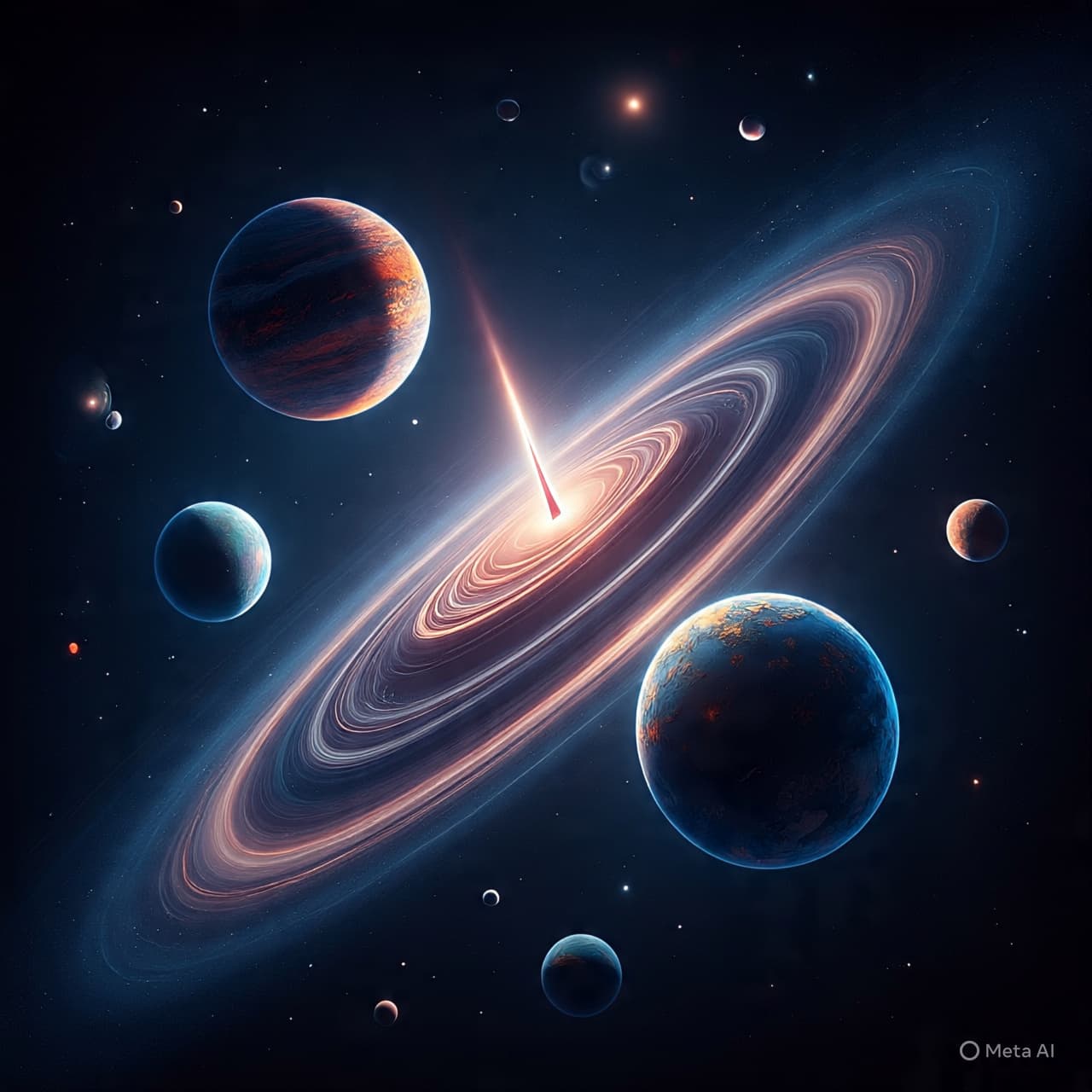
Astronomers have turned their attention to a particular class of objects known as exotrojans—bodies that share an orbit with a larger companion, moving in gravitational balance. These objects do not travel alone, nor do they follow independent paths. Instead, they exist within a relationship, positioned in stable points shaped by gravitational forces.
Detecting such objects requires precision. Their presence is not obvious. Instead, it is inferred through subtle variations—small irregularities in timing, light, or motion that suggest something else is there.
Recent studies focusing on pulsar systems—highly dense, rapidly rotating remnants of stars—have provided new opportunities for this search. Pulsars emit regular signals, making even slight deviations noticeable. Within these deviations, astronomers look for patterns that may indicate the presence of exotrojans.
The work is slow, built on observation and verification. Data is collected over extended periods, analyzed carefully, and compared against models that attempt to explain what cannot be directly seen.
Discovery, in this context, is not a moment, but a process. It unfolds gradually, as evidence accumulates and understanding deepens.
What makes exotrojans significant is not only their existence, but what they reveal about how systems form and evolve. They offer insight into gravitational dynamics, stability, and the complexity of celestial motion.
In the vastness of space, even the smallest objects matter. They remind us that the universe is not empty, but layered with relationships—some visible, others waiting quietly to be understood.
Published by Banx Network. This article is part of the Banx decentralized media programme, powered by the BXE token on the XRP Ledger.