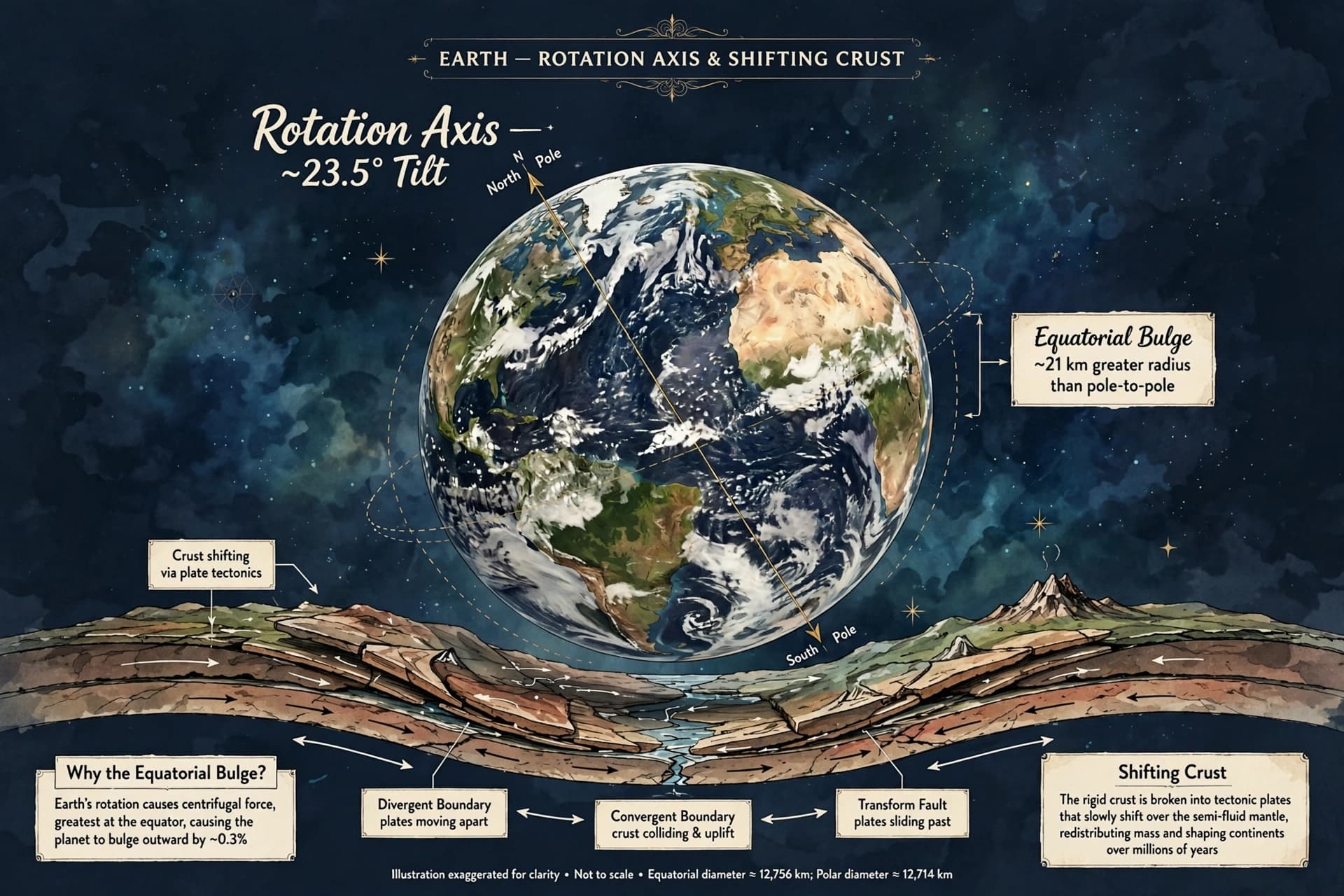
The Earth is not a perfect sphere. It bulges at the equator, flattened by the centrifugal force of its own rotation. This shape is not merely a curiosity of geometry; it is a balance, a physical equilibrium between the planet‘s mass distribution and the axis around which it spins. When that balance is disturbed—by the slow drift of continents, by the churning of the mantle, by the redistribution of mass deep within the planet—the solid Earth can shift relative to its spin axis. The poles move. The planet reorients. This phenomenon, known as true polar wander, has long been difficult to detect and even harder to date. A new study suggests that the ancient seas may hold the evidence.
Researchers led by Mathew Domeier at the University of Oslo have developed a novel method for identifying episodes of rapid true polar wander by examining global patterns of sea-level change over the past 320 million years . Their findings, published in the journal Science, identify four intervals where the signature of sea-level fluctuations matches the distinctive quadrupolar pattern that true polar wander would produce .
The logic behind the method is elegant. When the solid Earth shifts relative to its spin axis, regions that move toward the equator experience rising sea levels—a transgression—while regions that move toward the poles experience falling sea levels, or regression . This creates a characteristic pattern of flooding and exposure across the globe, one that is symmetrical in a particular way. It is not random. It is not the result of local tectonics. It is the fingerprint of a planet rebalancing itself.
Domeier and his colleagues analyzed paleogeographic reconstructions—maps of ancient continental flooding and exposure—at ten-million-year intervals . By applying statistical modeling, they could distinguish patterns consistent with rapid true polar wander from those caused by ordinary plate motion. This is a critical distinction, because the two processes can produce similar geological signatures and have been difficult to untangle.
The analysis revealed four intervals with significant true polar wander signals. Three occurred during the Mesozoic era: one in the Late Jurassic to Early Cretaceous, around 150 to 140 million years ago, and two in the mid-Cretaceous, around 100 to 90 million years ago . A fourth episode occurred during the Cenozoic . These findings broadly corroborate earlier paleomagnetic studies that had suggested rapid polar wander during these periods, but the new sea-level approach provides independent confirmation and a more precise temporal framework .
The implications of rapid true polar wander extend beyond geology. Because the core and climate belts remain tied to the spin axis while the crust and mantle shift, large or rapid episodes of polar wander could produce significant changes in climate, the biosphere, and Earth’s magnetic field . The authors argue that true polar wander should be considered as an episodic control on sea-level change and likely other global environmental and biological dynamics .
The study also challenges some previous interpretations. The researchers found little evidence for rapid true polar wander during most of the Cenozoic, and no significant signal supporting the idea that rapid northward movement of the supercontinent Pangea was driven primarily by polar wander during the late Carboniferous and Permian . The picture that emerges is not of a planet in constant, dramatic reorientation, but of one that experiences long periods of relative stability punctuated by episodes of rapid adjustment.
The ancient seas, it seems, have been keeping a record. In the patterns of flooding and exposure preserved in rock, in the rise and fall of shorelines long vanished, the Earth has left an account of its own rebalancing. The new method does not reveal absolute rates of polar wander directly, but it provides a way to identify intervals of heightened mobility—moments when the planet‘s solid body shifted more quickly relative to its spin axis . For a planet that has been turning for billions of years, those moments matter.
AI Image Disclaimer: All images accompanying this report are AI-generated and intended for illustrative purposes only.
Sources: Science, EurekAlert
Published by Banx Network. This article is part of the Banx decentralized media programme, powered by the BXE token on the XRP Ledger.