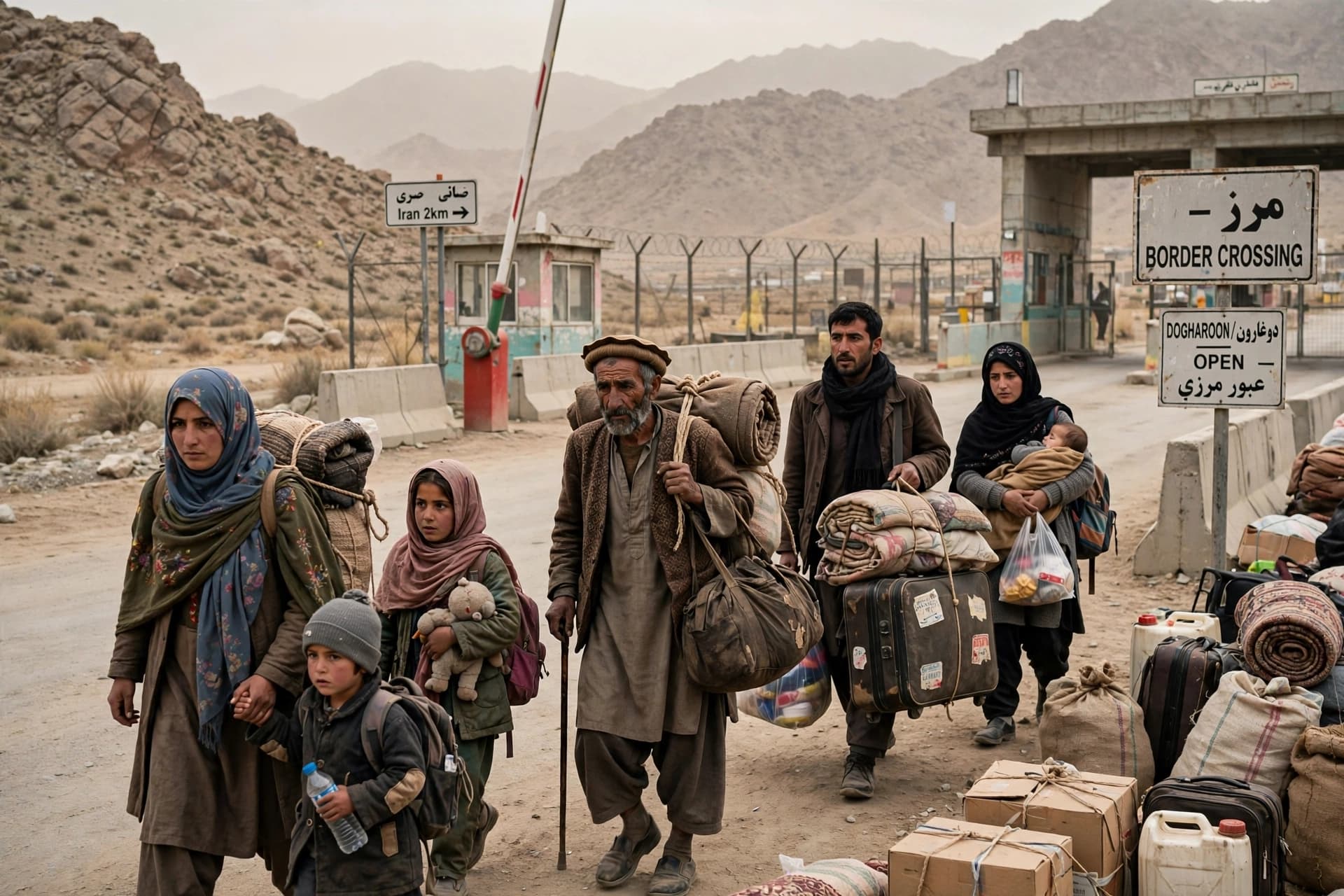
For many Afghans living in Iran, the decision to leave is not simply about crossing a border. It is also about weighing work, family, income and the possibility of finding a more stable life somewhere else. As Iran’s economic difficulties deepen, some Afghan migrants are once again considering whether remaining in the country is still sustainable.
Reuters reported that Iran’s economic crisis has placed additional pressure on Afghan migrants, many of whom depend on informal employment and daily wages. Rising living costs and reduced economic opportunities have made an already uncertain situation more difficult for families who have spent years building their lives inside Iran.
The pressure is visible through the movement of people. When economic conditions deteriorate, migrant workers can be among the first groups to feel the change because employment is often concentrated in construction, agriculture, services and other sectors sensitive to changes in consumer demand.
Iran has hosted millions of Afghans over many years, including documented refugees, migrants and people without formal residency status. Their circumstances vary considerably, meaning the economic impact is not experienced in exactly the same way by every household.
The latest pressure comes as Iran's wider economy faces disruption from the continuing conflict and restrictions on trade. The Associated Press reported that Iran has increasingly shifted some commerce toward land routes after disruptions to maritime trade through the Persian Gulf. At the Turkey-Iran border, truck traffic rose sharply, creating long queues and delays.
Such disruptions can eventually reach ordinary workers. Higher transportation expenses can increase the cost of food and household goods, while interruptions to trade can make businesses more cautious about hiring. For migrants who already have limited financial reserves, even relatively small changes in daily expenses can become significant.
The situation is also connected to the broader movement of people between Iran and Afghanistan. Economic pressure is only one factor behind migration decisions. Security conditions, family circumstances, employment prospects and the availability of assistance can all influence whether someone remains in Iran or begins the journey back toward Afghanistan.
For those who leave, returning does not necessarily mean returning to certainty. Afghanistan itself faces substantial economic and humanitarian challenges, and migrants may be returning to communities with limited employment opportunities. The decision can therefore become a choice between different forms of uncertainty rather than a simple movement from hardship toward security.
The changing economic landscape also shows how closely migration and trade can be connected. A disruption that begins with shipping routes or financial restrictions can eventually appear in a marketplace, a workshop or a household budget. The effects move gradually through the economy before becoming visible as a decision made at a border.
For Afghan migrants in Iran, that border represents more than geography. It marks a moment when years of work and adaptation must be weighed against an increasingly difficult economic environment. Whether they remain or leave, their decisions reflect the human side of an economic crisis whose effects extend well beyond financial statistics.
IMAGE DISCLAIMER: Images accompanying this article are illustrative and may not depict the exact individuals, border locations, or circumstances described.
SOURCES: Reuters Associated Press United Nations agencies International Organization for Migration
Published by Banx Network. This article is part of the Banx decentralized media programme, powered by the BXE token on the XRP Ledger.