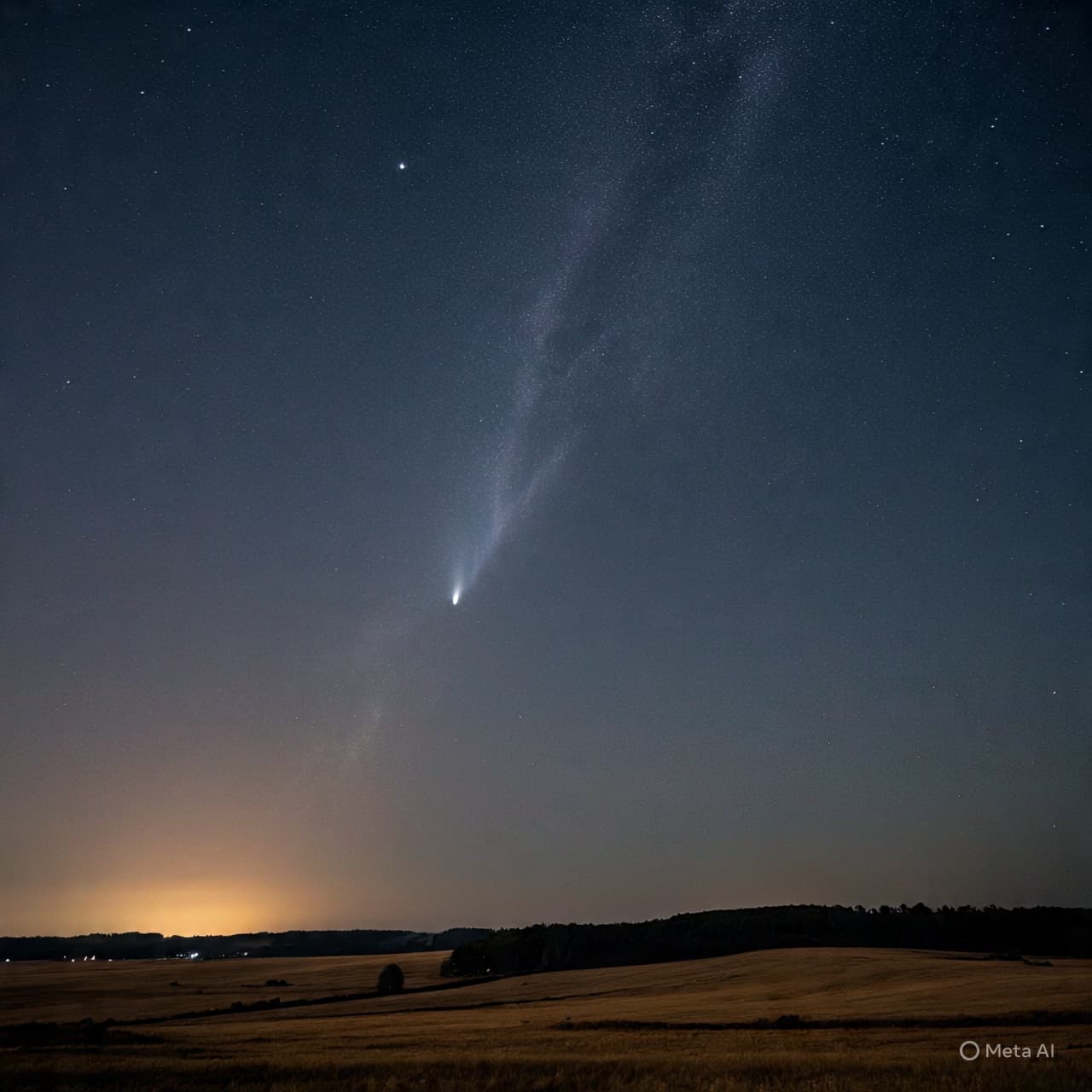
In the quiet dusk of an Italian evening, the sky offered a moment of soft drama—a gentle dance between a visitor from the depths of space and a streaking spark in Earth’s atmosphere. It was as though a fleeting meteor, burning in a brief blaze of glory, chose to trace a path around the distant figure of Comet Lemmon, weaving light and ice in a fleeting embrace.
The comet, discovered earlier this year and designated C/2025 A6 (Lemmon), was already making its presence known in the twilight skies. Observed from the Virtual Telescope Project in Manciano, Italy, on October 24, the comet’s long ion tail was captured in wide-field footage. Then, as if rewriting the script of the heavens, a meteor streaked through the same patch of sky. What followed was the luminous afterglow of the meteor’s atmospheric passage—ionised oxygen glowing red and orange—expanding and lingering in such a way that to our eyes it appeared to coil around the comet’s tail.
Of course, in truth, the two phenomena were vastly separated: the meteor’s trail formed just tens or hundreds of kilometres above Earth’s surface, while the comet lay some 100 million kilometres away. What made the image so arresting was purely perspective—a moment when Earth’s atmospheric drama aligned with deep-space wanderer in our field of view.
For astrophotographers and sky-watchers, this is the sort of image that resonates—not simply because of its technical daring, but because it reminds us of the layered nature of the night sky. A meteor’s ephemeral glow, an ancient comet’s silent journey, the ambient twilight—all converge in a single frame. The meteor’s ion trail is the consequence of high-speed particles entering Earth’s upper atmosphere, exciting molecular oxygen and causing emission at specific wavelengths.
Meanwhile, Comet Lemmon continues on its path, brightening as it approaches perihelion (its closest approach to the Sun) on November 8, 2025. The juxtaposition of the meteor’s immediate light and the comet’s slow, silent drift offers a poetic reflection: what is short-lived and what persists; what is near and what is far; what we can capture in a moment and what travels for millions of kilometres unseen.
For observers now, this moment serves as an invitation. If you have access to dark skies and perhaps binoculars or a modest telescope, turn your gaze westward after sunset. The comet and its tail are visible in the constellation Serpens Caput moving toward Ophiuchus. And keep in mind: the sky holds surprises—sometimes a meteor’s afterglow might flourish around a comet’s tail, not as interaction, but as a visual alignment gifted by chance.
This cosmic tableau also reminds the amateur and the professional alike that photography of the night sky often reveals more than we expect: networks of light, fleeting moments, and the blending of Earth-bound phenomena with distant cosmic travellers. The meteor photobomb wasn’t planned, yet it reveals how many layers of reality hover above us, and how easily one can dance in front of another.
AI Image Disclaimer Illustrations were produced with AI and serve as conceptual depictions.
Sources Space.com LiveScience NASA Space News IFLScience The Virtual Telescope Project
Published by Banx Network. This article is part of the Banx decentralized media programme, powered by the BXE token on the XRP Ledger.