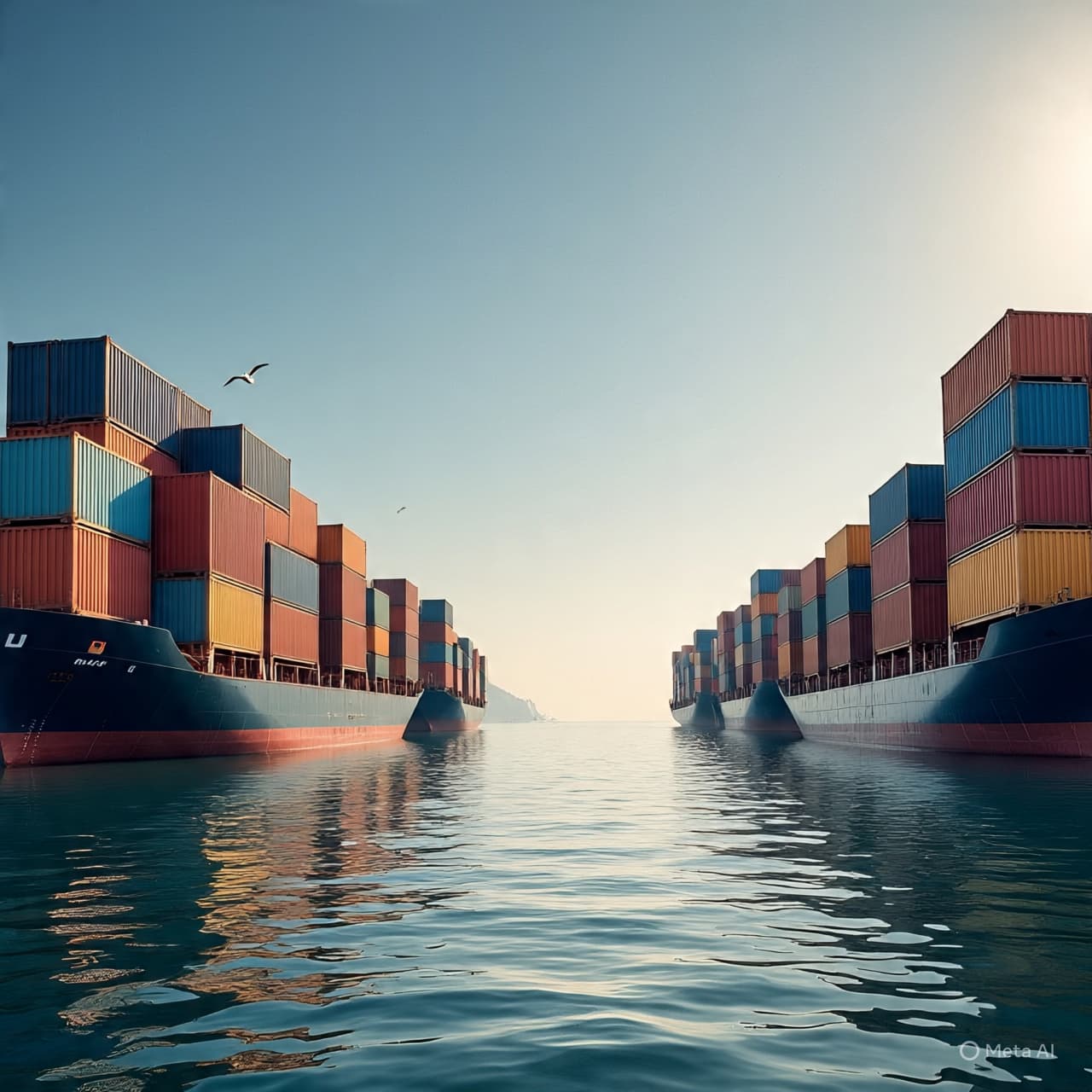
At the narrow mouth of the Gulf, where the sea compresses into a corridor of restless currents, vessels have begun to gather in uneasy stillness. Steel hulls stretch toward the horizon, their stacked containers forming a skyline of commerce paused mid-journey. In the Strait of Hormuz, movement has slowed to a crawl, and the geometry of global trade feels suddenly fragile.
According to the chief executive of Maersk, roughly 10 percent of the world’s container fleet is now caught in congestion linked to heightened security conditions and maritime rerouting near the strait. It is a statistic that sounds clinical until imagined in scale: hundreds of ships idling or inching forward, each carrying goods bound for distant ports — electronics, machinery, textiles, food — suspended between departure and delivery.
The Strait of Hormuz has long been more than a passage of water. It is a threshold through which a significant share of the world’s energy exports and maritime trade must pass. When tension rises along its shores, insurers recalculate risk, naval patrols intensify, and captains reconsider timing. In recent days, precautionary slowdowns and route adjustments have created a bottleneck that ripples outward into supply chains already shaped by years of disruption.
Shipping executives describe mounting delays, with some vessels instructed to wait for clearer transit windows while others proceed under tighter coordination. The result is a backlog that extends beyond the visible line of anchored ships. Ports downstream brace for uneven arrivals. Warehouses anticipate staggered deliveries. Commodity traders monitor freight rates as they edge upward in response to constrained capacity.
Yet on deck, daily routines continue. Crews maintain engines, check manifests, and scan horizons that look deceptively calm. The sea itself gives no indication of strain. It is the accumulation — the waiting — that tells the story. Ten percent of the global container fleet represents a temporary pause in the bloodstream of commerce, a reminder that even vast networks depend on narrow passages.
Markets will measure the economic impact in figures and forecasts. But for now, the image is simpler: vessels clustered at the edge of a chokepoint, the world’s cargo stacked in patient columns, awaiting the moment when passage opens and the currents of trade resume their familiar rhythm.
AI Image Disclaimer
Illustrations were generated using AI tools and are intended as visual representations rather than real photographs.
Sources
Reuters Bloomberg Financial Times
Published by Banx Network. This article is part of the Banx decentralized media programme, powered by the BXE token on the XRP Ledger.