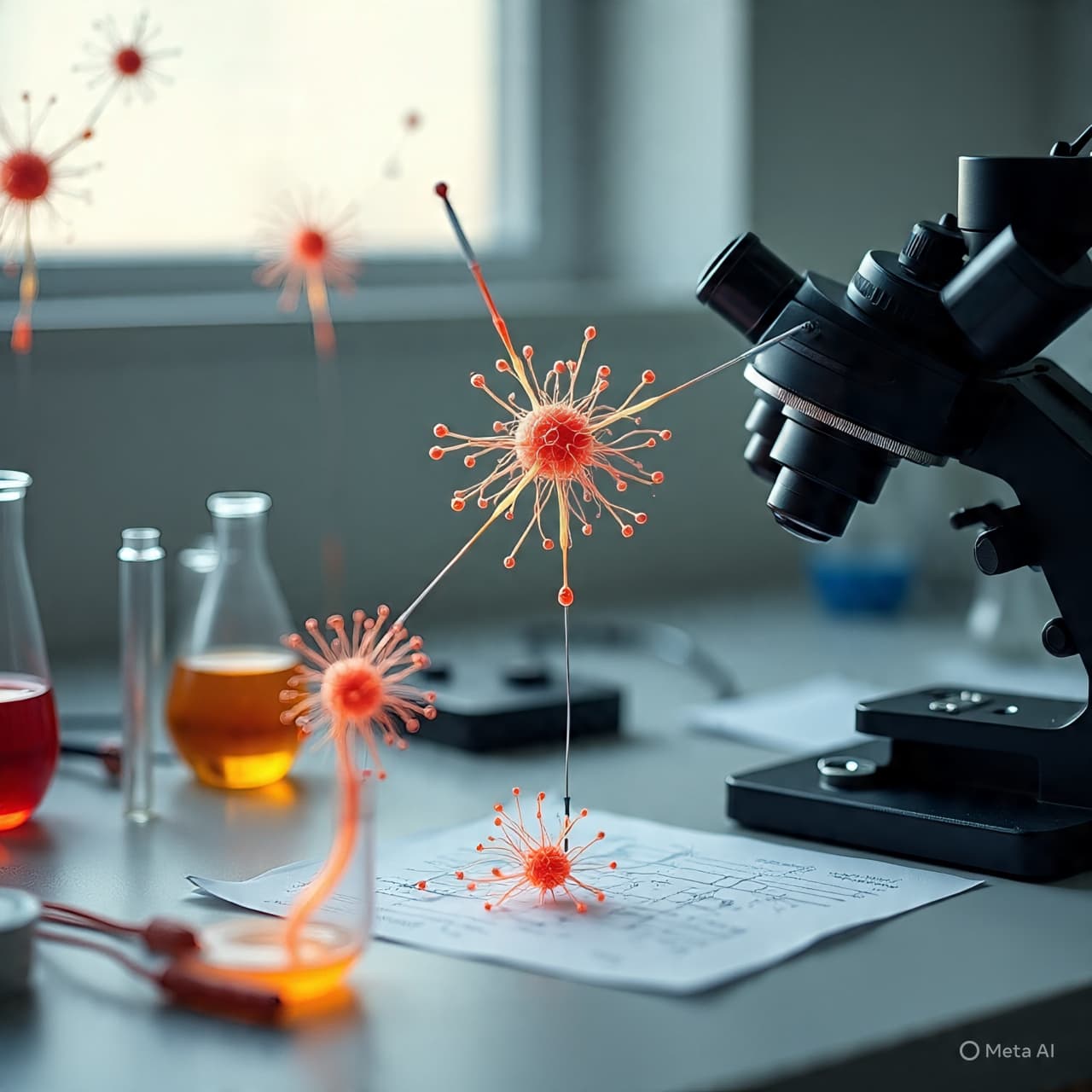
There is a kind of quiet in a lab when all the machines hum at a steady pace and the fluorescent lights cast their even glow across rows of dishes. Within those silent containers, life’s rhythms unfold unseen by most of us — cells divide, networks form, and time is measured not in heartbeats but in the slow geometry of growth. Among the many experiments that fill this space, some of the most remarkable are not the roaring collisions of particles or flashes of lasers, but the gentle unfolding of brain‑like tissues in petri dishes.
These “mini‑brains,” grown from human stem cells and known to scientists as cerebral organoids, have long offered a window into how our brains take shape and function. For years, researchers have watched them develop layers of neurons that fire and interact, hinting at the deep complexity from which cognition eventually arises. But in recent work, these delicate clusters of neural tissue have begun to show something new: not merely activity, but a capacity to change in response to feedback. In a series of experiments, teams guided lab‑grown brain organoids through a classic engineering challenge — the “cart‑pole” problem — and found that with the right stimulation, these networks could improve their performance over time.
The cart‑pole task is a simple benchmark used in robotics and artificial intelligence: keep a stick balanced on a moving cart by adjusting its position. Every child learns this instinctively as they try to keep a broom upright in their palm; the physical brain coordinates sensory input and motor output in a smooth, adaptive arc. For organoids, there is no body, no sensory apparatus, no muscle. Yet when researchers delivered electrical signals corresponding to the pole’s motion and provided feedback based on success or failure, the mini‑brains began to show more goal‑directed responses. Their rate of “wins” climbed, signaling that these tissues could adjust internal connections and better process information with practice.
This finding does not suggest that a petri dish colony has ambitions or awareness. Organoids lack sensory input, hormones, and the full architecture of an intact brain. They are not conscious in any ordinary sense. But the ability of these cultures to change behavior in response to iterative feedback highlights a remarkable quality: the intrinsic potential of neural circuits themselves to support adaptive computation. It’s a reminder that before there are thoughts or intentions, there are patterns — electrical rhythms and connections that can be reinforced, altered, and shaped over time.
The history of lab‑grown brain research stretches back over a decade, from the first cerebral organoids created in the early 2010s to increasingly sophisticated models that resemble early stages of human brain development. Scientists have used these systems to study diseases such as Alzheimer’s and Zika‑related neural damage, to test drugs in human tissue rather than animal models, and, more recently, to explore interfaces between living neural tissue and machines.
These advances invite a range of reflections. On one hand, the more we learn about how neural networks — whether in a person’s head or a cluster of cells — adapt and reorganize, the better positioned we are to understand disease and potentially develop treatments. On the other, the capacity to coax organoids toward greater responsiveness raises questions about how we define learning, computation, and the relationship between biological and artificial systems.
In reporting this work, researchers emphasize its potential for basic science and medical insights rather than grand claims about synthetic minds. The organoids in question participate in structured experiments with tightly controlled inputs and outputs, and their “learning” reflects changes at the level of synaptic connectivity rather than conscious strategy. The breakthrough lies in demonstrating that even minimal neural tissues can support forms of adaptive processing under guidance, opening new paths for neuroscience research and potentially for biohybrid systems that blend living and engineered components.
As the field evolves, scientists and ethicists alike continue to explore the implications of these developments, balancing excitement about discovery with careful consideration of where such technologies may lead.
Visuals are AI‑generated and serve as conceptual representations.
Sources (Media Names Only)
Reuters Science.org (AAAS) Northwestern University News Vox Newsbytes App
Published by Banx Network. This article is part of the Banx decentralized media programme, powered by the BXE token on the XRP Ledger.