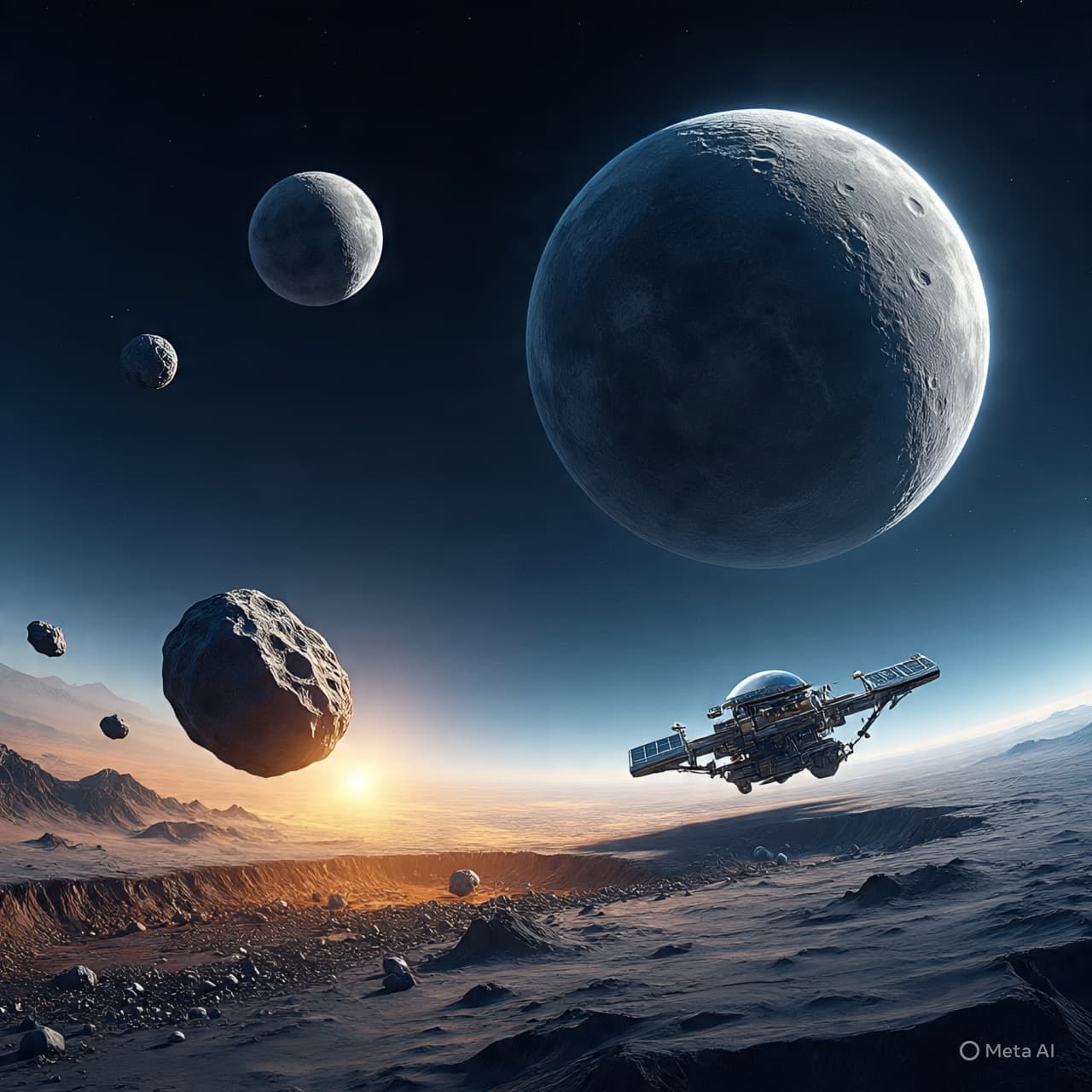
Far beyond the blue horizon of Earth, where planets drift in patient circles and sunlight fades into the quiet darkness, countless asteroids wander along ancient paths. They are remnants from the early days of the solar system—fragments of a cosmic workshop where planets were once being assembled. For billions of years, these rocky travelers have moved through space largely undisturbed, guided only by gravity and time.
Yet in the autumn of 2022, one small asteroid experienced something entirely new.
A spacecraft built by human hands arrived with a singular purpose—not to land gently, not to observe from a respectful distance, but to collide. The mission was called the Double Asteroid Redirection Test, known simply as DART, and it represented humanity’s first practical experiment in planetary defense.
The target was a small moonlet named Dimorphos, which orbits a larger asteroid called Didymos. Together they travel around the Sun as a paired system, like two stones circling each other while drifting through the solar system’s wide currents. Scientists selected this system carefully: the collision would not threaten Earth, but it would allow researchers to observe how an asteroid’s motion could be changed by impact.
When the spacecraft struck Dimorphos at roughly 14,000 miles per hour, the moment lasted only seconds. Yet the consequences would echo through months of observation.
Initial measurements soon revealed that the impact had shortened Dimorphos’s orbit around Didymos by about 33 minutes—a far greater change than scientists had originally expected. Telescopes around the world watched as clouds of debris spread outward, sunlight scattering through the dust like mist in a beam of light.
But as researchers continued studying the aftermath, they noticed something even more intriguing.
The impact had not only altered the moonlet’s orbit around its parent asteroid. Evidence suggested that the collision also produced a subtle shift in how the entire system moves around the Sun. The force of the strike, combined with the spray of ejected material, appears to have delivered a small but measurable push to the asteroid pair itself.
In cosmic terms, the change is tiny—far too small to affect the solar system in any dramatic way. Yet scientifically, it carries quiet significance. For the first time, humanity has demonstrated that a spacecraft can physically alter the motion of a celestial body traveling through space.
Part of the surprise lies in the debris. When DART slammed into Dimorphos, it did not simply dent the surface. Instead, the collision released a plume of rocks and dust that shot outward like a natural rocket exhaust. This ejected material multiplied the momentum of the impact, providing an additional push that amplified the change in the asteroid’s motion.
In a sense, the asteroid itself helped redirect its path.
For scientists studying planetary defense, this result offers a valuable glimpse into how future missions might protect Earth from potentially hazardous objects. If a threatening asteroid were discovered decades before a possible collision, even a small change in its trajectory—applied early enough—could cause it to miss our planet entirely.
The DART mission therefore represents more than a single experiment. It is a proof of concept, showing that careful planning and precise engineering can influence the motion of objects that once seemed beyond human reach.
Still, researchers continue to examine the details. The exact structure of Dimorphos—whether it is solid rock or a loosely packed “rubble pile”—played a role in how the impact unfolded. Future missions may explore these questions more closely.
One such mission, led by the European Space Agency, is already on its way. The Hera spacecraft will arrive at the Didymos system in the coming years to map the impact site, measure the asteroid’s mass, and better understand how the collision reshaped its surface and motion.
For now, the results from DART remain a quiet milestone.
In the vast choreography of the solar system, where gravity guides every orbit and every drifting stone, a small spacecraft has demonstrated that even human hands can add the gentlest of nudges. And in that subtle shift, scientists see the beginning of a new chapter in how we understand—and perhaps one day safeguard—the pathways of worlds moving through the Sun’s long light.
AI Image Disclaimer Graphics are AI-generated and intended for representation, not reality.
Sources
NASA Nature The New York Times Space.com Scientific American
Published by Banx Network. This article is part of the Banx decentralized media programme, powered by the BXE token on the XRP Ledger.