In the stillness where sunlight fades and the world softens into blue shadow, humans have always wondered what lies hidden beneath. The sea, like a gentle poet’s metaphor for the unknown, beckons with its vastness—quiet, deep, and full of mysteries we have only begun to glimpse. Now, where the water turns to darkness and pressure presses like the weight of unspoken questions, a new kind of explorer has been born.
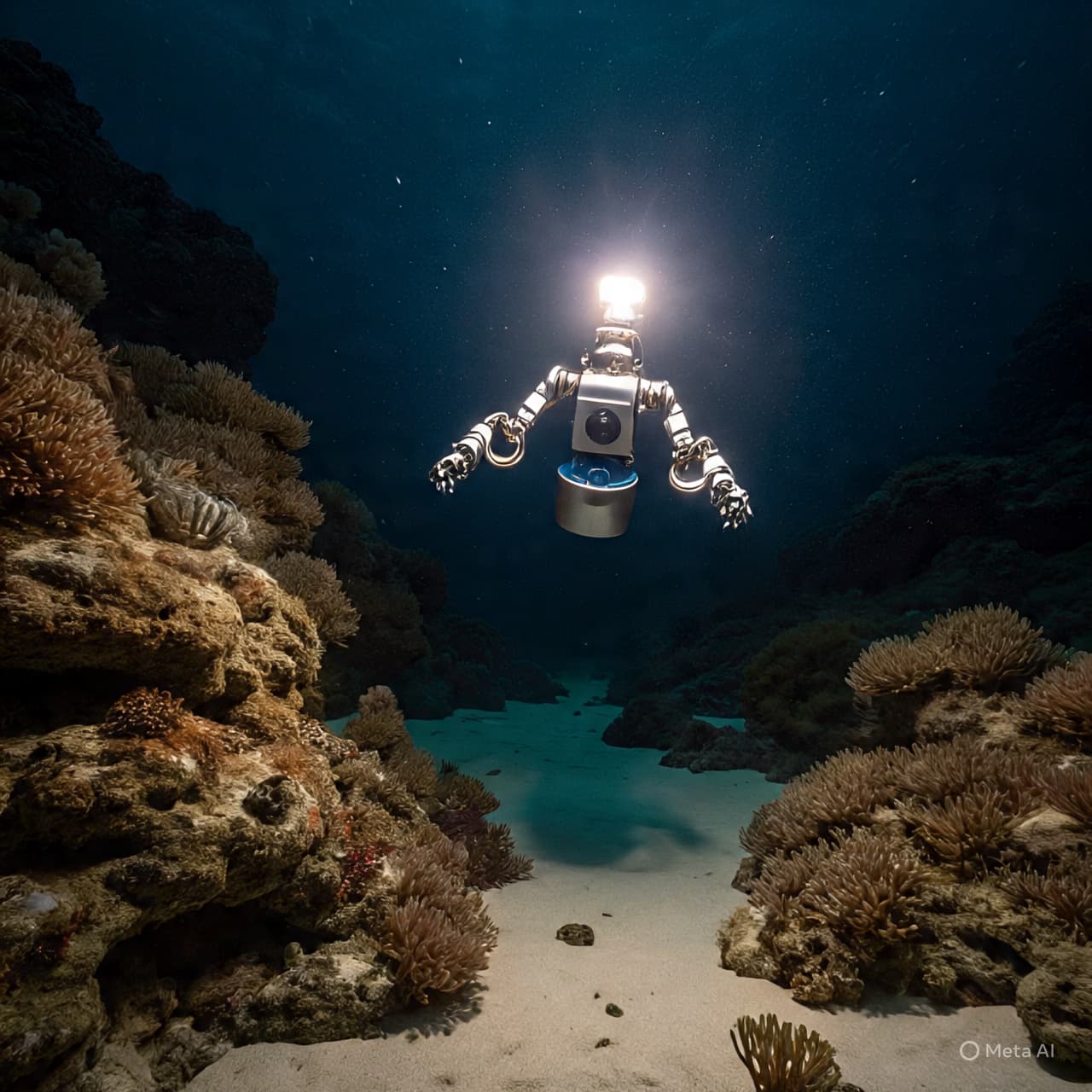
In mid-January, scientists in Guangzhou unveiled an undersea robot designed to pierce not just the water but the secrets buried in the earth beneath the waves. This remarkable creation, developed by the Guangzhou Marine Geological Survey under the China Geological Survey, combines the work of engineers and dreamers. At a depth of more than 1,200 meters in the South China Sea, the robot completed a trial operation, meeting its performance goals and planting a modest but telling flag in the frontier of deep-sea discovery.
The machine is not just a lump of metal or a tool chained to human commands; it is something subtler. Its design borrows inspiration from nature’s own subterranean voyagers—earthworms carving paths through soil so that it can drill within seabed strata and position itself with surprising autonomy. With a suite of sensors and AI guidance, it gathers data on methane levels, oxygen, and strata structures as it moves, stitching together clues about what lies beneath.
For those who ponder the deep as more than a scientific puzzle, this robot represents a quiet reaching beyond our known horizons. Beneath its external frame lies a story of technological patience: inertial navigation, magnetic positioning, and carefully calibrated algorithms that help it slip around rocks and biological debris as effortlessly as a school of fish parting for an ocean current.
The stakes are practical, too. Deep-sea strata are not just poetry; they contain materials that nations see as strategic methane hydrates, rare-earth elements, and polymetallic nodules. To study these safely and sustainably, scientists need tools that can not only reach deep places but also listen and learn once they are there. The robot’s ability to record thousands of data points during a single mission hints at what might be possible when machines become our eyes and ears in places beyond human reach.
Yet this is not a story of conquest, but rather one of careful observation. The deep sea is an environment of extremes: intense pressure, frigid temperatures, and an ecosystem complex beyond our best imagination. Traditional drilling techniques often struggle with these conditions; the new robot is an attempt to move gently into the deep, to understand rather than merely extract.
Looking ahead, the team behind this invention speaks of refinement and resilience—of making a machine ever better prepared for even harsher environments. The robot is expected to play a part in broader scientific drilling projects, contributing to national and global efforts to broaden humanity’s understanding of the ocean’s hidden realms.
In that quiet blue deep, where light cannot reach and pressure mounts like a whisper of eternity, humans send forth their fragile creations. In these mechanical paths beneath the waves, our curiosity finds form, and in the data the robot gathers, we may hear echoes of our own longing—to know, to explore, to imagine what lies beyond our sight.
AI Image Disclaimer (Rotated Wording) Visuals are created with AI tools and are not real photographs.
Sources
Xinhua / China Daily; China Daily global edition; People’s Daily Online; CGTN; Big News Network / Xinhua.
Published by Banx Network. This article is part of the Banx decentralized media programme, powered by the BXE token on the XRP Ledger.