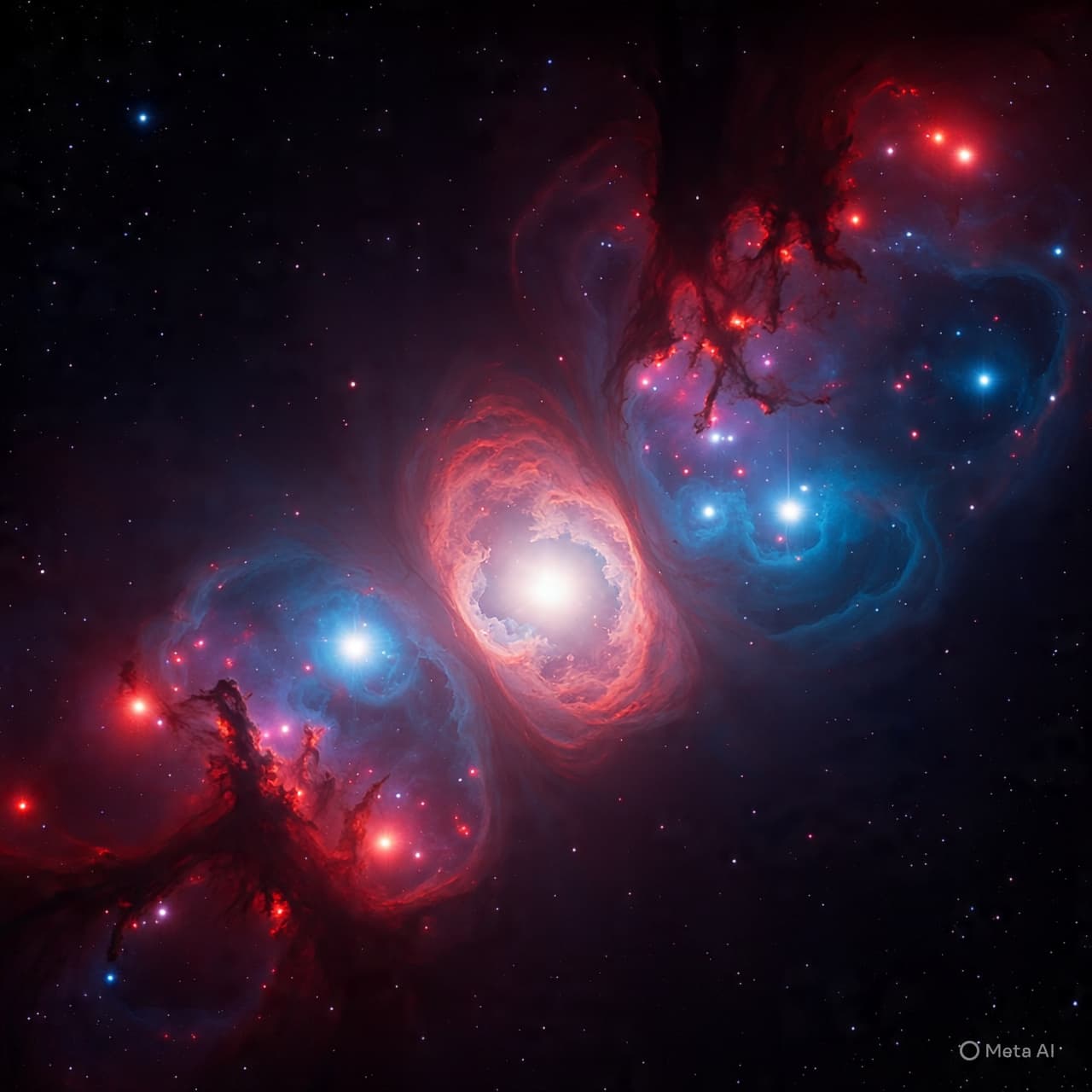
There are moments when the universe feels less like an expanse of cold distance and more like a living tapestry—stitched with light, shadow, and the quiet persistence of creation. Through the patient gaze of infrared and radio waves, what once seemed like darkness begins to breathe. In that glow emerges a shape so intricate, so sprawling, it resembles a cosmic web suspended in silence. Astronomers call it the Tarantula Nebula, but its presence feels more like a story unfolding across light-years.
Located within the Large Magellanic Cloud, a neighboring galaxy that orbits our own Milky Way, the Tarantula Nebula is one of the most active star-forming regions in our cosmic vicinity. Its spindly filaments stretch outward like the threads of an immense celestial web, shaped by stellar winds and radiation from some of the most massive stars ever observed. What appears delicate at first glance is, in truth, a furnace of staggering intensity.
Infrared observations—most recently refined by instruments aboard the James Webb Space Telescope—allow scientists to peer through dense clouds of dust. These wavelengths reveal newborn stars still wrapped in their dusty cocoons, glowing warmly beneath veils once impenetrable to optical telescopes. Radio data, captured through powerful arrays on Earth, adds another layer to the portrait, tracing the movements of gas and the invisible architecture sculpted by stellar explosions.
Together, infrared and radio imaging transform the nebula from a distant blur into a vivid ecosystem. Massive stars at its heart emit radiation so powerful that it carves cavities into surrounding gas, compressing some regions while dispersing others. In this tension between force and fragility, new stars ignite. It is an ongoing cycle—creation shaped by destruction, light emerging from turbulence.
At the core of this nebula lies a cluster of extraordinarily massive stars, whose ultraviolet radiation energizes the surrounding hydrogen gas. The result is a glowing landscape of ionized clouds, sculpted pillars, and shock fronts rippling outward. Scientists believe the Tarantula Nebula mirrors, in many ways, the kind of starburst activity that was more common in the early universe. In studying it, astronomers are not only observing a nearby wonder; they are glimpsing echoes of cosmic history.
What makes the image so compelling is not merely its beauty but its depth. Infrared highlights warmth and birth. Radio traces structure and motion. Each wavelength contributes a different verse to the same cosmic poem. Together, they reveal that what resembles a spider’s web is, in truth, a cradle—a vast stellar nursery where gravity, radiation, and time collaborate in quiet grandeur.
In the measured language of science, the Tarantula Nebula remains an active star-forming region roughly 160,000 light-years from Earth. Observations from space- and ground-based telescopes continue to refine understanding of its structure, mass distribution, and stellar population. While the imagery evokes metaphor, the data offers clarity: this is one of the most energetic nurseries known in the local universe. Through infrared and radio eyes, astronomers continue to chart its evolution—thread by luminous thread.
Image Disclaimer Visuals are created with AI tools and are not real photographs.
Source Check (Credible Media Coverage Found): NASA ESA (European Space Agency) Space.com BBC News The Guardian
Published by Banx Network. This article is part of the Banx decentralized media programme, powered by the BXE token on the XRP Ledger.