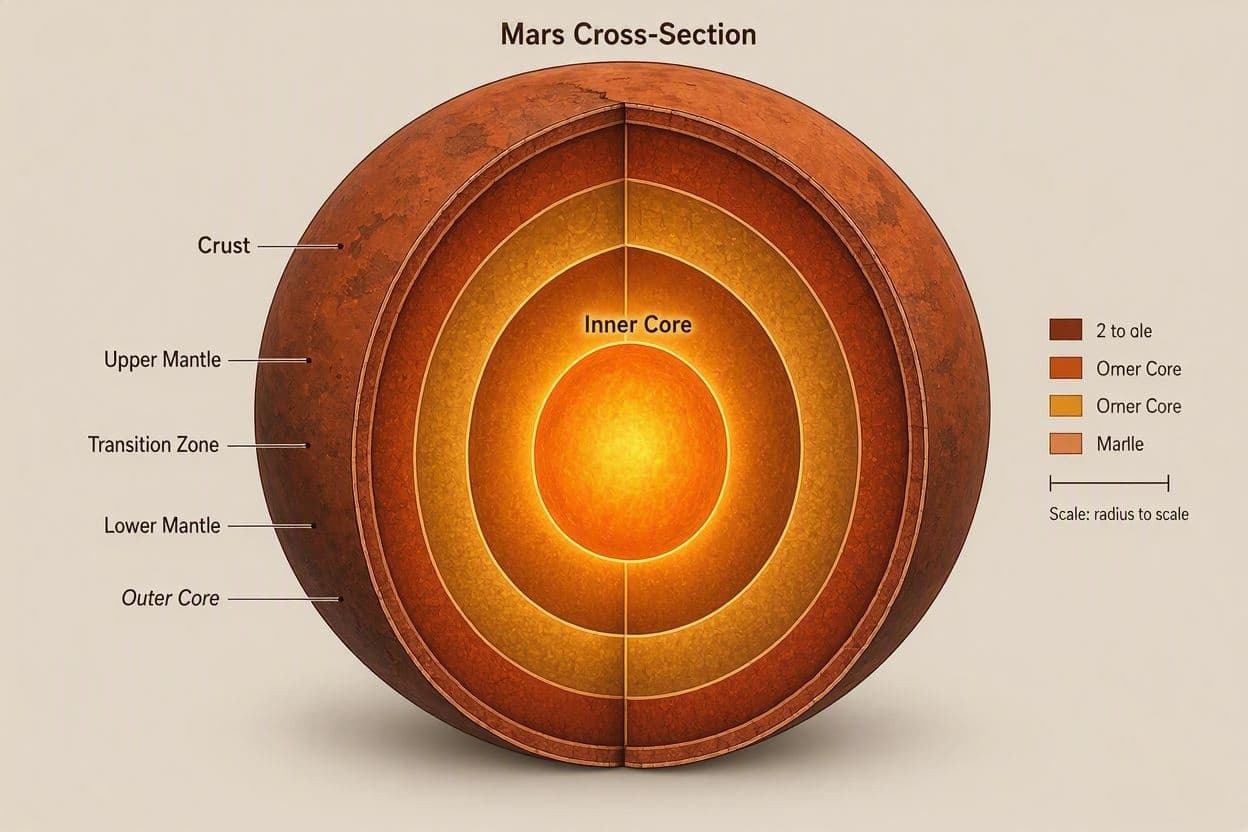
In the silent, rust-colored expanse of the solar system, Mars has long been viewed as a cold, dormant world. Yet, beneath its frozen surface and thin atmosphere, new data from gravity mapping and spacecraft missions have revealed a surprising truth: the Red Planet possesses a warm, dynamic interior. This discovery, pieced together through precise measurements of Martian gravity and seismic activity, challenges our understanding of planetary evolution and suggests that Mars is more geologically alive than previously thought.
The insights come largely from NASA’s InSight mission and subsequent orbital gravity studies. By tracking subtle changes in the planet’s gravitational field, scientists have mapped variations in density deep within the crust and mantle. These maps indicate the presence of a significant thermal anomaly, particularly in the southern hemisphere, where the interior appears to be hundreds of degrees hotter than the north. This heat source may be responsible for recent volcanic activity and tectonic shifts observed on the surface.
For decades, Mars was considered a "one-plate planet," lacking the active plate tectonics that drive Earth’s geological engine. However, the detection of marsquakes by InSight’s seismometer provided the first direct evidence of internal movement. These tremors, though smaller than Earth’s earthquakes, reveal a crust that is still adjusting and releasing energy. The combination of seismic data and gravity models paints a picture of a planet with a partially molten core and a mantle that continues to convect.
The implications of a warm interior are profound. Heat drives geological processes that can release gases into the atmosphere, potentially influencing climate stability over millions of years. It also raises questions about the potential for subsurface liquid water, which could harbor microbial life. If the interior remains warm enough to maintain hydrothermal systems, Mars may still possess environments capable of supporting basic biological functions.
Scientists used a technique involving precise tracking of spacecraft orbits to detect these gravitational anomalies. As satellites circle Mars, their speed changes slightly in response to variations in mass below. By analyzing these fluctuations, researchers created a high-resolution map of the planet’s internal structure. This method, akin to an MRI for planets, allows us to see what lies hidden beneath the rocky exterior.
The discovery also helps explain the stark difference between Mars’ northern and southern hemispheres. The south, with its thicker crust and higher elevation, appears to retain more heat, possibly due to differences in composition or ancient impact events. This thermal divide may have played a crucial role in shaping the planet’s surface features, including its vast volcanoes and deep canyons.
As we look toward future human exploration, understanding Mars’ internal heat is essential. It informs decisions about where to land, how to build habitats, and where to search for resources. A warm interior could provide geothermal energy opportunities for future colonies, making sustained presence on the planet more feasible. It transforms Mars from a static museum piece into a dynamic world with ongoing processes.
In the end, the revelation of Mars’ warm heart reminds us that even seemingly dead worlds can hold secrets of vitality. It invites us to look deeper, both literally and metaphorically, at the planets we share our solar system with. By listening to the faint whispers of marsquakes and measuring the pull of gravity, we continue to uncover the vibrant history and present reality of our neighboring planet.
AI Image Disclaimer: The visual representations in this article are AI-generated illustrations designed to convey the themes of planetary science and space exploration.
Sources: Brown University, Nature Communications, NASA, ScienceDaily
Published by Banx Network. This article is part of the Banx decentralized media programme, powered by the BXE token on the XRP Ledger.