
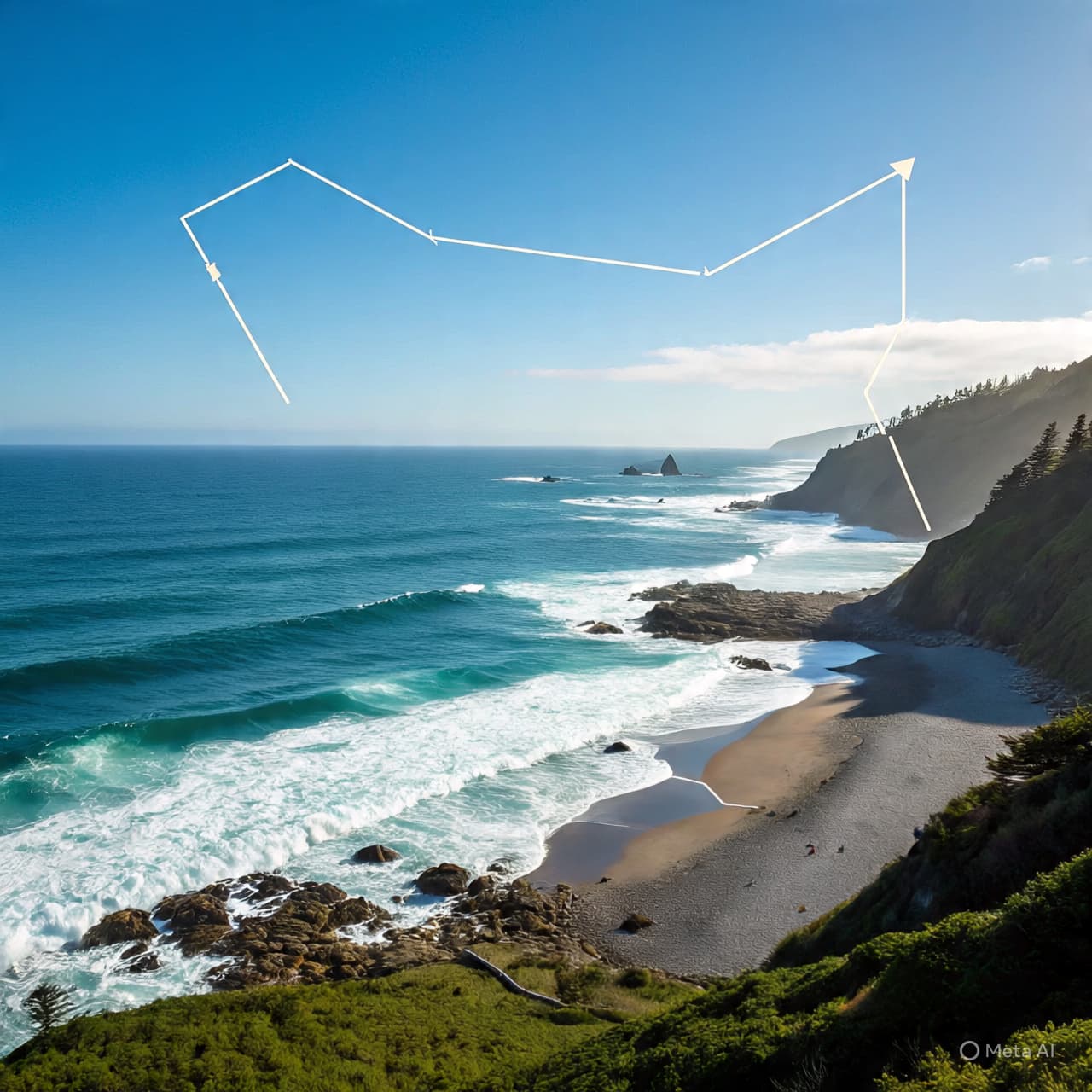
At the edge of continents, where land meets ocean, the Earth’s surface often carries a quiet tension. Beneath forests, mountains, and coastal waters of the Pacific Northwest, forces move steadily, shaping the region in ways that are rarely visible but deeply significant.
Scientists studying tectonic activity in the Pacific Northwest have identified processes associated with the Cascadia subduction zone, where the Juan de Fuca Plate is sliding beneath the North American Plate. This interaction is part of a complex system that influences earthquakes and geological changes.
Recent findings suggest that parts of the region may be experiencing subtle forms of crustal deformation, sometimes described in simplified terms as the Earth “splitting.” In reality, these processes involve gradual stretching, faulting, and shifting within the Earth’s crust.
The Cascadia region is already known for its seismic potential. Historical evidence points to a massive earthquake in 1700, and ongoing research aims to better understand the conditions that could lead to future events.
Geophysical tools, including GPS measurements and seismic imaging, allow scientists to monitor movements with remarkable accuracy. These instruments reveal that stress continues to build along fault lines, even when the surface appears calm.
Experts emphasize that while such findings are important, they do not indicate an immediate or sudden rupture. The processes involved occur over extended periods and are part of the natural behavior of tectonic boundaries.
Public awareness of these dynamics has led to increased preparedness efforts in the region. Infrastructure planning and emergency response strategies are informed by scientific assessments, aiming to reduce risk over time.
The language used to describe geological activity can sometimes evoke urgency, but researchers encourage a measured understanding. The Earth’s movements, though powerful, often unfold gradually and predictably within known patterns.
In the Pacific Northwest, the ground may be shifting in quiet ways, yet it remains a story of gradual change rather than sudden division.
AI Image Disclaimer: Some accompanying visuals are AI-generated to illustrate tectonic processes and geological structures.
Sources: US Geological Survey, NOAA, Nature, Scientific American
Published by Banx Network. This article is part of the Banx decentralized media programme, powered by the BXE token on the XRP Ledger.



