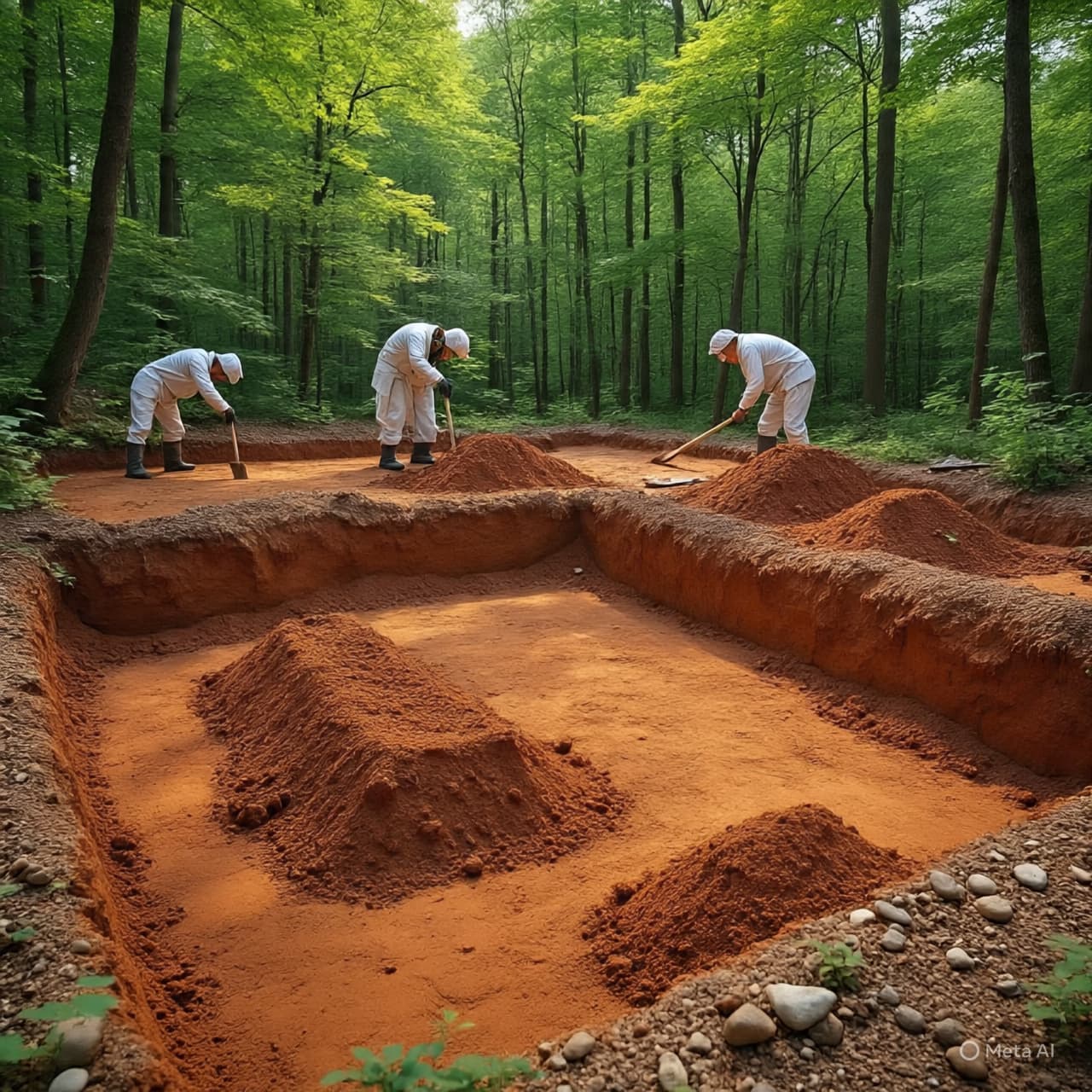
There are discoveries that arrive not with spectacle, but with a whisper from the soil. A small outline beneath the earth, a careful brushing away of sand, and suddenly a life from thousands of years ago begins to speak again. In Sweden, archaeologists recently uncovered such a quiet testimony: the grave of a Stone Age boy, laid to rest in deerskin and adorned with a remarkable headdress made from woodpecker feathers.
The burial, dated to the Mesolithic period roughly 7,000 to 8,000 years ago, was found at a prehistoric site in southern Sweden. The region, once a landscape of dense forests and shifting coastlines, was home to hunter-gatherer communities whose lives were deeply interwoven with animals, seasons, and ritual practice. Within that world, the boy’s burial stands out not for its size, but for its care.
Archaeologists discovered that the child, estimated to be between seven and nine years old, had been placed on a bed of red ochre—a mineral pigment frequently associated with symbolic or ceremonial meaning in prehistoric burials. Around him were the preserved traces of deerskin, suggesting he had been wrapped or dressed deliberately for his final rest. Most striking of all was evidence of a headdress constructed from the beaks and feathers of woodpeckers.
Such detail invites reflection. In Mesolithic Europe, grave goods were not distributed casually. Objects placed with the dead often carried meaning—indicators of identity, belief, or status within a community. The presence of a carefully crafted headdress suggests that this child may have held a particular role, or that the community expressed something symbolic through the bird itself.
Woodpeckers, with their rhythmic tapping and vivid plumage, are not inconspicuous creatures. In many later cultures, birds—especially those connected to forests—were associated with spiritual mediation or communication between worlds. While it would be speculative to impose later mythologies onto Stone Age societies, the deliberate inclusion of bird elements in burial attire suggests an intention that reached beyond practicality.
The deerskin wrapping also speaks of connection. Deer were central to survival in northern Europe’s Mesolithic communities, providing meat, tools, clothing, and materials for daily life. To envelop the child in deerskin may have represented protection, belonging, or continuity with the natural world that sustained his people.
Excavations at the site have revealed multiple burials, indicating a designated cemetery area rather than isolated graves. This suggests structured funerary customs and communal memory. The use of ochre, animal materials, and decorative elements points toward ritual behavior more complex than often assumed for early hunter-gatherer groups.
Scientific analysis, including osteological study and environmental sampling, continues to refine understanding of the burial. Researchers examine not only the objects themselves but pollen traces, soil chemistry, and microscopic residues to reconstruct the broader cultural setting. Each fragment of data adds dimension to a life otherwise known only through bone and artifact.
The discovery contributes to a growing body of evidence that Mesolithic societies possessed rich symbolic traditions. Far from being defined solely by subsistence, these communities invested meaning into death and remembrance. The burial of a child with such distinct adornment challenges simplified narratives of prehistoric life as purely utilitarian.
Today, conservation specialists are working to preserve the fragile materials recovered from the grave. Organic remains such as leather and feathers rarely survive millennia without exceptional conditions. Their preservation offers a rare and intimate glimpse into clothing, craftsmanship, and belief systems long vanished from living memory.
As archaeologists continue their work, the boy’s burial stands as a quiet reminder that ritual, identity, and care are not modern inventions. Thousands of years ago, beneath the forests of what is now Sweden, a community paused to prepare a child for rest—with deerskin for warmth, with woodpecker feathers for meaning, and with a gesture that has endured far longer than they could have imagined.
AI Image Disclaimer Visuals are created with AI tools and are not real photographs.
Source Check
Credible coverage and reporting found in:
BBC The Guardian Smithsonian Magazine Live Science Reuters
Published by Banx Network. This article is part of the Banx decentralized media programme, powered by the BXE token on the XRP Ledger.