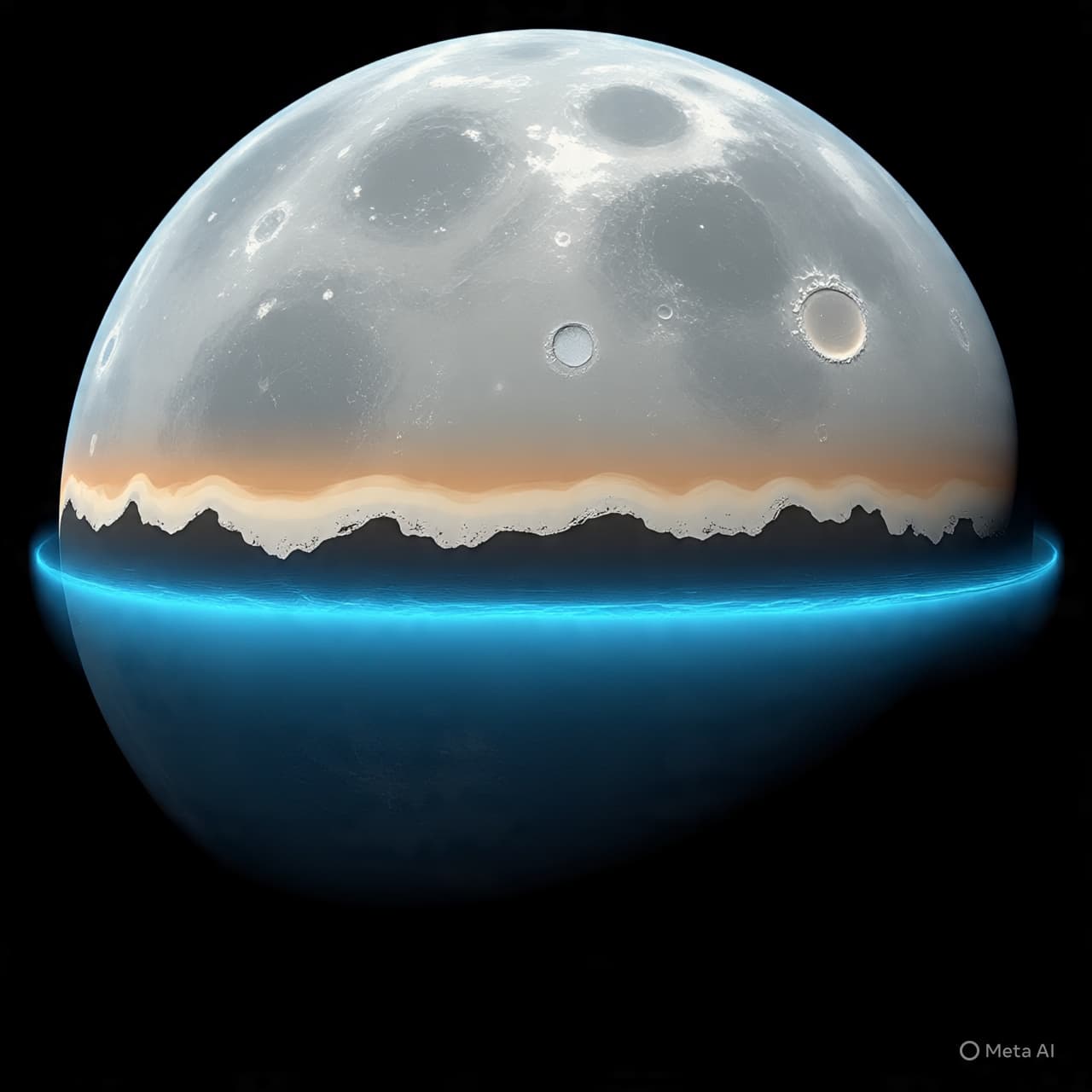
Europa has long occupied a quiet, luminous place in the imagination of planetary science. Beneath its fractured shell of ice, scientists have envisioned a vast, dark ocean, warmed by tidal forces and stirred by the gravity of Jupiter itself. It has been a setting rich with possibility, where water, energy, and time seemed to overlap just enough to suggest life might find a way.
That vision has now been tempered by a new study that urges restraint. Rather than overturning the idea of an ocean entirely, the research narrows the conditions under which that ocean might support living chemistry. The space beneath Europa’s ice, it suggests, may be more isolated, more chemically limited, and less dynamic than once hoped.
At the center of the study is the question of exchange. Life, as it is understood on Earth, depends not only on liquid water but on the steady movement of materials — salts, nutrients, and energy — between environments. The new findings indicate that Europa’s icy shell may act as a stronger barrier than previously assumed, restricting the flow of oxidants and other key ingredients from the surface down into the ocean below.
Without that exchange, the ocean could remain chemically starved despite its size. It may be liquid and ancient, yet largely inert, its waters circulating slowly in darkness with little opportunity for complex reactions to take hold. The conditions, while intriguing, begin to look less hospitable when examined through this lens.
For researchers, this does not erase Europa from the map of astrobiology. Instead, it sharpens the questions. The moon remains one of the few places beyond Earth where liquid water almost certainly exists today. What changes is the confidence with which habitability can be inferred from water alone.
The study also reflects a broader shift in planetary science. Early discoveries often open doors wide, fueled by the excitement of possibility. Later work narrows those openings, replacing optimism with precision. This is not disappointment so much as maturation, a process by which hope becomes hypothesis and hypothesis submits to constraint.
Future missions, including spacecraft designed to fly close to Europa and sample its environment indirectly, will test these conclusions. Instruments may yet detect plumes, chemical gradients, or signs of interaction that soften the study’s implications. Until then, Europa occupies a more ambiguous space, still fascinating, but less assured.
In plain terms, new research suggests that while Europa likely has a subsurface ocean, the conditions within it may be less favorable for life than previously believed, due to limited chemical exchange and energy availability.
AI Image Disclaimer Visuals are AI-generated and serve as conceptual representations.
Published by Banx Network. This article is part of the Banx decentralized media programme, powered by the BXE token on the XRP Ledger.