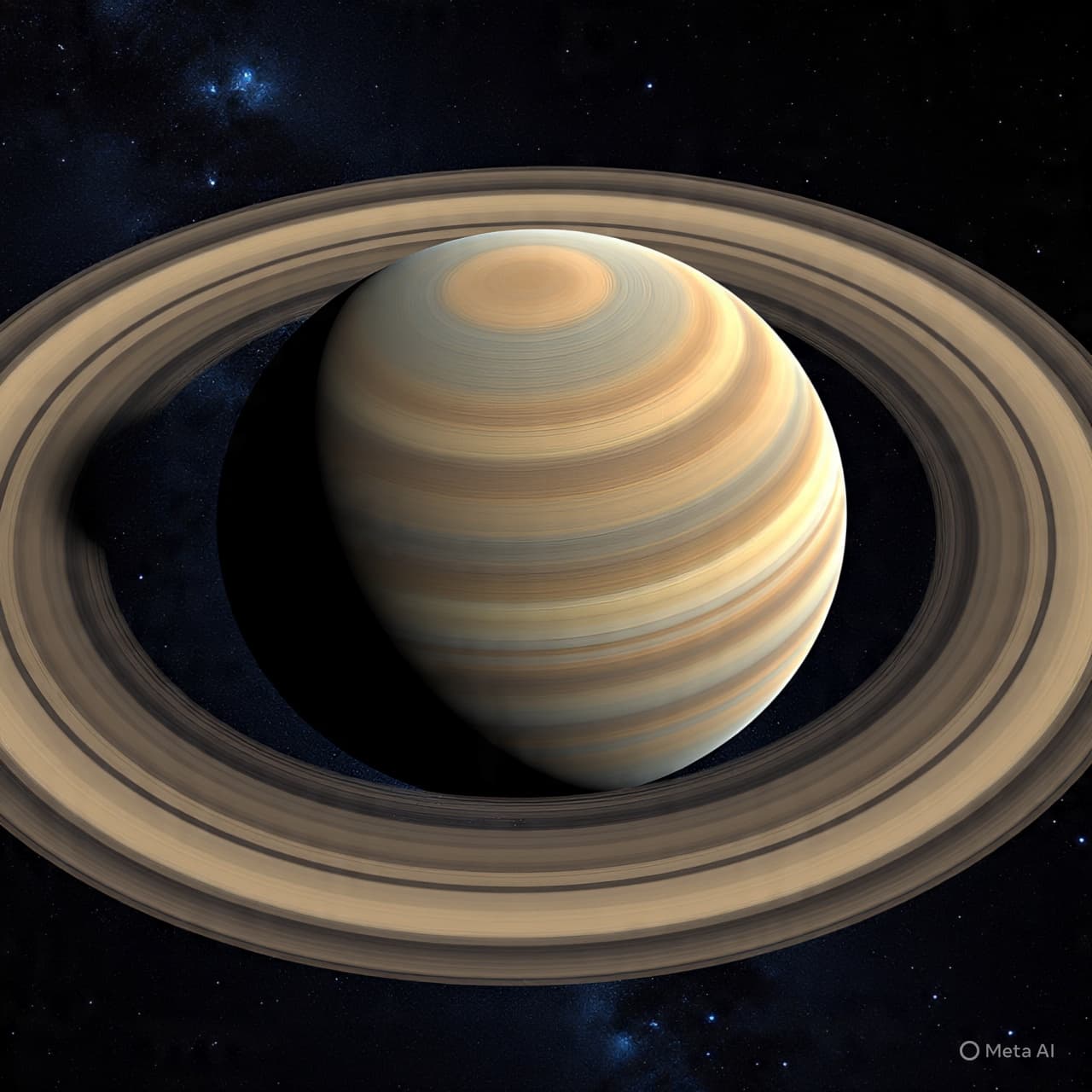
There are mysteries in the solar system that linger like unfinished sentences. For generations, astronomers have looked toward the pale gold glow of Saturn and wondered about the quiet enigma woven into its beauty. The planet’s rings shimmer with precision, its storms spin in silent choreography, and yet beneath that elegance lay a question that refused to settle. How old are those rings, and how long have they circled their giant host?
Now, astronomers say they may have resolved one of Saturn’s most enduring puzzles. Using data gathered during the final orbits of NASA’s Cassini–Huygens mission, researchers have refined their understanding of the planet’s internal rotation and gravitational field. Those measurements, taken during Cassini’s dramatic “Grand Finale” dives between Saturn and its rings in 2017, provided unprecedented insight into the planet’s deep interior.
For decades, determining Saturn’s rotation rate proved unexpectedly difficult. Unlike rocky planets, Saturn has no solid surface to track. Its thick atmosphere shifts and flows, masking the true spin of its core. Earlier radio measurements hinted at one value, while atmospheric observations suggested another. The discrepancy left scientists uncertain about how quickly the gas giant truly turns.
By analyzing subtle gravitational signals recorded during Cassini’s close passes, astronomers constructed more accurate models of Saturn’s internal structure. These models indicate a refined rotation period—slightly different from earlier estimates—and offer clues about how mass is distributed within the planet. In turn, this information reshapes understanding of the rings’ age and stability.
The rings themselves, long thought by some to be ancient relics from the birth of the solar system, now appear comparatively young in cosmic terms—possibly only a few hundred million years old. If confirmed, that would mean Saturn’s most iconic feature formed long after the planet itself. Some theories suggest the rings may have emerged from the remnants of a shattered moon or icy body that ventured too close, torn apart by Saturn’s immense gravity.
What makes this resolution significant is not only the age estimate but the method. Cassini’s final data allowed scientists to untangle the gravitational dance between planet and rings, distinguishing their individual influences. The result is a clearer portrait of a world once blurred by uncertainty.
Saturn, often admired for its symmetry, is revealed to be more complex beneath the surface. Its internal layers may mix more dynamically than once assumed. Its magnetic field, unusually aligned with its rotation axis, continues to challenge theoretical models. Yet each answer narrows the field of mystery, turning speculation into measurement.
In measured scientific terms, researchers report that new modeling based on Cassini’s gravitational data refines Saturn’s rotation rate and supports the conclusion that its rings are relatively young. Findings have been shared through peer-reviewed studies and institutional releases. While further analysis may continue, astronomers describe this as a substantial step toward resolving a question that has persisted for decades. Saturn remains luminous in the night sky—but now, perhaps, slightly less enigmatic.
AI Image Disclaimer Illustrations were produced with AI and serve as conceptual depictions.
Source Check (Credible Media Coverage Found): NASA BBC News The Guardian Space.com Scientific American
Published by Banx Network. This article is part of the Banx decentralized media programme, powered by the BXE token on the XRP Ledger.