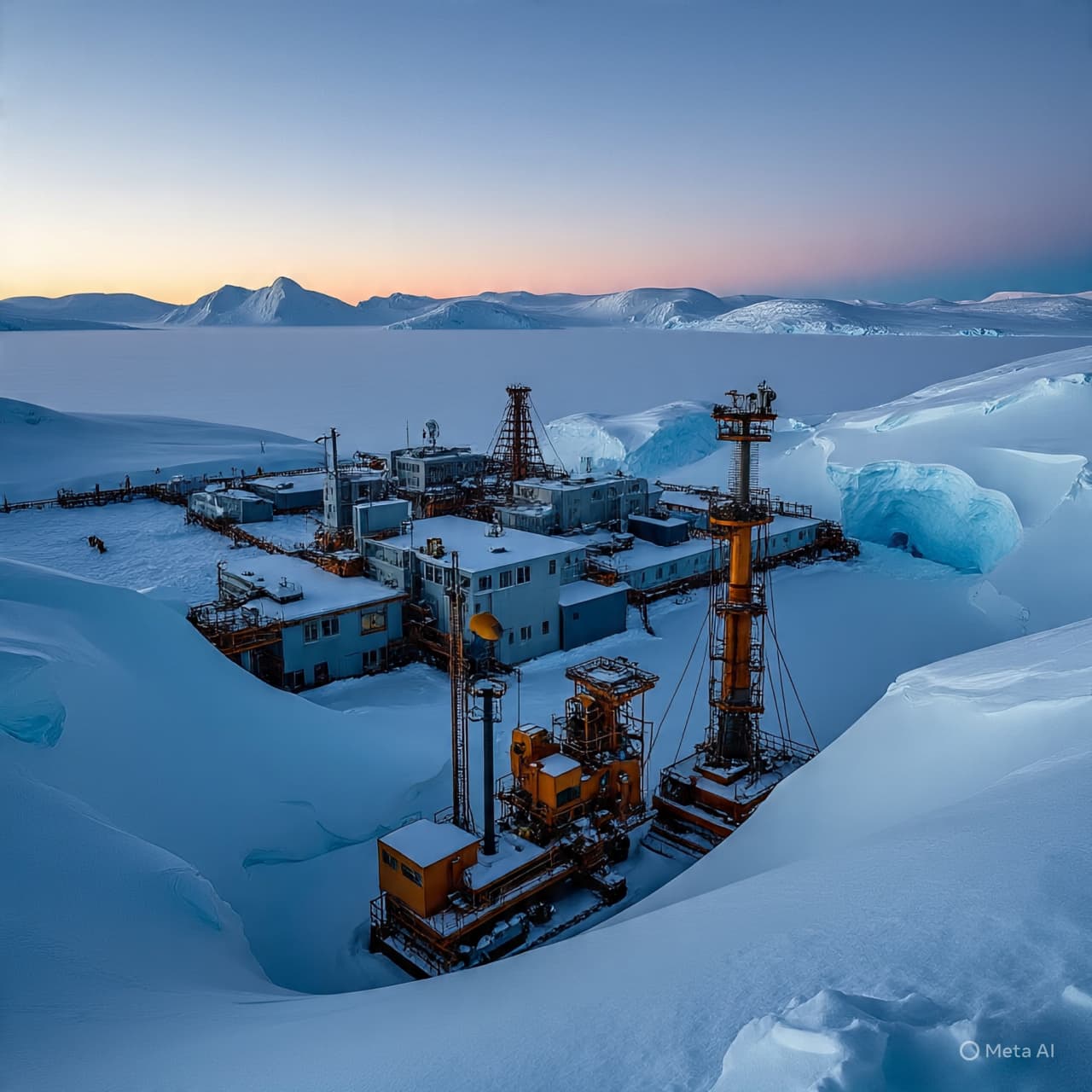
In Antarctica, silence is not empty. It hums.
Beneath a continent of wind-carved snow and shifting light lies a darkness so complete it feels almost ancient — a cold vault preserving not fossils or relics, but motion itself. Two kilometers below the surface, embedded in ice that fell as snow long before human memory, instruments wait for whispers from the cosmos.
At the IceCube Neutrino Observatory, scientists have turned the Antarctic ice sheet into a listening device for the universe. Here, the ice is not obstacle but medium — clear, stable, and vast. Suspended in vertical strings deep within it are thousands of optical sensors, each poised to catch the faintest flicker of blue light.
Recently, a new chapter in this experiment’s quiet vigil began with the preparation of a long optical module equipped with 18 photomultiplier tubes. Cylindrical and deliberate in design, the module is lowered into a narrow borehole drilled by jets of hot water, descending slowly into darkness. Once frozen in place, it becomes part of a three-dimensional lattice — a patient geometry of light sensors spanning a cubic kilometer.
What these instruments seek are neutrinos: nearly massless particles that move through space almost untouched by matter. Billions pass through every square centimeter of Earth each second, ghostlike and indifferent. Most slip through the planet without notice. But on rare occasions, one collides with an atom in the Antarctic ice, releasing a faint burst of Cherenkov radiation — a subtle flash of blue light that blooms and vanishes in less than a blink.
The photomultiplier tubes inside the module are built for this moment. Sensitive enough to detect single photons, they convert the light into electrical signals, capturing the time and intensity of each flash. From these data points, scientists reconstruct the trajectory and energy of the incoming neutrino, tracing its origin back across unimaginable distances.
Some of these particles began their journeys in violent cosmic arenas — near black holes, exploding stars, or the dense cores of distant galaxies. Unlike light or charged particles, neutrinos travel in straight lines, unbent by magnetic fields and largely unimpeded by matter. They carry information unaltered, making them extraordinary messengers from the far reaches of the universe.
The IceCube array has already identified high-energy neutrinos from beyond our galaxy, offering glimpses into processes that cannot be fully understood through traditional telescopes. With each new optical module added, the detector’s sensitivity improves, expanding the window through which humanity observes the cosmos.
The installation itself is an exercise in precision and endurance. Antarctica’s summer offers only a narrow window for drilling and deployment. Equipment must function reliably in temperatures that can plunge well below freezing. Teams work in cycles of light that barely resemble night, aware that each successful installation will soon be sealed forever beneath refreezing ice.
And yet, this effort is not simply technical. It is philosophical. The particles sought here are among the universe’s most elusive, and in studying them, scientists address foundational questions: Where do the most energetic cosmic rays originate? How do extreme astrophysical engines operate? What processes shaped the early universe?
Deep below the ice, the modules do not glow or hum. They wait. They listen.
Above them, the Antarctic wind continues its patient sweep across the plateau. The continent remains austere, luminous, and indifferent. But within its frozen depths, humanity has placed a lattice of eyes — not to conquer the cold, but to read the faint handwriting of the cosmos written in particles older than the stars we see.
AI Image Disclaimer Images are AI-generated artistic representations intended for illustrative purposes.
Published by Banx Network. This article is part of the Banx decentralized media programme, powered by the BXE token on the XRP Ledger.