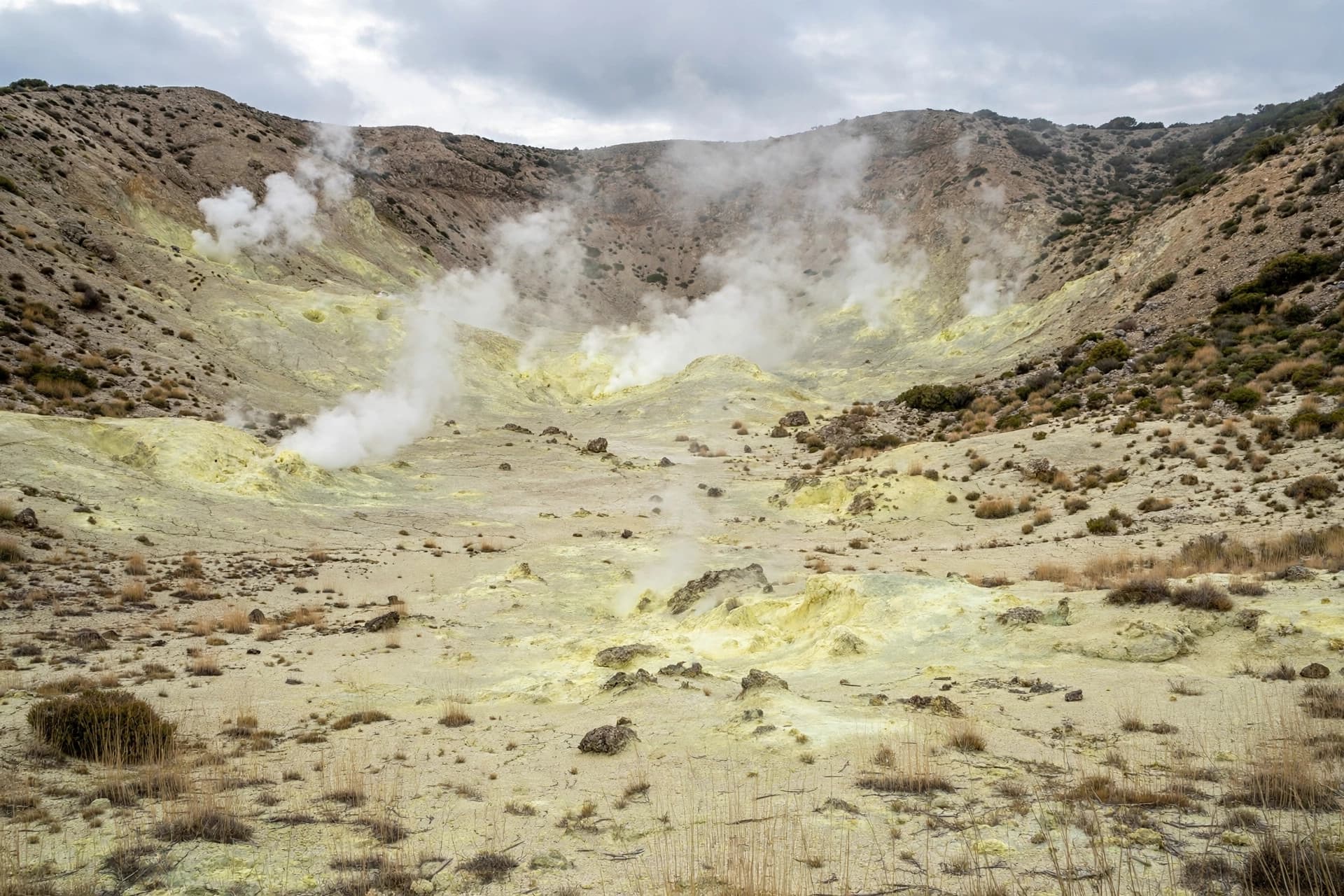
Beneath the gentle hills west of Naples, where vineyards and apartment blocks share space with the remnants of ancient craters, a vast system is stirring. The Campi Flegrei, a caldera volcano that has not produced a major eruption since 1538, has been in a state of unrest for decades. The ground rises and falls. The earthquakes come in swarms. And according to a growing body of research, the engine behind this restlessness is the continued arrival of magma and magmatic fluids from below, accumulating at shallow depths and pressurizing the system above .
A recent study published in Nature Communications Earth & Environment examined the thermal evolution of the magmatic reservoir beneath Campi Flegrei over the past 75 years of unrest. The researchers modeled the injection of magma during each episode of unrest and found that the time intervals between injections are not sufficient for the system to cool back to its pre-1950s temperatures. The volume of magma above the solidus—the temperature at which rock begins to melt—increases with time . Their calculations suggest that between 60 million and 80 million cubic meters of eruptible magma may be present today at a depth of about four kilometers, depending on the thickness of the injected layers .
The evidence for magmatic input is not limited to thermal modeling. A separate multidisciplinary study, published in Science Advances and involving researchers from the National Institute of Geophysics and Volcanology in Italy and the University of Beijing, analyzed more than 30,000 measurements of carbon dioxide flux from the ground at Campi Flegrei, collected over 27 years. The data show a near-exponential increase in CO2 emissions since 2005, correlated with the ground uplift recorded at Pozzuoli, which reached approximately 1.6 meters by December 2025, and with the intensification of seismicity .
The researchers interpret this correlation as evidence of the "engine" of the current crisis: the continuous rise of magmatic fluids accumulating at a depth of three to four kilometers and moving upward, pressurizing and heating the overlying hydrothermal system. The thermal energy released by these fluids, they estimate, is an order of magnitude greater than the elastic energy deforming and lifting the crust, and five orders of magnitude greater than the energy released by all earthquakes recorded between 2005 and 2025 .
Campi Flegrei is not a conventional volcano with a single cone. It is a caldera, a broad depression formed by the collapse of the ground after massive eruptions in the distant past. About 500,000 people live within the red zone, the area most exposed to volcanic hazard . The ground has been rising and falling—a phenomenon known as bradyseism—for centuries, but the current phase of unrest, which began in the early 2000s, has been more sustained and more pronounced than any in recent memory.
What this means for the future is not simple to say. The research does not predict an eruption. It describes a system that is evolving, with magma and fluids accumulating at shallow depths and producing measurable signals: ground deformation, seismic swarms, and gas emissions. The shallow deformation source, one study notes, should not necessarily be considered a signal of impending eruption, but rather a signal of magma supply and transfer from depth within a vertically connected plumbing system . The observation of permanent deformation since 1950, however, warns that the magmatic system is evolving toward eruptive conditions .
For the people of Pozzuoli and the surrounding towns, the science is not abstract. It is the ground beneath their homes, the tremors they feel, the plans they make with an awareness of the mountain that is not quite a mountain. The authorities monitor the caldera continuously, and evacuation plans exist. The research continues, adding detail to a picture that is clearer than it was a decade ago but still incomplete.
Campi Flegrei is not a sleeping giant in the conventional sense. It is a system in motion, a caldera that breathes and shifts and fills. The magma is arriving, the fluids are rising, and the ground is responding. The question is not whether the volcano is active, but what its activity will mean in the years and decades to come.
AI Image Disclaimer: The imagery in this article is AI-generated and intended solely for illustrative purposes.
Sources: Nature Communications Earth & Environment, Science Advances, INGV, AGU Publications
Published by Banx Network. This article is part of the Banx decentralized media programme, powered by the BXE token on the XRP Ledger.