Nature often keeps some of its greatest stories hidden beneath the surface. While towering mountains and sweeping coastlines readily capture attention, the soil beneath our feet quietly shelters life that can remain undiscovered for generations. Occasionally, a chance encounter reminds us that even familiar landscapes still hold remarkable scientific mysteries.
Scientists believe several giant earthworms discovered across South Australia are almost certainly members of previously undescribed species. The conclusion follows decades of documented sightings gathered by insect ecologist Kristen Messenger and assessments by earthworm specialist Dr. Geoff Dyne, who say some of the unusually large specimens differ from any officially recognized species in the state.
Messenger has spent nearly 30 years collecting reports from farmers, landowners, and local residents who described encountering exceptionally large earthworms. While many early accounts appeared difficult to verify, repeated observations from different regions gradually revealed consistent patterns. Photographs and field evidence eventually convinced researchers that the reports warranted closer scientific attention.
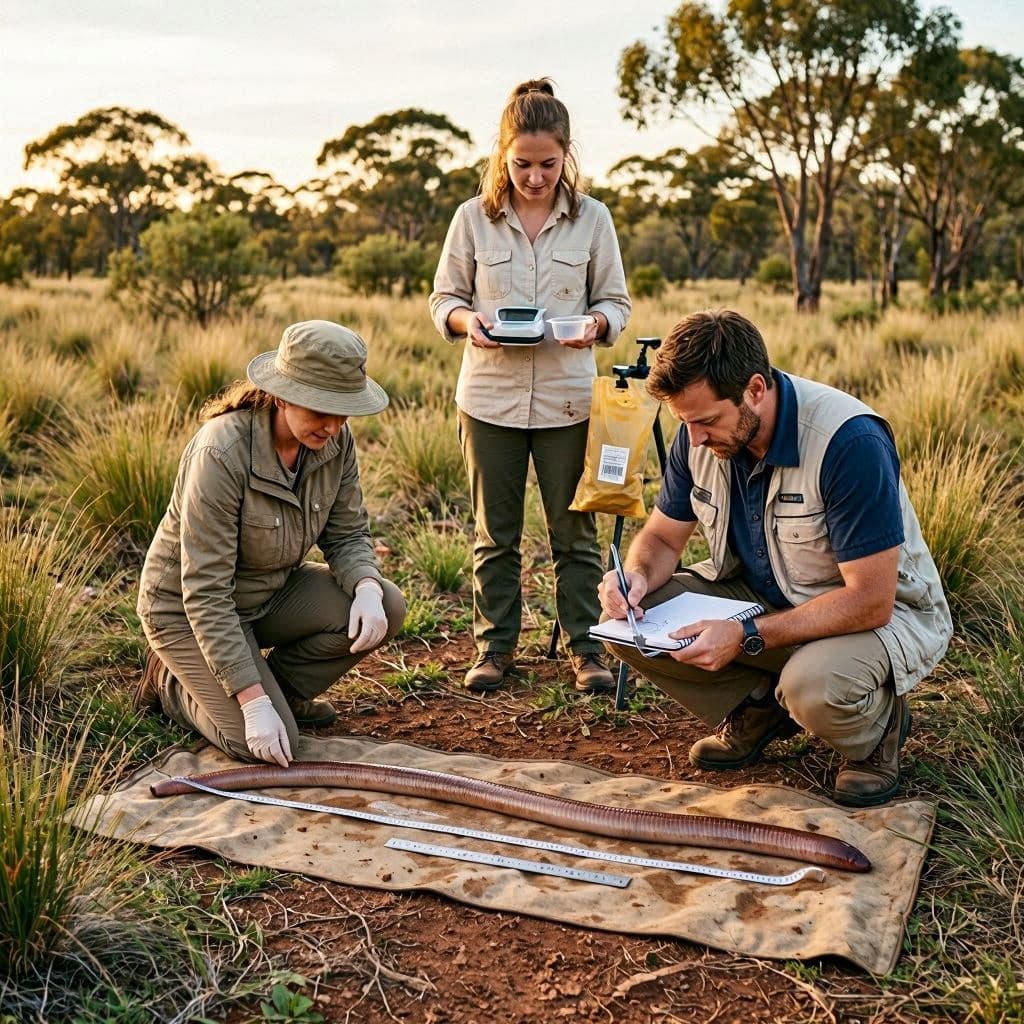
The giant earthworms reported in South Australia are far larger than common earthworms, with some estimated to measure between 70 centimeters and 1.5 meters in length. One specimen from the state's Mid North was estimated to be close to two meters long. Although South Australia is already home to the Giant Mount Lofty Earthworm, researchers believe some of the newly reported worms may represent entirely different species.
According to Dr. Dyne, who previously described a new giant earthworm species near Broken Hill, confirming a new species requires detailed anatomical examination and the publication of a peer-reviewed scientific paper. External appearance alone is not sufficient for formal classification under international zoological standards.
Researchers note that giant earthworms are rarely observed because they spend most of their lives deep underground in permanent burrows, sometimes extending several meters below the surface. Heavy rainfall can temporarily saturate the soil, forcing the animals to emerge where they become visible to people. Their hidden lifestyle has likely contributed to the lack of scientific documentation despite decades of occasional sightings.
Australia is already recognized as home to more than 700 native earthworm species, with scientists suggesting many more remain undocumented. Because earthworms play an important role in improving soil structure, nutrient cycling, and ecosystem health, identifying previously unknown species also contributes to a broader understanding of biodiversity and conservation.
The discoveries highlight how scientific exploration continues even in well-studied environments. As researchers work to determine whether these remarkable earthworms represent new species, the findings serve as a reminder that the natural world still holds many unanswered questions waiting patiently beneath the surface.
AI Image Disclaimer: The accompanying illustrations are AI-generated visual interpretations based on verified scientific reporting and are not actual field photographs.
Sources (verified):
ABC News Australia CSIRO Memoirs of the Queensland Museum Museums Victoria
Published by Banx Network. This article is part of the Banx decentralized media programme, powered by the BXE token on the XRP Ledger.