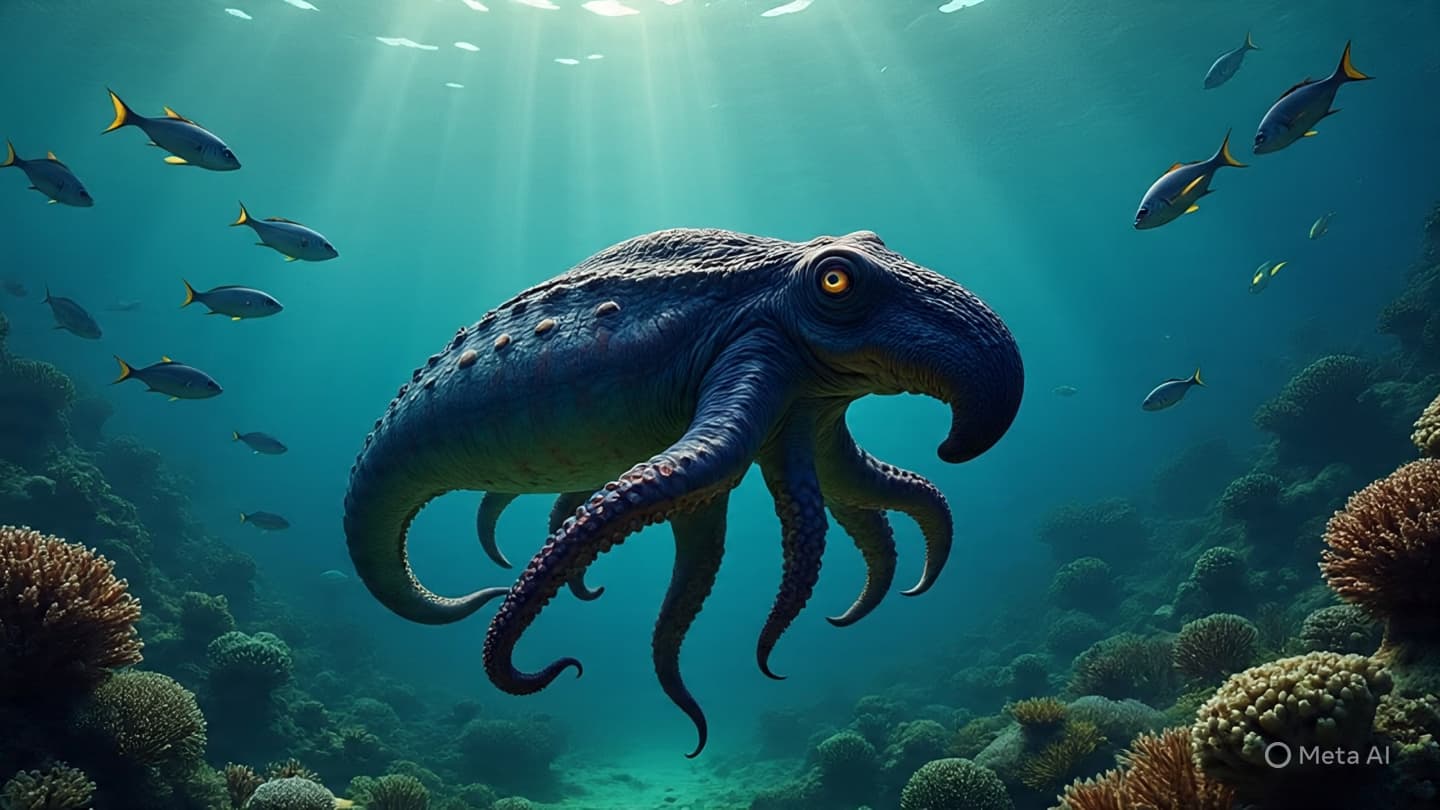
In the depths of the ocean, where light fades and silence deepens, imagination has often filled the unknown with stories of vast, elusive creatures. Yet from time to time, science offers its own measured revelations, grounded not in myth but in careful observation.
Researchers have reported findings related to a large prehistoric marine predator, informally referred to as “Kraken,” believed to have been an enormous ancient octopus reaching lengths of up to 19 meters. The discovery is based on fossil evidence and reconstructed interpretations of ancient marine ecosystems.
Scientists suggest that this creature may have occupied the role of an apex predator, existing at the top of its food chain. Evidence indicates that it lived millions of years ago, during a time when marine biodiversity differed significantly from what is observed today.
The conclusions are drawn from fossilized remains and patterns found in ancient seabeds, where unusual arrangements of bones and markings have been interpreted as possible signs of predation behavior. These findings have prompted renewed discussion about the capabilities of early cephalopods.
While modern octopuses are known for intelligence and adaptability, their ancient relatives may have exhibited different physical characteristics. The scale suggested by this research, however, remains subject to ongoing analysis and debate within the scientific community.
Marine paleontology often relies on fragmentary evidence, requiring researchers to piece together incomplete records. As a result, interpretations are approached cautiously, with multiple hypotheses considered before broader conclusions are accepted.
The “Kraken” nickname reflects a cultural reference rather than a formal scientific classification. It serves as a way to communicate the scale and intrigue of the discovery, though researchers continue to rely on precise terminology in their work.
These findings contribute to a broader understanding of ancient ocean ecosystems, highlighting the diversity and complexity that existed long before modern marine life took shape.
Further study will be needed to confirm the characteristics and ecological role of this proposed ancient predator.
AI Image Disclaimer: Some images depicting the prehistoric creature are AI-generated interpretations based on scientific descriptions.
Sources: Nature, ScienceAlert, BBC, The Guardian
Published by Banx Network. This article is part of the Banx decentralized media programme, powered by the BXE token on the XRP Ledger.