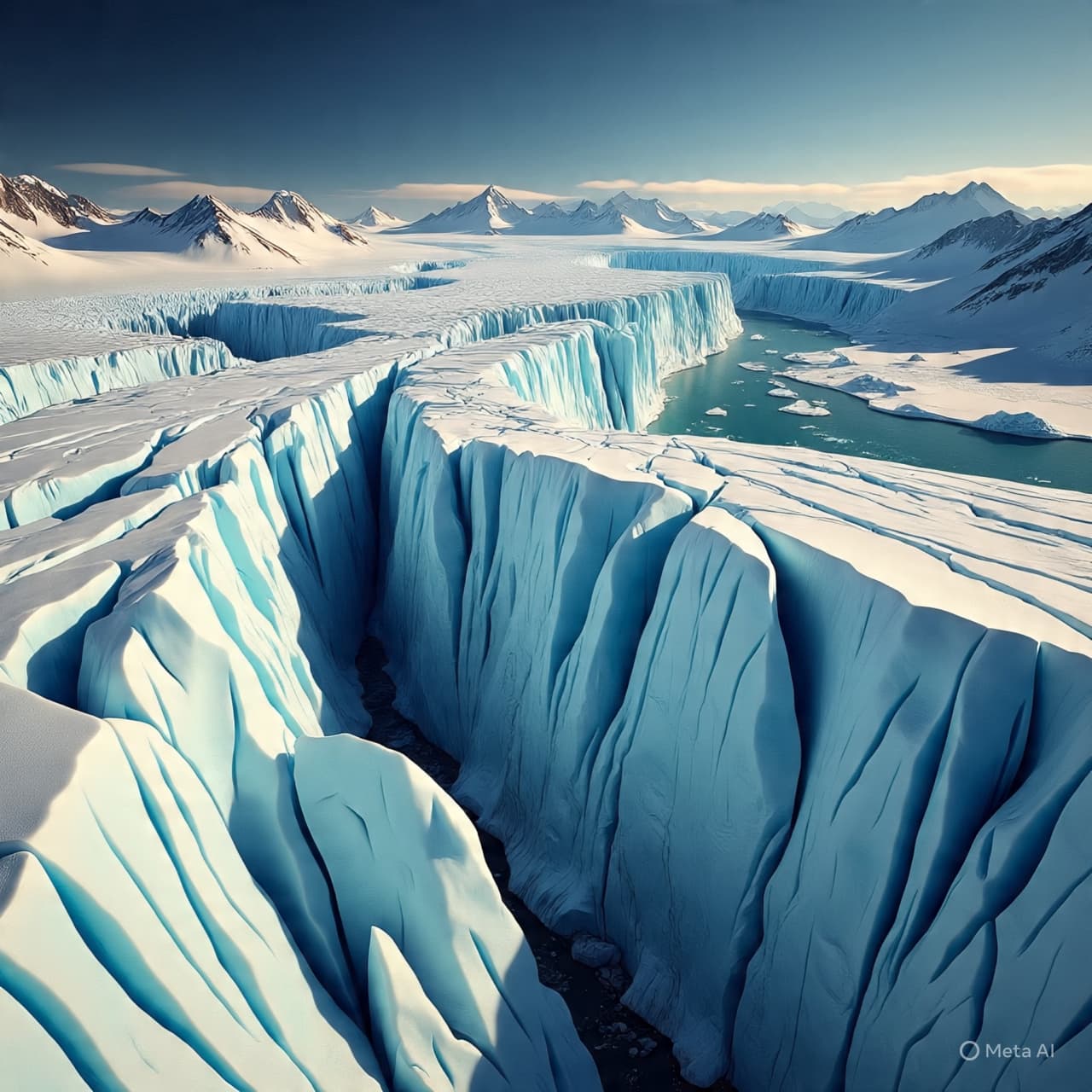
There was a time, long before forests and wings, when the planet is thought to have worn a near-continuous mantle of ice. Glaciers reached toward the equator, oceans sealed beneath frozen expanses, sunlight reflecting sharply from a white and silent Earth. The era, often referred to as “Snowball Earth,” has lingered in scientific imagination as one of the most extreme chapters in planetary history.
For decades, many models suggested that during these deep freezes—hundreds of millions of years ago—the oceans were almost entirely encased, limiting opportunities for life to persist near the surface. Yet new research indicates that the story may be more textured. Rather than a planet locked in uniform frost, Snowball Earth may have included ice-free oases—patches of open water and exposed land that offered refuge for early life.
Geological and climate modeling studies suggest that even during global glaciations, certain regions could have remained seasonally or persistently ice-free. Volcanic activity, wind patterns, ocean circulation, and variations in topography may have created localized environments where sunlight reached liquid water. These refuges, though limited in size, could have supported microbial ecosystems.
The existence of such oases carries implications for understanding how early life survived periods of extreme climate stress. Fossil evidence indicates that simple life forms predated and endured the Cryogenian glaciations, which occurred roughly 720 to 635 million years ago. If open-water pockets persisted, they would have provided critical habitats—allowing photosynthetic organisms to continue harnessing light, sustaining oxygen production and biochemical cycles.
Researchers examining sedimentary records and chemical signatures have identified markers consistent with intermittent open conditions. Certain deposits suggest active water circulation rather than total stagnation beneath thick ice. Climate simulations, too, increasingly point toward dynamic ice coverage rather than a perfectly sealed planetary shell.
This evolving interpretation softens the once stark image of Snowball Earth as entirely frozen. Instead, the planet may have resembled a mosaic: vast ice sheets punctuated by narrow margins of resilience. In these spaces, life would not have flourished widely, but it may have endured—quietly, persistently.
Such findings also echo into modern discussions of planetary habitability. Understanding how life survived extreme glaciation on Earth informs the search for life beyond it. Icy moons and distant exoplanets, once considered inhospitable, may likewise harbor microenvironments capable of sustaining biological processes.
The Snowball Earth hypothesis remains a subject of active research and refinement. Scientists continue to debate the thickness of ice cover, the duration of glaciations, and the precise mechanisms that eventually thawed the planet. What appears increasingly likely, however, is that total uniformity—absolute freeze without exception—may not tell the whole story.
In the imagination, a frozen Earth suggests stillness. Yet beneath even the coldest surfaces, motion often persists: geothermal warmth, shifting currents, the slow chemistry of survival. The possibility of ice-free oases during Snowball Earth reminds us that resilience often resides in margins, in spaces small enough to overlook yet large enough to matter.
When the glaciers eventually retreated and oceans reopened, life did not begin anew—it continued. That continuity, sheltered perhaps in scattered sanctuaries of liquid water and light, forms part of the deep inheritance of the living world. Even in a planet wrapped in white, there may have been windows of blue.
Published by Banx Network. This article is part of the Banx decentralized media programme, powered by the BXE token on the XRP Ledger.