There is a particular cruelty in motorsport that distinguishes it from other forms of competition. A driver can be flawless, a team can execute every strategy, and yet the race can slip away in a moment that no one controls. At the Bathurst 1000 on Sunday, Zach Bates and Aaron Seton experienced that cruelty in its purest form—a near-perfect weekend undone by a safety car and a fuel calculation that belonged to someone else.
Bates, in only his second Bathurst 1000, had stunned the field by claiming pole position for Matt Stone Racing, a team that few expected to challenge the established powers . Seton, the son of two-time champion Glenn Seton, converted that pole into a commanding opening stint, holding off the field through the early laps . The pair led thirty-eight laps between them and remained in contention throughout the afternoon . Their performance was not merely competitive; it was a statement.
With fifty-one laps remaining, Bates and Seton were in a strong position, and the race appeared to be unfolding in their favor . Ahead of them, Anton De Pasquale was leading but had a problem: Team 18 had miscalculated his fuel load, and he would not be able to reach the finish without a safety car intervention . If the race remained green, De Pasquale would have to pit or slow dramatically, handing the lead to Bates. The victory, almost certainly, was theirs.
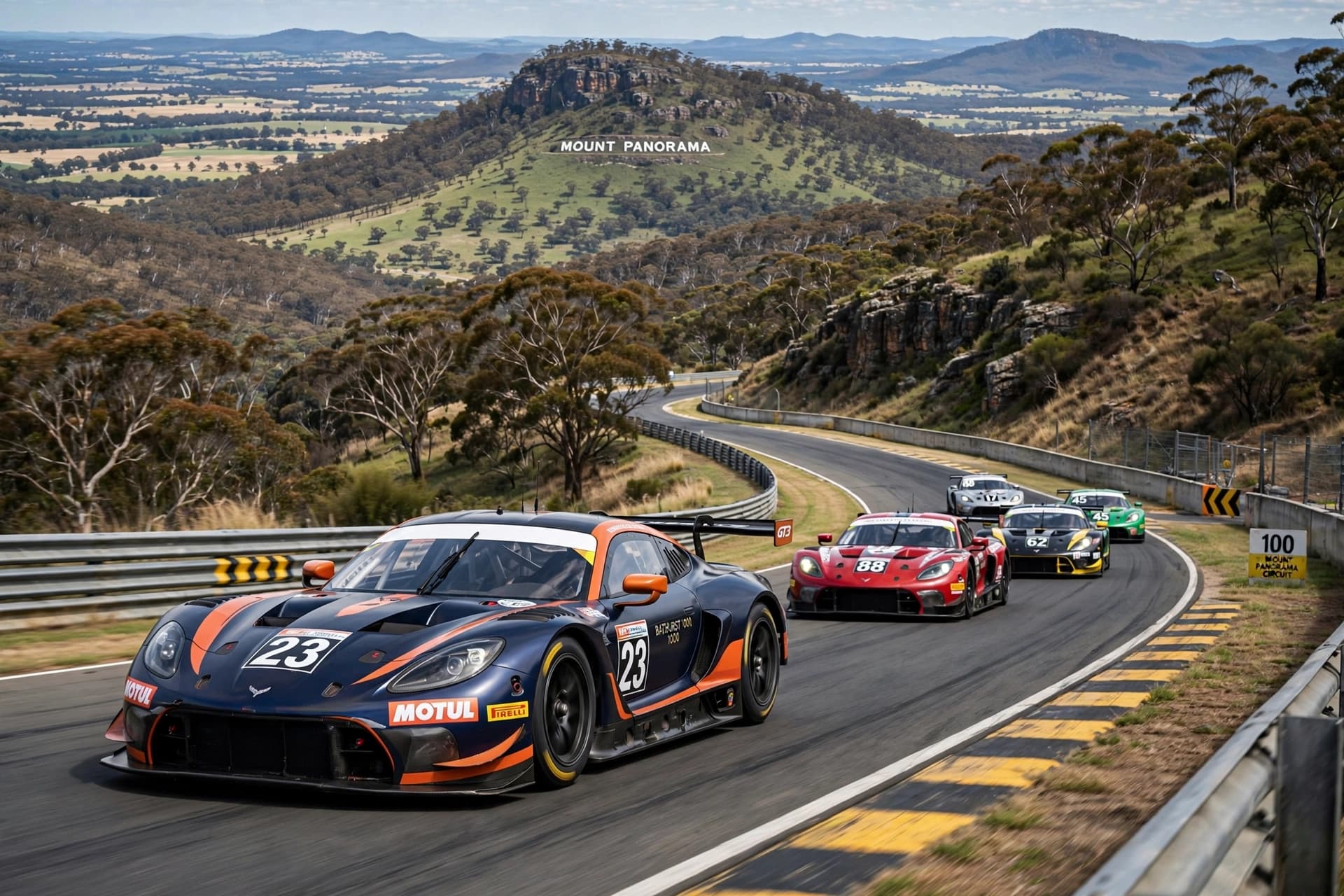
Then Chaz Mostert crashed. The safety car was deployed, bunching the field for a late restart . On fresher tires, Brodie Kostecki and Will Brown were able to attack. Bates, who had been managing his pace to conserve fuel in case of exactly this scenario, found himself vulnerable. He made a small mistake at The Chase on the restart, and Kostecki seized the opportunity, taking second place and then the lead as De Pasquale's car faltered on Mountain Straight . Brown followed through. Bates and Seton crossed the line third, just 1.9 seconds behind the winners .
The podium was Bates's first in Supercars, and Seton's drive had confirmed that the young pairing had genuine pace . But the result carried the weight of what might have been. Glenn Seton, watching from the pits, could not help but think of his own near-miss at Bathurst in 1995, when a late safety car cost him a victory that seemed within reach . "It almost brought me back to my incident in '95," he told V8 Sleuth. "There was no way Brodie was going to catch them, because we were just cruising to look after it in case a Safety Car came" .
Bates, for his part, was gracious in the aftermath. "If you'd told me at the start of the week that I'd be sitting here next to these guys, I would have taken it any day," he said . He acknowledged the small mistake at The Chase, but noted that Kostecki "did an intelligent move, a good move, and got it done" . Seton praised the team, saying the car "was great all weekend" and that he focused on "ticking all the boxes and not getting distracted by any emotions" .
For Matt Stone Racing, the result was both a triumph and a heartbreak. A small team had taken the fight to the giants of Supercars and come within two seconds of a Bathurst victory that would have ranked among the sport's great upsets. The safety car that intervened was not their fault, and the fuel calculation that put De Pasquale in the lead was not their error. They did everything right, and it was not enough.
In racing, as in few other pursuits, the margin between glory and what-might-have-been is measured in tenths of seconds and split-second decisions. Bates and Seton drove an inch-perfect race on a weekend that demanded nothing less. That they did not win is a fact that will fade with time. That they were there, in contention, on the final lap of the Bathurst 1000, is a fact that will endure.
AI Image Disclaimer: The imagery in this article is AI-generated and serves an illustrative purpose only.
Sources:
· Auto Action · Autosport · V8 Sleuth · RACER
Published by Banx Network. This article is part of the Banx decentralized media programme, powered by the BXE token on the XRP Ledger.