We admire telescope images the way we admire a photograph, rarely thinking about the machinery behind the frame. A sweeping view of a galaxy cluster looks effortless, as if the universe simply posed for us. But every such image is the product of instruments with limits, and those limits can quietly shape what we see and, more importantly, what we miss. A new study suggests that some of those blind spots may be addressed before the instruments are even built.
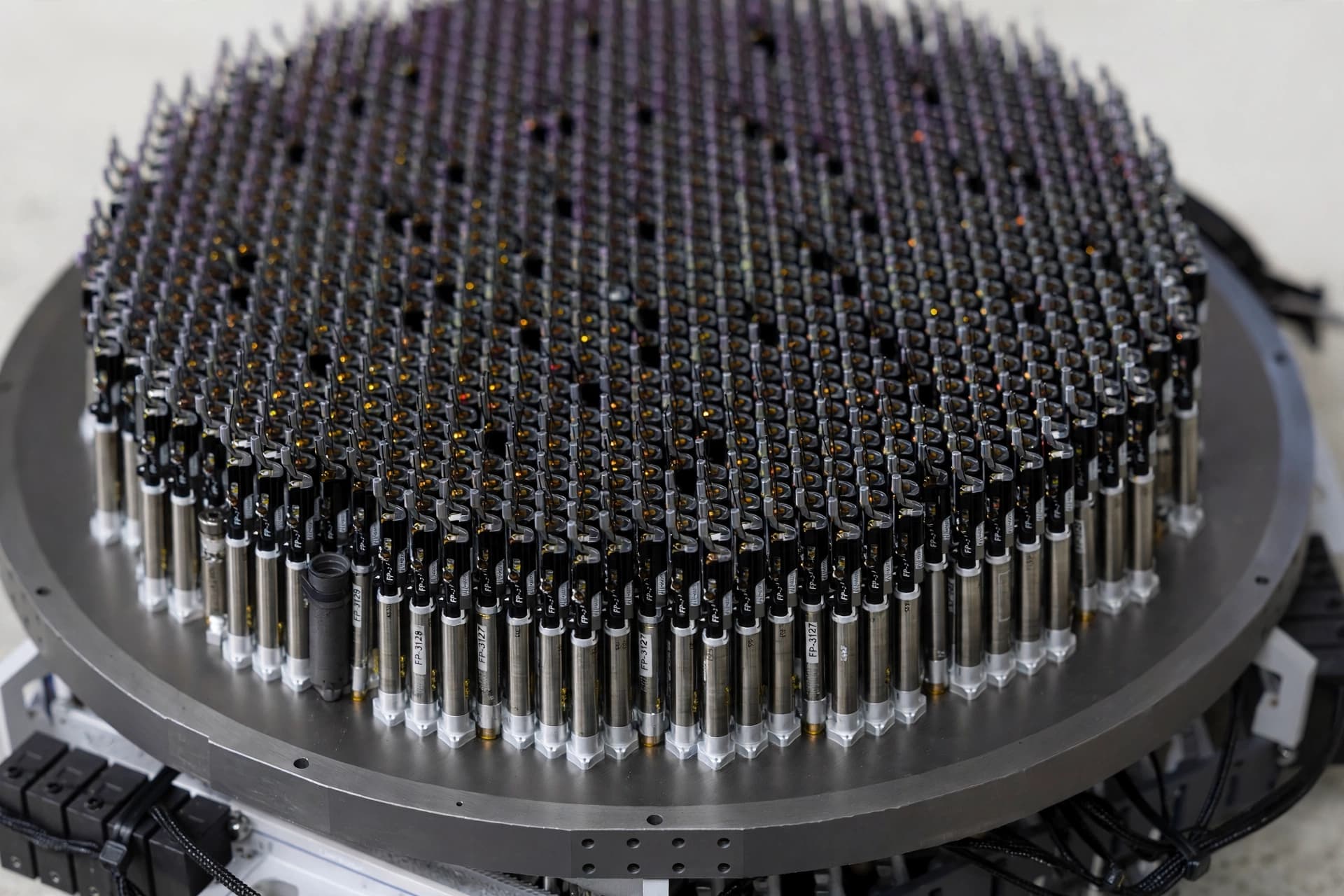
The research, published in the Astronomical Journal, presents a computer tool that models how tiny robotic fiber positioners work inside modern survey telescopes. These telescopes do not simply photograph the sky. They use thousands of small robots, each holding an optical fiber, to collect light from distant galaxies simultaneously. Future instruments plan to employ more than 20,000 of these robots at once. The fibers channel light to spectrographs, which split it to reveal what each galaxy is made of and how far away it sits.
The robots are remarkably capable, but they have physical constraints. They can collide with one another if positioned too closely, and in dense regions of the sky where galaxies cluster together, there may not be enough room for every fiber to reach its target. To avoid crashes, the system skips some galaxies. Those skips become blind spots, and if uncorrected, they can bias the resulting maps in ways that affect conclusions about how galaxies and the universe evolve.
The new software acts like a flight simulator for telescope design. It tests combinations of robotic systems and astronomical targets, mimicking the repeated process of positioning fibers across the sky. It tracks two measures: allocation efficiency, or how well the system assigns fibers to targets, and survey completeness, or how many galaxies are observed over time. By running these simulations before construction begins, engineers can identify design choices that reduce blind spots without adding cost or complexity.
The results yielded three practical rules. First, the smallest possible spacing between robot bases, which allows the highest fiber density, produces the best completeness and efficiency. Second, when spacing is fixed, increasing how far each robot can reach is the next most effective improvement. Third, reducing the safety gap between robots helps as well, though less than extending their reach. These findings offer a kind of pre-construction guidance, pointing designers toward choices that maximize what a telescope can actually see.
The implications extend beyond any single instrument. As astronomers plan ever-larger surveys to study dark energy, galaxy formation, and the structure of the universe, the volume of data they collect will depend not only on mirror size but on how intelligently thousands of tiny robots can be choreographed. A tool that models those choreographies early could help ensure that the maps we build reflect the universe more faithfully, not the limitations of the machines that built them.
The study's authors note that there remains much of the universe unmapped. Future progress will rely on both larger optics and smarter software, on the marriage of engineering precision with scientific ambition. Sometimes, seeing farther begins with helping small machines move in just the right way.
Note: The images in this article were created by AI for illustrative purposes.
Sources: The Conversation, Phys.org, Astronomical Journal
Published by Banx Network. This article is part of the Banx decentralized media programme, powered by the BXE token on the XRP Ledger.