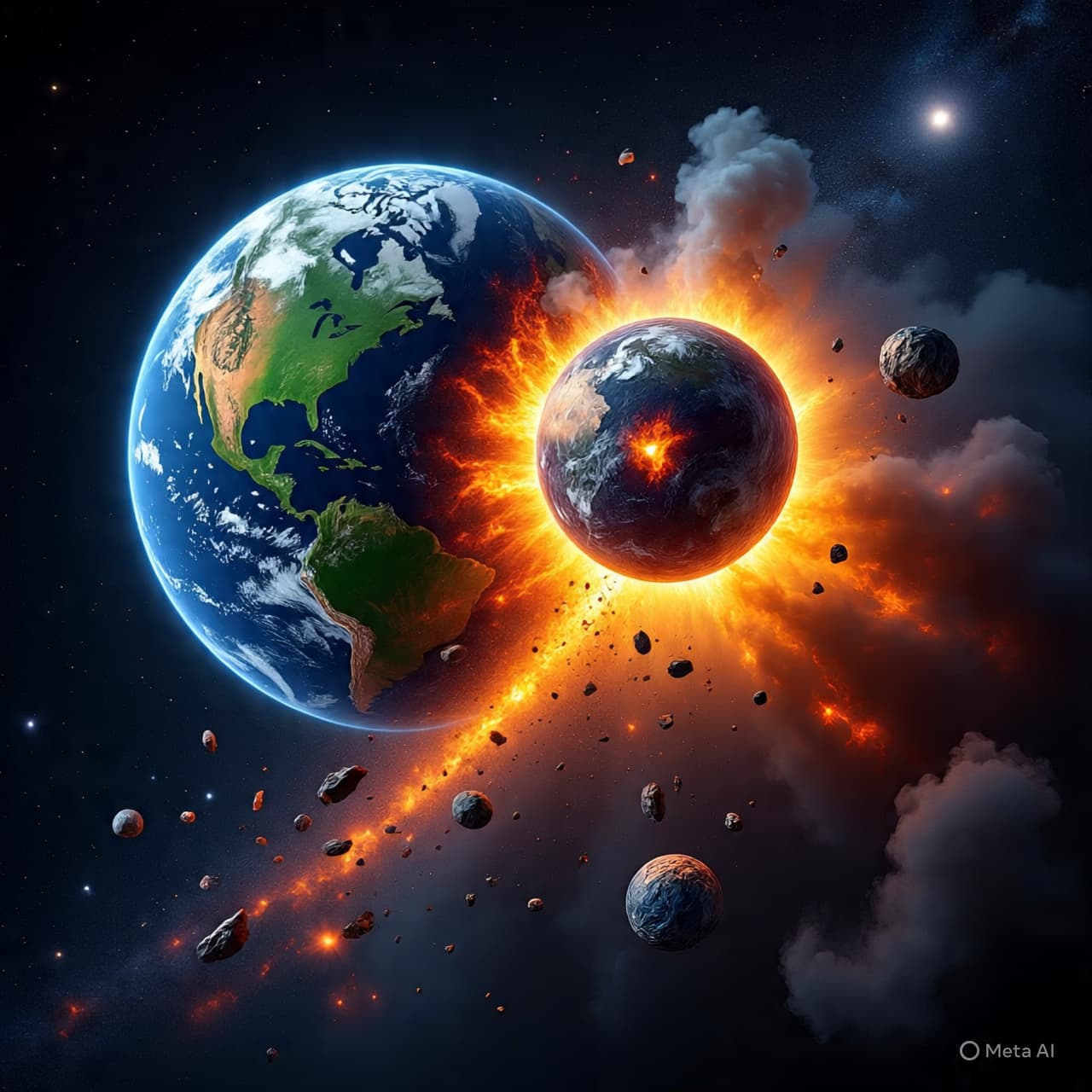
Long before Earth had oceans or storms or a Moon to steady its tilt, the early solar system was a crowded place—fiery, restless, and filled with wandering worlds competing for space. Astronomers often describe this era like a cosmic ballet performed without choreography, where planets danced too close, and collisions weren’t accidents but the language of creation. Somewhere in that swirling past lived Theia, the ancient world that struck Earth with such force that it reshaped both planets forever. For decades Theia has existed as a myth at the edges of planetary science: necessary, plausible, but unseen.
Now, researchers believe they have finally traced where Theia came from.
The answer emerges from a new analysis of lunar samples and Earth’s deep mantle signatures. Theia, it seems, was not just another rogue planetary embryo but a body formed in the same neighborhood as the early Earth—close enough that their compositions were nearly twins, yet distinct enough that the evidence of their union has lingered in subtle chemical echoes. Scientists propose that fragments of Theia may still be buried deep within our planet’s interior, locked in ancient mantle reservoirs that carry slightly different isotopic fingerprints than the rest of Earth.
This finding softens the mythology but amplifies the wonder: Theia was not an invader from the distant solar system. It was a sibling—one formed alongside Earth, one that ultimately became part of us. When the two collided approximately 4.5 billion years ago, the violence was unimaginable, but the outcome was strangely delicate. Debris thrown into orbit cooled and gathered into the Moon, while much of Theia merged into Earth’s body, strengthening its mass and altering its destiny.
The implications stretch far beyond origin stories. If Theia’s remnants still sit deep below our feet, they may influence mantle convection, volcanic hotspots, and perhaps even the long-term evolution of Earth’s magnetic field. The collision was not a single moment sealed by time, but an event whose fingerprints shaped the planet’s internal engine and the Moon's stabilizing presence—the reason our climate has remained balanced enough for life to take root.
This discovery also reframes Earth’s earliest identity. Our world was not forged in solitude. It is, in a literal sense, a composite—an outcome of chance encounters and cosmic inheritance. And the Moon, our quiet companion, is the reminder of the day when two worlds briefly became one.
Published by Banx Network. This article is part of the Banx decentralized media programme, powered by the BXE token on the XRP Ledger.