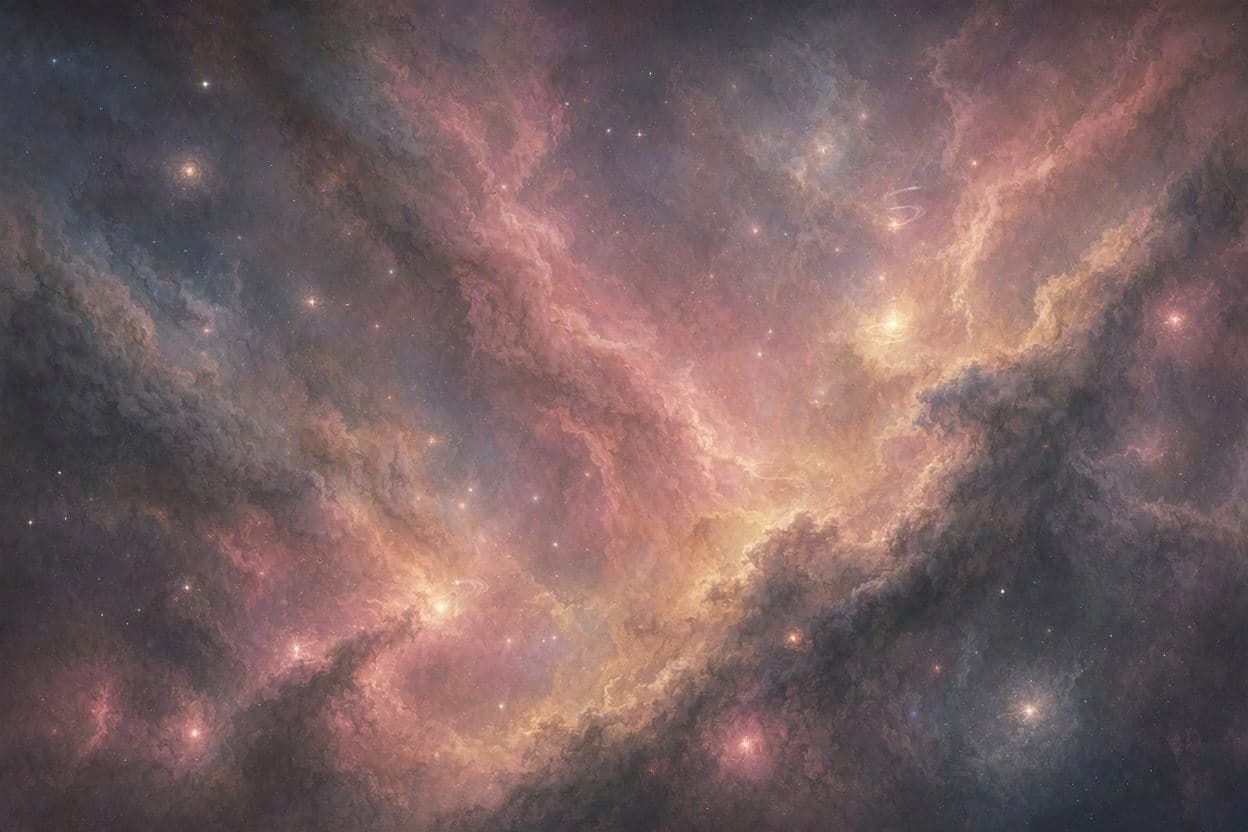
If you could somehow stand at the center of our galaxy, wrapped in a spacesuit that defied the laws of physics, you might be surprised by what your senses encountered. The air—if it could be called air—would carry the sweetness of raspberries and the warmth of rum, a scent profile more suited to a tropical cocktail than to the heart of a cosmic maelstrom. And then, beneath those pleasant notes, there would be something else entirely: the sharp, sulfurous bite of rotten eggs. The universe, it seems, has a complex palate.
The pleasant aromas originate from a colossal molecular cloud called Sagittarius B2, located about 390 light-years from the galactic center. Astronomers using the IRAM radio telescope in Spain detected significant quantities of ethyl formate, the chemical compound responsible for the flavor of raspberries and the scent of rum . The discovery came during a survey searching for amino acids—the building blocks of life—in the dense, star-forming region .
Ethyl formate is formed from ethanol, a common molecule in star-forming clouds, combined with formic acid . Its presence was detected because the molecules absorb radiation from nearby stars and re-emit it at radio wavelengths, creating a signature that telescopes can read . The molecules are among the largest ever found in space and are considered precursors to more complex organic compounds .
The rum connection is not merely poetic. Ethyl formate is one of the aroma compounds that contributes to the characteristic scent of rum, alongside its role in raspberry flavor . Astronomers have noted that while the cloud contains the chemical responsible for raspberry flavor, many other molecules would be needed to actually create a space raspberry . The density of the cloud is also impossibly thin by Earth standards—roughly 3,000 molecules per cubic centimeter, compared to about 25 million trillion in the air we breathe . Even if one could survive there, the scent would be imperceptible.
The less pleasant smells come from other compounds in the same region. Astronomers detected propyl cyanide in Sagittarius B2, a lethal chemical that would be dangerous to inhale . Elsewhere in the universe, the scent of rotten eggs is associated with hydrogen sulfide, a compound found in various cosmic environments. The combination of sweet, alcoholic, and sulfurous notes suggests that the galactic center is not a place for a casual stroll, even if one could survive the radiation and vacuum.
What makes these discoveries significant is not their olfactory qualities but what they reveal about chemistry in space. The detection of complex organic molecules like ethyl formate and propyl cyanide in star-forming regions supports the idea that the building blocks of life are synthesized in the interstellar medium and delivered to young planets. The search for amino acids in Sagittarius B2 continues, with astronomers believing their discovery is only a matter of time .
Astronomers have detected ethyl formate in the Sagittarius B2 molecular cloud near the Milky Way's center, a compound responsible for raspberry flavor and rum scent. The same region also contains propyl cyanide, a lethal chemical, and other compounds associated with less pleasant odors.
AI Image Disclaimer: Visuals in this article are produced by artificial intelligence for illustrative purposes only and do not represent actual cosmic phenomena.
Sources: The Guardian, How It Works, Smithsonian Institution, IOPSpark, Science.org.au
Published by Banx Network. This article is part of the Banx decentralized media programme, powered by the BXE token on the XRP Ledger.