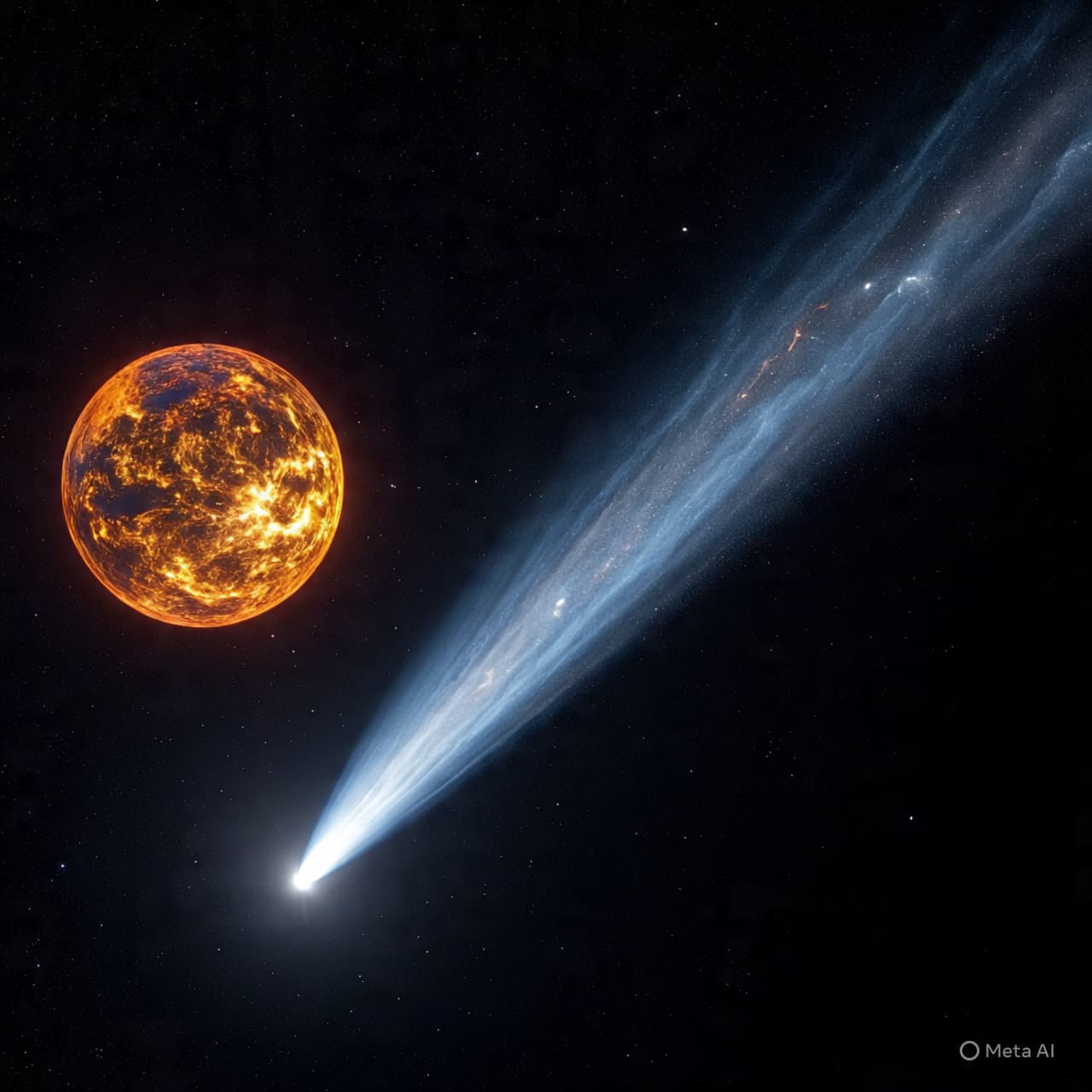
There are paths in the sky that seem less like journeys and more like risks. A line drawn too close to the Sun, where brightness overwhelms distance, and survival becomes uncertain. Along such a path, a comet travels—not as a steady wanderer, but as something exposed, its fate tied to how much it can endure.
These are the sungrazers, comets that pass extraordinarily close to the Sun, skimming its outer atmosphere in arcs that leave little room for error. Their approach is dramatic, but their outcome is rarely guaranteed. Some emerge from the encounter brighter, their surfaces heated into sudden activity. Others do not emerge at all.
Astronomers are now tracking one such object, a potential sungrazing comet that may soon become visible shortly after sunset. Its trajectory brings it into a region where solar heat and gravitational forces intensify, testing the structural limits of what is often a loosely bound mixture of ice and dust.
As the comet nears the Sun, its frozen materials begin to vaporize rapidly. Jets of gas and dust stream outward, forming a glowing coma and, if conditions allow, a tail that can stretch across vast distances. This activity is what makes a comet visible from Earth, transforming a small, dark body into something luminous.
But this same process carries risk. The rapid release of gas can place stress on the comet’s structure, while extreme heat may weaken or fracture its surface. In some cases, tidal forces from the Sun’s gravity can pull the comet apart entirely, scattering its fragments along its orbital path. For smaller or more fragile objects, this outcome is common.
The uncertainty lies in balance. A comet that holds together may brighten significantly, becoming visible to observers in the evening sky, low on the horizon where daylight has only just receded. Such appearances are often brief, dependent on viewing conditions and the comet’s own behavior. Even then, its glow may be subtle, requiring clear skies and patience to detect.
If it fragments, the story changes. Instead of a single bright object, there may be a fading trail of debris, each piece following a slightly altered course, their combined brightness diminished. In some cases, the comet disappears from view entirely, its passage marked only by observation records and orbital calculations.
There is a certain familiarity in this unpredictability. Comets, by their nature, are transient and variable, responding to forces that are both external and internal. Their appearances are moments rather than fixtures, shaped by conditions that cannot be fully controlled or predicted.
For observers, this creates a different kind of anticipation. Not the certainty of a scheduled event, but the possibility of one. A clear evening, a low western horizon, and the chance that something faint and fleeting might appear—if it has endured.
Astronomers report that a sungrazing comet may become visible after sunset in the coming days, depending on its survival during its close approach to the Sun. Such comets can either brighten due to increased activity or disintegrate under solar stress. Observations are ongoing to determine its condition and visibility.
AI Image Disclaimer
Illustrations were created using AI tools and are not real photographs.
Sources
NASA Space.com Sky & Telescope EarthSky Astronomy Magazine
Published by Banx Network. This article is part of the Banx decentralized media programme, powered by the BXE token on the XRP Ledger.