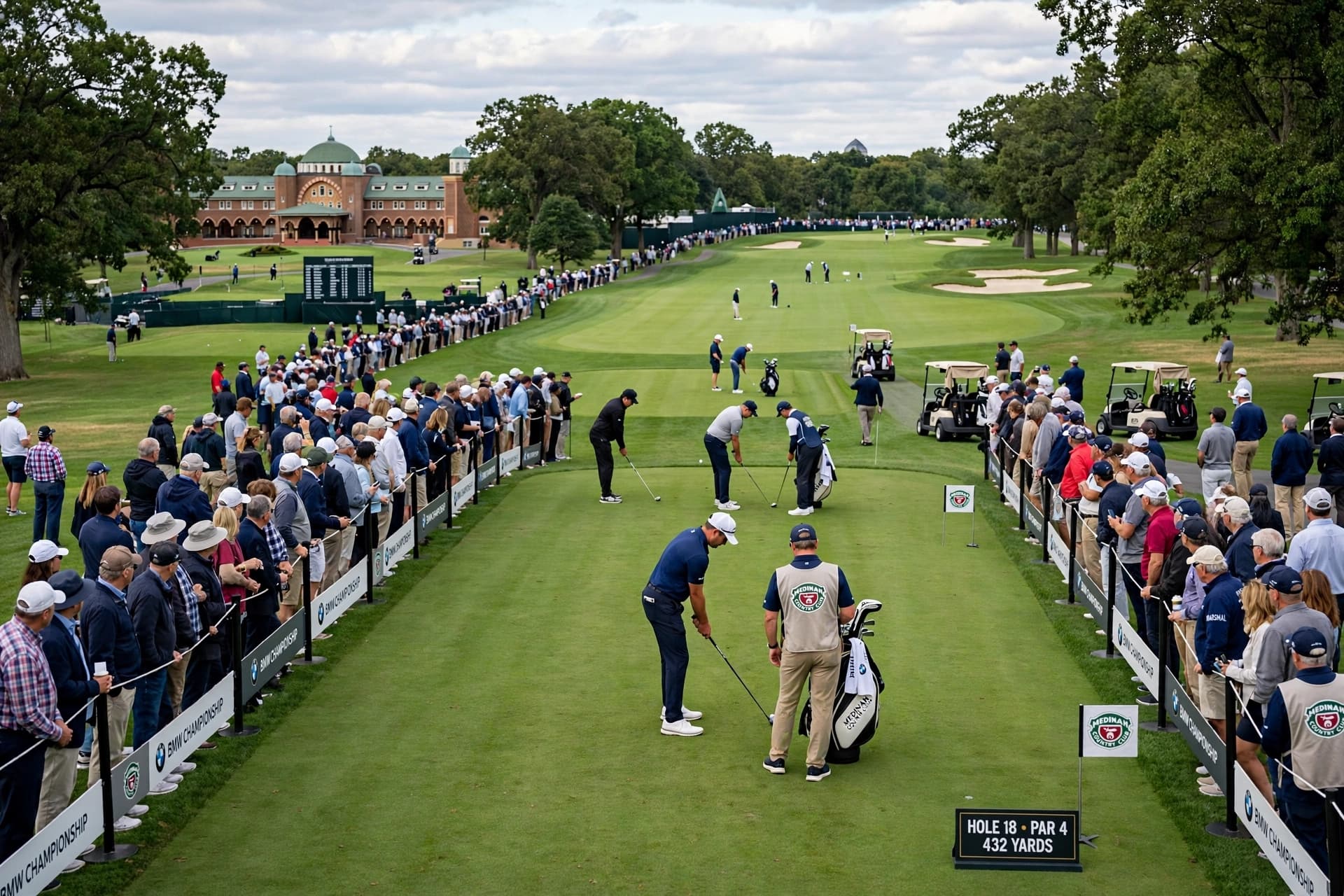
The Medinah Country Club, with its storied fairways and ghosts of competitions past, has long carried a peculiar reputation in American team golf—a place where the improbable tends to find a stage. On this Sunday afternoon in Illinois, the United States team stood on the precipice of a different kind of history. Trailing by three points entering the final session, the Americans faced the uncomfortable possibility of losing a home Presidents Cup for the first time. What unfolded was less a coronation than a quiet exhale, a comeback that was both record-setting and, in its own way, deeply revealing.
The numbers tell part of the story. The United States claimed 9.5 points in Sunday singles, the largest final-day rout in Presidents Cup history, securing a 17-13 victory and an eleventh consecutive title. Cameron Young, Wyndham Clark, Justin Thomas, and Scottie Scheffler were sent out early, a front-loaded lineup designed to apply pressure quickly. Three rapid victories followed, narrowing the deficit before the Internationals could steady themselves.
Yet the afternoon belonged, in many ways, to a twenty-one-year-old rookie named Jackson Koivun. Matched against Si Woo Kim, arguably the Internationals' most consistent performer, Koivun found himself two down through ten holes. What followed was not the tentative play of a newcomer but something steadier—consecutive birdies to square the match, then a bogey from Kim, and suddenly the rookie held a lead he would not relinquish. When his approach on the eighteenth found its mark, teammates who had gathered along the fairway embraced him, draping a Chicago Cubs "W" flag across his shoulders.
The clinching moment arrived from Jacob Bridgeman, another unlikely name in a week full of them. One down with three holes to play against Min Woo Lee, Bridgeman won the final two holes, rolling in a short par putt on the eighteenth that sent a ripple of relief through the American sideline.
For all the celebration, the week left unanswered questions. The United States had been outplayed across the first three sessions, swept in Friday foursomes and unable to generate meaningful momentum until the final day. Captain Brandt Snedeker, who had openly questioned his own decisions, told reporters that "funny stuff happens here," invoking Medinah's history—though the previous chapter of that history, the 2012 Ryder Cup collapse, had gone against the Americans.
Collin Morikawa's late surge against Hideki Matsuyama, capped by a thirty-foot putt on the fifteenth, and Patrick Cantlay's clutch birdie on the sixteenth against Adam Scott, provided the veteran backbone upon which the rookie heroics rested. Still, the question lingered: whether a single Sunday can mask the structural inconsistencies that have plagued American team golf for years.
The International team, for its part, leaves with the knowledge that it held a three-point lead and needed only five singles points to rewrite a narrative that has repeated itself since 2005. Captain Geoff Ogilvy described the day as "on a knife's edge," acknowledging that a few flipped matches would have told a different story.
The trophy remains in American hands, as it has for two decades. But the manner of its keeping—a record comeback that felt at times like an escape—suggests that the margin between dominance and vulnerability may be thinner than the scoreboard suggests.
AI Image Disclaimer: The accompanying images are AI-generated and intended for illustrative purposes only.
Sources: Sporting News, PGA Tour, CBC Sports, Fox News, Australian Golf Digest, New York Post
Published by Banx Network. This article is part of the Banx decentralized media programme, powered by the BXE token on the XRP Ledger.