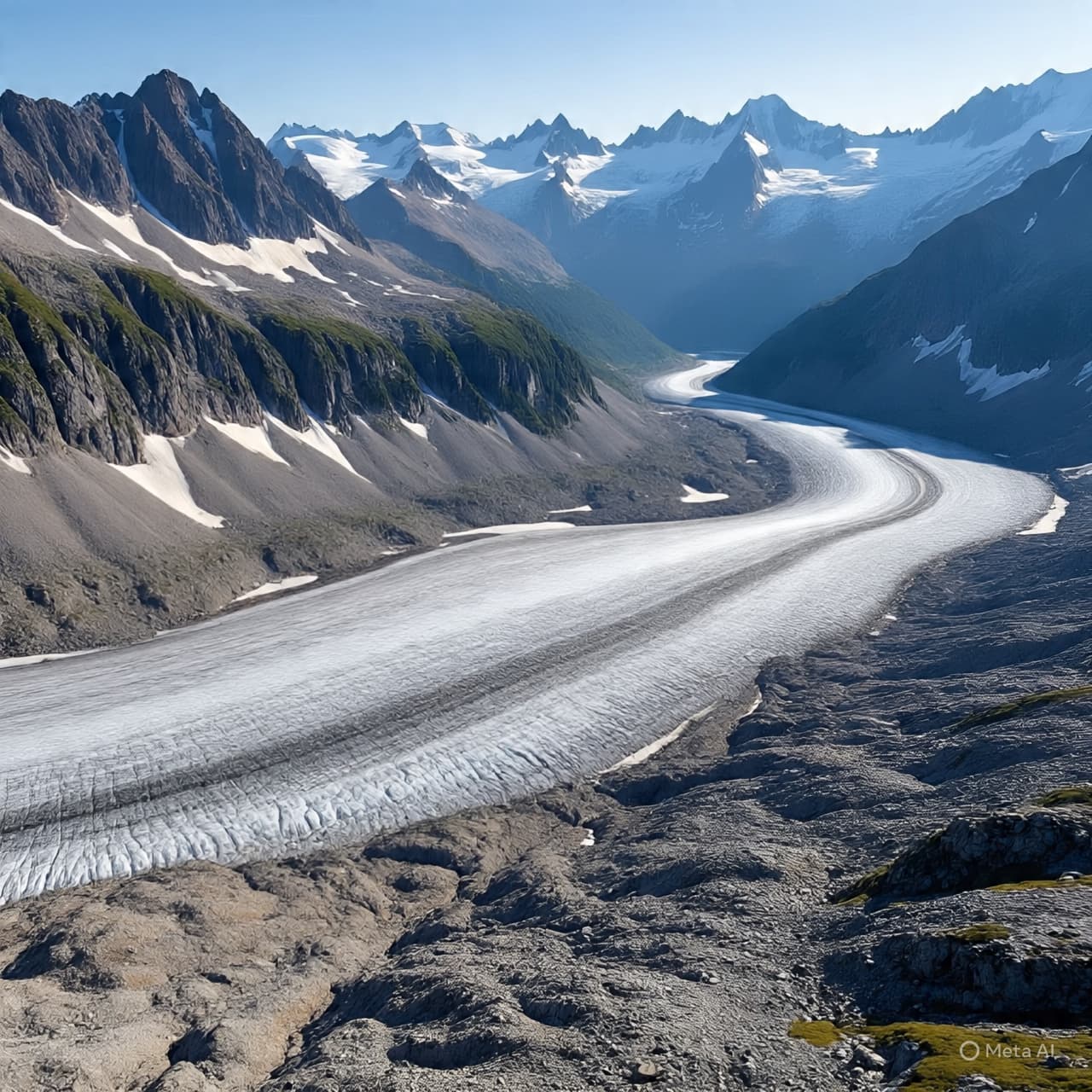
High in the European Alps — where winter landscapes have long been painted with sweeping ribbons of ice and snow — scientists are now sounding a stark and urgent note about the future of those iconic glaciers. A major new study finds that the rate at which Alpine glaciers disappear could reach its peak as early as within the next eight years, as the smaller glacier ice bodies that have hitherto survived into the twenty-first century finally succumb to rising temperatures and changing climate conditions.
Researchers led by glaciologists at ETH Zurich and affiliated institutions introduced the concept of “peak glacier extinction”, referring to the year when the annual count of glaciers disappearing entirely — losing all measurable ice — hits its maximum. In regions dominated by small and fast-reacting glaciers, such as the Alps, this peak is projected to occur earlier than in areas with larger ice bodies because the smaller glaciers respond more rapidly to warming.
Under scenarios aligned with current warming trends — which exceed the Paris climate agreement’s +1.5 °C benchmark — the Alps are expected to see more glaciers vanish each year than ever before as early as the early 2030s. By contrast, global peak glacier loss — including both small alpine glaciers and the much larger ice masses in the polar regions — is forecast to occur later, in the 2040s or even mid-century, as the slower-responding ice of Greenland, Antarctica and high-latitude ranges continues to retreat.
The implications are profound. Alpine glaciers have long provided more than scenic landscapes: they are vital sources of fresh water, especially during summer months; they feed rivers and reservoirs; they shape local ecosystems; and in many valleys, they support tourism economies centered on skiing and mountaineering. Their disappearance would thus reshape not only the physical environment but also the cultural and economic life of mountain communities.
Scientists caution that while the number of disappearing glaciers will eventually decline after the peak — simply because many of the smallest bodies will already be lost — the total loss of glacier ice will continue for decades. Even beyond peak extinction, larger ice bodies will continue to shrink, and many Alpine glaciers that persist will be mere remnants of their former selves.
Importantly, the timing and severity of glacier losses remain tied to global climate action. Lower levels of warming, closer to the Paris Agreement’s targets, could delay the peak and preserve more glaciers into late century; higher warming trajectories would accelerate extinction and shrink surviving ice inventories to a fraction of today’s.
For now, the Alps stand as both a symbol and a sentinel of climate change — their icy crowns gradually giving way as Earth’s thermometer climbs. Communities, scientists and policymakers alike face the challenge of adapting to the changes ahead while seeking to slow the forces driving one of the most visible markers of a warming world.
AI Image Disclaimer Visuals in this article are AI-generated illustrations, intended for conceptual representation only; they are not real photographs.
Sources (Credible News & Research)
• The Guardian — Glaciers to reach peak rate of extinction in the Alps in eight years
• ETH Zurich / Nature Climate Change research summary — study on peak glacier extinction and regional projections
Published by Banx Network. This article is part of the Banx decentralized media programme, powered by the BXE token on the XRP Ledger.