The sun had sunk below the edge of everything visible, and the Atlantic air lay soft and warm over the waters near the islands of The Bahamas. In that stillness, fewer heard the distant rising of fire and plume — a rocket ascending with a gentle insistence, as though tracing its own path between sea and sky. Onboard that slender column of flame were 29 small satellites, hushed ambassadors of connectivity that would soon begin their long orbit high above. But tucked beneath that ignition and light was another drama unfolding, one of return and repose, of motion becoming rest.
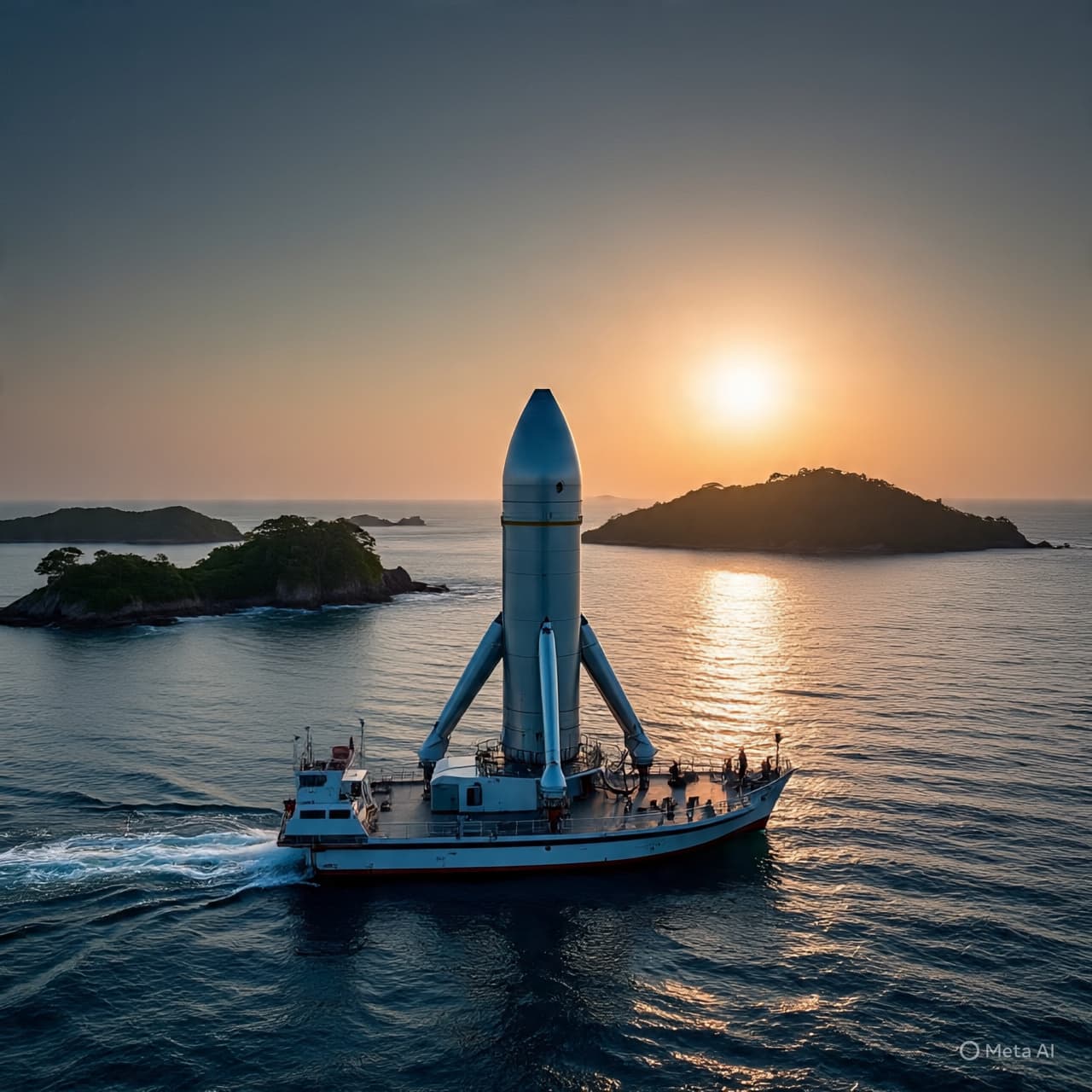
For just the second time in history, a SpaceX Falcon 9 first‑stage booster, blazing into the night from Cape Canaveral in Florida, curved back toward the Earth to settle upon a platform at sea — a droneship stationed in the warm waters off the Bahamian islands. This was not merely another landing, but a quiet testament to the dance of human ingenuity and nature, a meeting of engineered perfection and the ebbing, forgiving tides. The booster, known as B1077, soared skyward before beginning its controlled descent about eight minutes after liftoff, touching down upon the surface of the drone barge with a grace that belied the thunder from which it had just emerged.
In the gentle glow of ship lights and distant stars, engineers and spectators alike witnessed a moment that folds time: a machine that had carried its cargo upward now finding its place once more upon the unstill sea. This particular booster was no novice; it had served on many missions before this one, its worn metal echoing years of work lofting satellites and supplies skyward, and then returning to Earth with deliberate precision. That it should now find calm in waters beyond the usual recovery zones — closer to those coral and sandy shores touched by warm breezes — spoke to an evolving partnership between space ambition and places once distant from the calculus of launch windows.
The choice of landing location is more than mathematical. Nestled amid that blue sweep of ocean, nearer to islands familiar with the sway of trade winds and salt air, the Falcon’s descent recalls an older rhythm: that of voyagers returning to harbor after days at sea, metal under timber. It is a reminder that the instruments of tomorrow can rest where the tides lap softly, where sea creatures take their constant and quiet journeys, and where human communities watch the curving arcs of flight as though reading the last light in the sky.
The Bahamas itself has seen these crests and troughs of space enterprise before. A year earlier, the first such landing brought a similar hush and awe to these waters, accompanied by both celebration and careful thought about how powerful machines interact with fragile ecosystems. Now, as boosters land again and satellites whisper overhead into orbital paths, the conversations continue — sharing wonder, weighing consequence, and recalling that each return brings not only hardware home but questions about harmony between ambition and the places that witness our reaching.
In the end, the sea receives the rocket’s descent as though it were the stilling of a long breath, permitting space and Earth to meet again. In straight news terms, SpaceX successfully launched a Falcon 9 rocket carrying 29 Starlink satellites on Feb. 19, 2026, from Cape Canaveral Space Force Station and completed a second historic booster landing on a droneship positioned off the coast of The Bahamas — a continuation of reusable launch practices and an extension of recovery operations into new maritime regions.
AI Image Disclaimer
Visuals are AI‑generated and serve as conceptual representations.
Sources (Media Names Only)
Spaceflight Now Space.com Times of India TechGenyz
Published by Banx Network. This article is part of the Banx decentralized media programme, powered by the BXE token on the XRP Ledger.