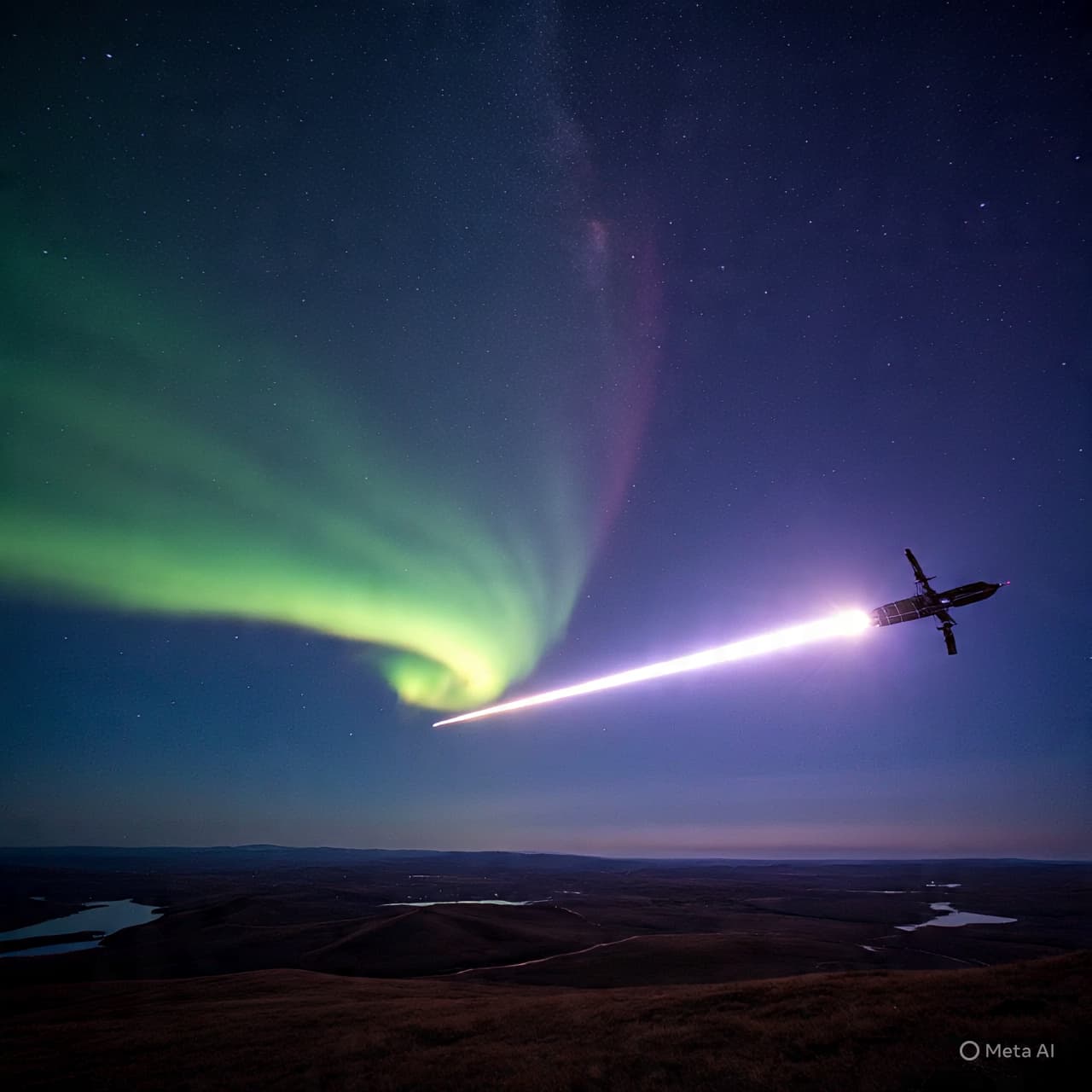
High above the weather, beyond the silver threads of jet trails and the slow drift of clouds, thousands of satellites circle in patient silence. They blink with data, map the Earth’s shifting surfaces, carry voices and images across oceans. For a time, they seem weightless and permanent. And then, almost unnoticed, they begin to fall.
Reentry is not a dramatic spectacle for most of us. It unfolds far overhead, where thin air meets friction and metal becomes fire. Satellites that have reached the end of their working lives descend through the atmosphere and disintegrate in streaks of heat, scattering vaporized materials into layers of sky rarely considered in daily life. It is here, in this upper realm, that scientists are beginning to ask a new and quieter question: what happens when all that metal becomes dust?
Recent research suggests that the growing number of satellites burning up in Earth’s atmosphere may be altering its chemistry in subtle but measurable ways. As private companies and national space agencies launch ever-larger constellations into low Earth orbit, the rate of reentries is increasing. Each spacecraft that breaks apart releases compounds — including aluminum oxides and other metallic particles — into the mesosphere and stratosphere.
The quantities involved are small compared to many terrestrial emissions, yet they are deposited in a part of the atmosphere where composition is delicate and processes are slow. Scientists studying atmospheric chemistry have found evidence that metallic particles from reentering space debris can persist at high altitudes, potentially influencing ozone chemistry and cloud formation in ways not fully understood.
The concern is not one of immediate catastrophe, but of accumulation. Decades ago, the number of objects returning to Earth each year was modest. Today, with megaconstellations numbering in the thousands and plans for tens of thousands more satellites, the volume of reentry material is rising sharply. Researchers have noted that aluminum — a primary component in many satellite structures — does not simply vanish. When it oxidizes in the upper atmosphere, it forms fine particles that can remain suspended, interacting with sunlight and atmospheric gases.
Some scientists describe this as a form of “accidental climate engineering” — not deliberate, not designed, but nonetheless a human intervention in atmospheric systems. Unlike proposals to inject reflective particles intentionally into the stratosphere to cool the planet, this process emerges as a byproduct of modern connectivity. The same orbiting networks that deliver navigation, broadband, and climate data may also be introducing new variables into climate dynamics.
There are open questions. Could these particles affect how much solar radiation is absorbed or reflected? Might they contribute, however slightly, to ozone depletion or alter the formation of noctilucent clouds? The current body of research suggests that the impacts are still uncertain, and likely modest compared to greenhouse gas emissions. Yet uncertainty itself invites closer examination.
Space agencies and researchers are now looking more carefully at the life cycle of satellites — from launch emissions to orbital decay. Some propose redesigning spacecraft materials to reduce harmful residues. Others call for coordinated international monitoring of upper-atmospheric composition as reentry rates increase. The issue intersects with broader conversations about sustainable space practices, orbital congestion, and the invisible footprints left by technology.
What makes this moment distinct is scale. The sky is no longer sparsely populated. Low Earth orbit has become a busy corridor, a lattice of motion above the blue curve of the planet. Each mission carries promise — communication, observation, discovery — and each mission eventually ends in fire.
In the quiet afterglow of reentry, when metal becomes particulate and drifts into layers of cold air, a subtle exchange occurs between human industry and planetary system. It is neither wholly harmful nor wholly benign, but it is real. The atmosphere records it, even if we do not see it.
Researchers emphasize that more data is needed to determine the full climatic implications of satellite disintegration. Current studies indicate that metallic particles from reentries are increasing in the upper atmosphere, and scientists are calling for further monitoring and modeling to understand potential long-term effects. The expansion of satellite constellations is expected to continue, making the question of atmospheric impact increasingly relevant.
AI Image Disclaimer Visuals are AI-generated and serve as conceptual representations.
Sources (Media Names Only) Nature Geoscience Scientific American Space.com The Guardian NASA
Published by Banx Network. This article is part of the Banx decentralized media programme, powered by the BXE token on the XRP Ledger.