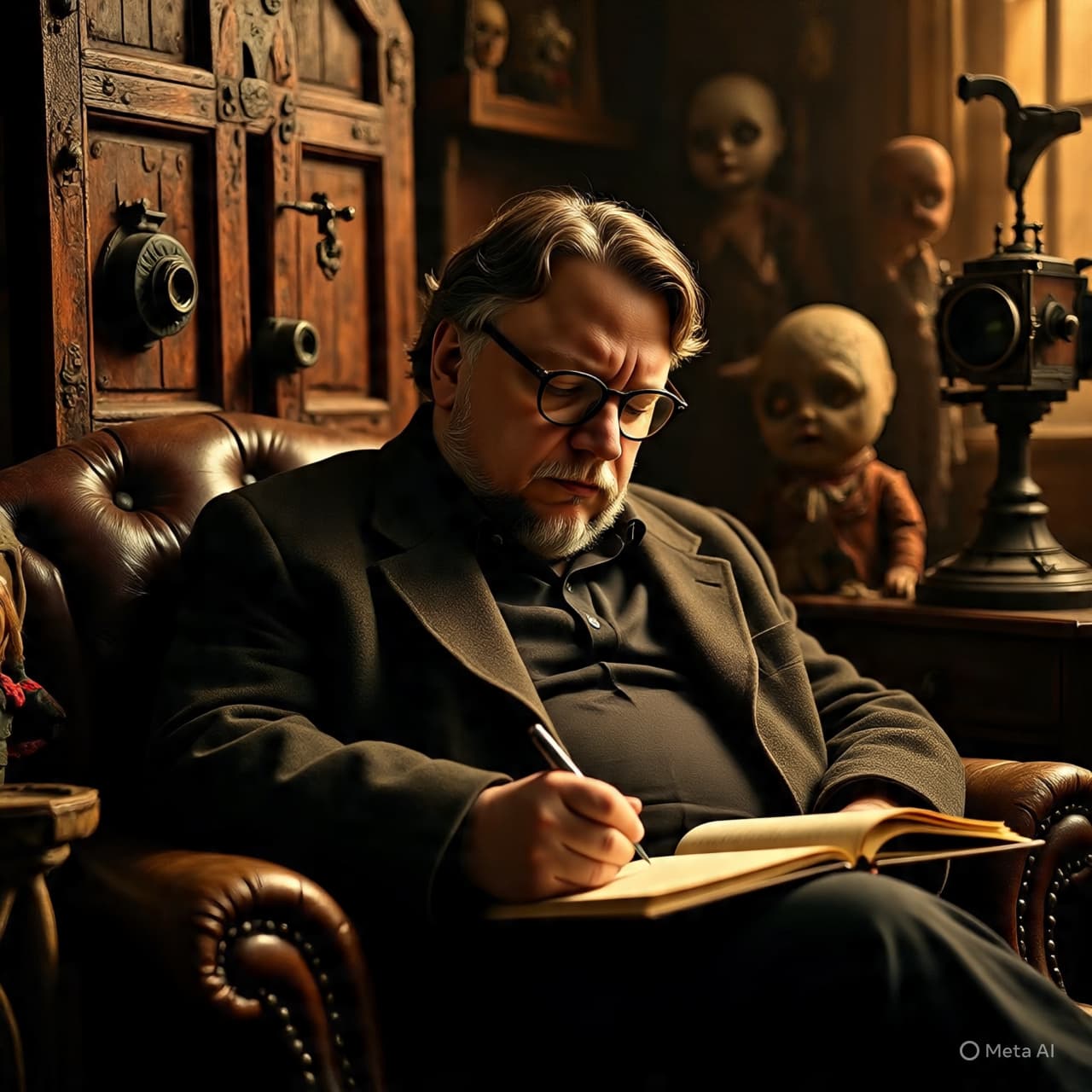
There is a subtle tremor in the art world when a creator of stature draws a firm line in the sand. For the acclaimed filmmaker Guillermo del Toro, that line has been drawn not just with conviction, but with emotion. He has declared — in language as stark as it is poetic — that he would “rather die” than use generative artificial intelligence in his films.
Del Toro’s stand is more than a personal preference; it is a declaration of faith in human imagination, imperfection, and the tactile art of storytelling. At age 61, speaking in an interview for the NPR show Fresh Air, he said: “AI, particularly generative AI — I am not interested, nor will I ever be interested… The other day, somebody wrote me an email, said, ‘What is your stance on AI?’ And my answer was very short. I said, ‘I’d rather die.’”
He went further, substituting the typical fear of machines with a sharper critique: “My concern is not artificial intelligence, but natural stupidity. I think that’s what drives most of the world’s worst features.”
The statement resonates deeply with his upcoming film Frankenstein, itself a re-imagining of Mary Shelley’s classic. Del Toro explained that he intentionally modelled the arrogance of the scientist-creator in his film — Victor Frankenstein (played by Oscar Isaac) — after today’s “tech bros,” the bold innovators who push technology without fully absorbing its consequences. “He’s kind of blind, creating something without considering the consequences,” del Toro said.
In another venue, at the British Film Institute, del Toro articulated his artistic ethos in relation to AI: “AI has demonstrated that it can do semi-compelling screensavers. That’s essentially that.” He argued that true art is not about how little effort is needed, but how much risk and human presence is demanded.
His stance can be understood in three intertwined strands: the value of the handmade, the caution toward unrestrained tech optimism, and the insistence that storytellers remain human at heart.
First, del Toro champions the “handmade” aesthetic — real sets, real textures, actors responding to real space. He has repeatedly expressed suspicion of perfection: “I love things that look handly will actually think it’s urgent.
Second, his critique if the “tech bros” is not a nostalgia for a bygone era so much as a warning against sacrificing meaning for the illusion of innovation. Just as Victor Frankenstein in his tale creates life without adopting responsibility, he views today’s recklessness in tech as a modern echo of that mythic immaturity.
Third, the core of del Toro’s resistance is this: creativity is not transferable to a machine that lacks the scars, impulses, failures and awakenings that real creators carry. For him, AI — especially when used to shortcut human process — risks flattening the lived dimension of story, character and emotion.
AI image disclaimer: Generated with the assistance of artificial intelligence.
Sources: NPR / Fresh Air, The Independent, Business Insider, Euronews, Reuters
Published by Banx Network. This article is part of the Banx decentralized media programme, powered by the BXE token on the XRP Ledger.