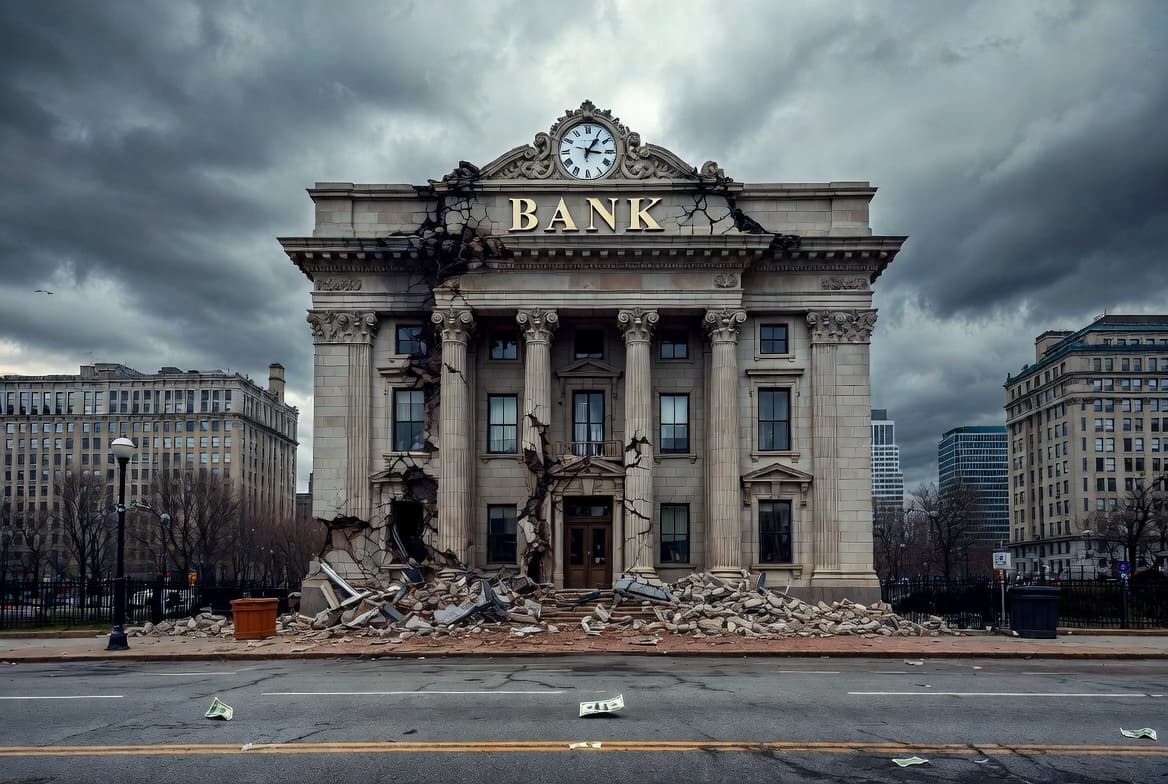
A Financial System Under Structural Stress
The global financial system today rests on increasingly fragile foundations. Public and private debt levels have reached historic highs. In the United States, Europe, and Japan, debt far exceeds thresholds once considered sustainable just two decades ago. This massive debt burden is only manageable through accommodative monetary policies, which themselves have fueled inflation, market distortions, and asset bubbles.
Central banks now find themselves trapped in a systemic dilemma:
Raising interest rates to contain inflation risks triggering recession and financial instability.
Maintaining low rates erodes purchasing power and undermines confidence in fiat currencies.
This structural impasse suggests that incremental adjustments may no longer be sufficient.
Geopolitical Fragmentation and the Questioning of the Dollar
Another key factor lies in the reconfiguration of the global geopolitical order. The dominance of the US dollar—an anchor of the international financial system since Bretton Woods—is increasingly being challenged. Several economic blocs are actively seeking to reduce their reliance on the greenback through bilateral trade agreements, the use of local currencies, and the development of alternative payment systems.
This financial fragmentation does not necessarily imply the imminent collapse of the dollar, but it does signal a gradual transition toward a multipolar monetary world, where no single currency holds absolute dominance. Historically, such transitions have often been accompanied by periods of heightened volatility and systemic reform.
Monetary Digitalization and New Instruments of Control
At the same time, Central Bank Digital Currencies (CBDCs) are advancing rapidly. Officially promoted as tools for efficiency and innovation, they also reflect governments’ desire to regain greater control over financial flows in an era of high debt and accelerating digitalization.
A financial reset does not necessarily mean a sudden collapse. It may instead take the form of a silent restructuring, involving:
new banking regulations,
increased transaction monitoring,
and a fundamental redefinition of money, savings, and financial privacy.
Inflation, Confidence, and Collective Psychology
At the heart of any monetary transformation lies an intangible yet critical factor: trust. Persistent inflation, market volatility, and recent banking crises have eroded the perception of stability that once underpinned the system. When citizens and investors begin to doubt institutions’ ability to preserve the value of money, conditions become ripe for profound change.
Historically, it is rarely a single event, but rather an accumulation of confidence shocks that ultimately triggers a reset.
Disorderly Reset or Managed Transition?
The core question, therefore, is not whether the current system will change, but how. Two dominant scenarios emerge:
A disorderly reset, triggered by a major financial, geopolitical, or monetary shock.
A controlled transition, orchestrated by institutions through managed inflation, monetary innovation, and structural reforms.
In both cases, the financial rules of tomorrow are likely to differ significantly from those that have governed the past several decades.
Discussing a global financial reset is no longer a fringe exercise. Macroeconomic, geopolitical, and monetary signals increasingly point toward a deep restructuring of the international financial system. What remains uncertain is whether this transformation will be imposed by crisis or guided by policy.
For economic actors and citizens alike, understanding these dynamics is becoming essential. In any reset, those who anticipate and adapt tend to preserve value—while those who ignore the signals often bear the cost.
Published by Banx Network. This article is part of the Banx decentralized media programme, powered by the BXE token on the XRP Ledger.