There are moments in astronomy when the universe appears not as a vast chaos, but as something carefully arranged, almost contemplative. Light travels for years, even centuries, only to reach our instruments carrying quiet stories of balance and motion. In one such moment, astronomers have turned their gaze toward faint rings of dust and debris, circling distant stars like delicate traces left behind by time itself.
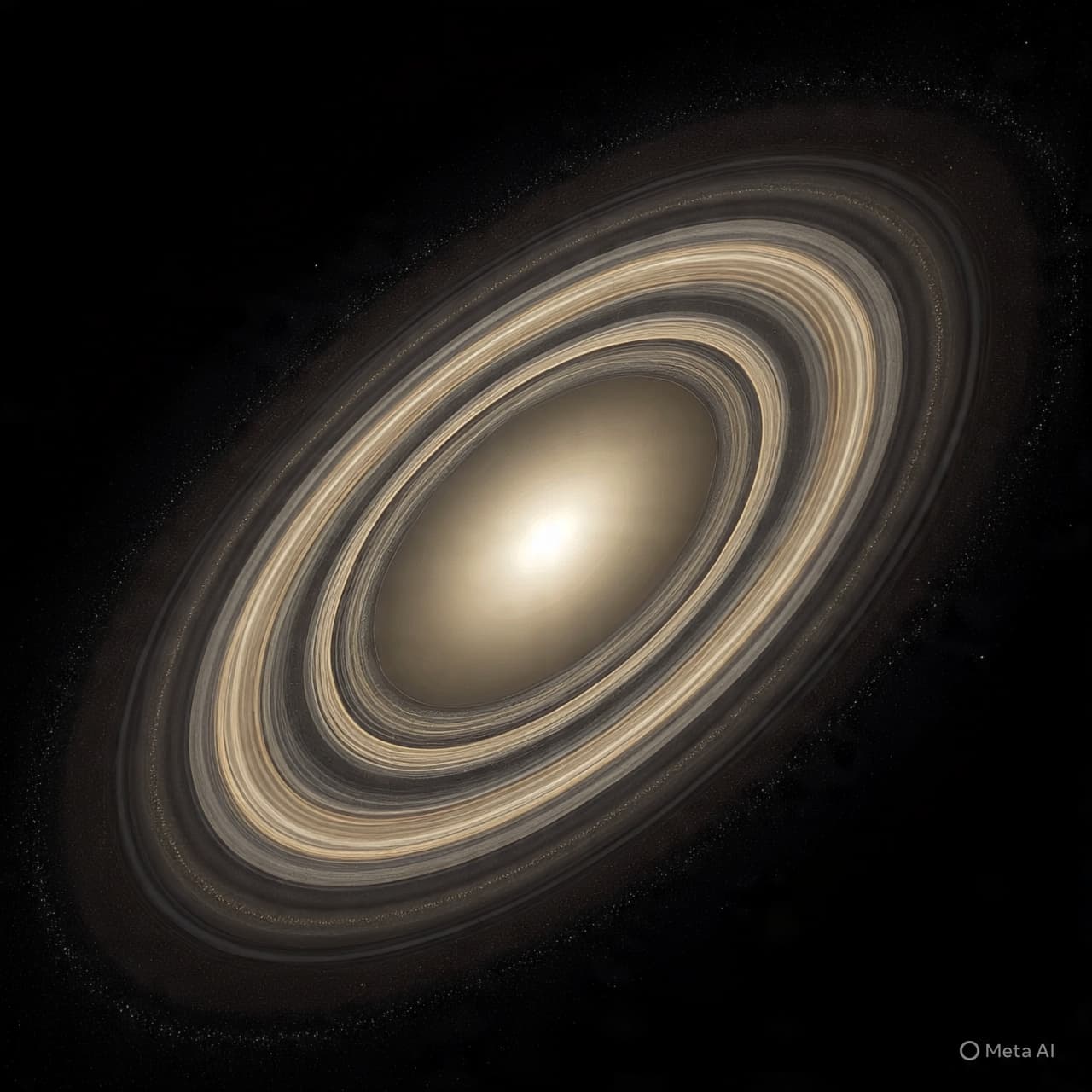
Using the Atacama Large Millimeter/submillimeter Array, known as ALMA, scientists have captured one of the most detailed images yet of debris disks surrounding young stars. These disks, composed of dust, ice, and rocky fragments, form luminous rings that appear orderly and precise, despite originating from collisions and remnants of planetary formation. What might first appear as cosmic clutter instead reveals structure, symmetry, and an unexpected elegance.
These rings are not merely decorative features of space. They are shaped by gravity, motion, and the subtle influence of unseen planets. As material moves within the disk, gaps and rings emerge, suggesting that planets may already be forming or quietly shaping their environment. Each ring becomes a record of interaction, a soft imprint of forces that are present but not directly seen.
ALMA’s ability to observe at millimeter wavelengths allows astronomers to peer into regions previously obscured, revealing how debris disks evolve long after the earliest stages of star formation. The images suggest that planetary systems may remain active and dynamic for far longer than once assumed, continuously reshaping their surroundings through gentle but persistent motion.
There is also a sense of familiarity in these distant structures. The rings echo what scientists believe once surrounded our own young Sun, offering a reflective mirror into the Solar System’s distant past. In studying these debris disks, astronomers are not only observing faraway stars, but revisiting the conditions that may have shaped Earth itself.
As observations continue, these images do not declare final answers. They offer something quieter: evidence that planetary systems are patient constructions, refined over time, shaped by both collision and calm. Each new image adds clarity, not urgency, to our understanding of how worlds emerge.
ALMA’s latest observations will now be analyzed further, compared with existing models, and used to guide future studies of planetary formation. The findings expand existing knowledge without overturning it, gently reinforcing the idea that structure in the universe often arises from long, unhurried processes.
AI Image Disclaimer (Rotated Wording) Graphics are AI-generated and intended for representation, not reality.
Sources (media names only):
Nature Science ESO (European Southern Observatory) NASA BBC Science
Published by Banx Network. This article is part of the Banx decentralized media programme, powered by the BXE token on the XRP Ledger.