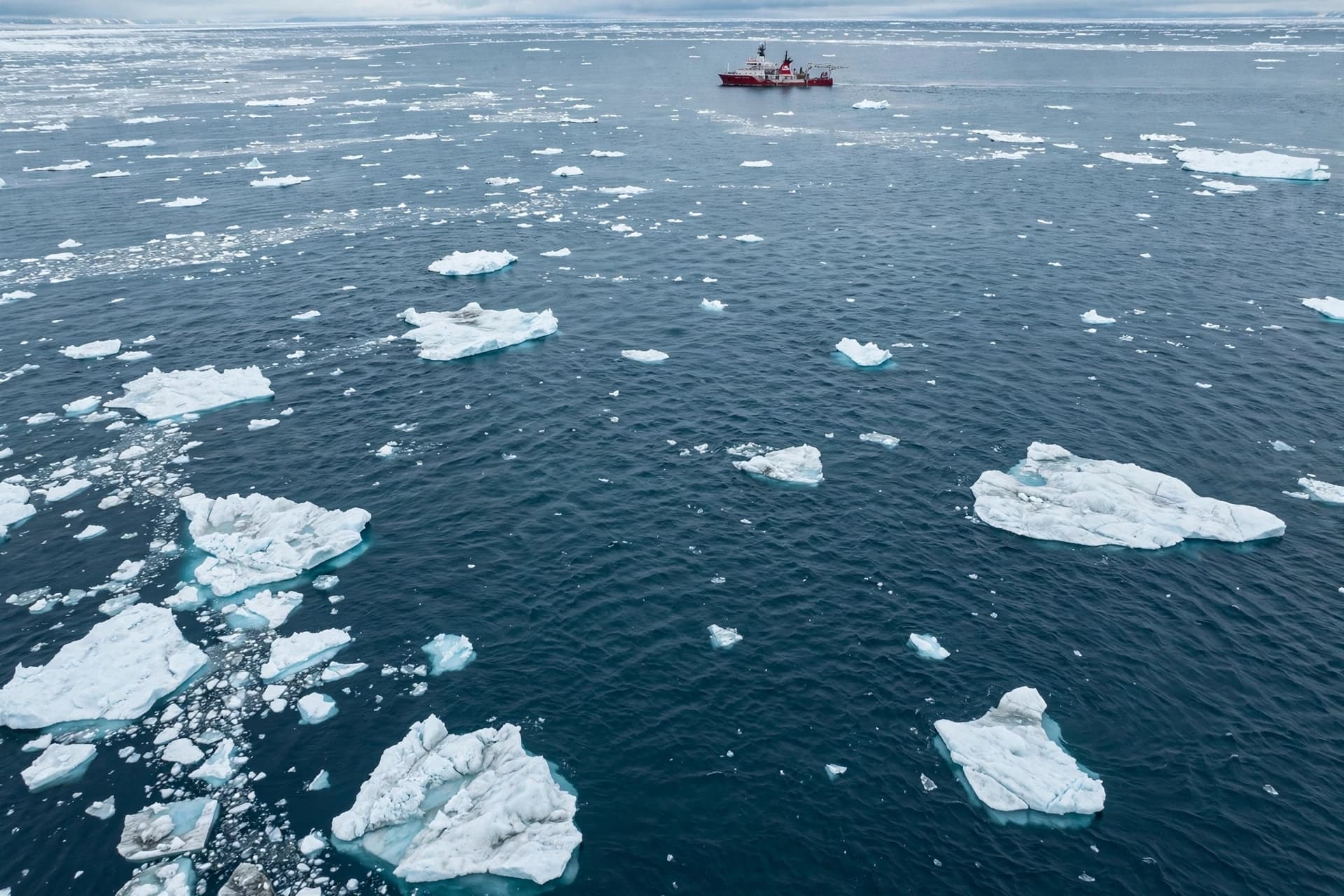
There is a particular kind of silence that accompanies the disappearance of ice—a silence that is not peace but absence, the quiet of a white expanse that is no longer there, of a reflective surface that has become open water. In the Arctic, that silence is growing louder. Scientists have confirmed that Arctic sea ice has reached another historic low, continuing a decades-long decline that is reshaping the region and, with it, the planet's climate system.
The numbers tell a story of relentless retreat. According to data from the National Snow and Ice Data Center, Arctic sea ice extent at its annual minimum in September was the lowest ever recorded in the satellite era, which began in 1979. The decline is not a single-year anomaly but part of a long-term trend: the Arctic is warming nearly four times faster than the rest of the world, and the ice that once persisted through the summer is disappearing. What was once a reliable feature of the northern landscape—a frozen ocean that reflected sunlight and moderated global temperatures—is becoming a seasonal phenomenon, thinner and younger and less able to survive the warming months.
The consequences extend far beyond the Arctic itself. Sea ice acts as a mirror, reflecting solar radiation back into space. As it melts, it exposes darker ocean water, which absorbs more heat. This creates a feedback loop: warming causes melting, and melting causes more warming. The loss of sea ice also disrupts weather patterns across the Northern Hemisphere, influencing the jet stream and potentially contributing to extreme weather events in Europe, North America, and Asia. For the people and wildlife of the Arctic, the changes are already profound: polar bears are losing their hunting platforms, walruses are crowding onto shrinking shorelines, and Indigenous communities are facing the erosion of coastlines that were once protected by ice.
Scientists are careful to note that the trend is not entirely linear. Some years are cooler than others; weather patterns can temporarily slow or accelerate the decline. But the direction is unmistakable. The Arctic that existed in the 20th century—a region defined by ice—is becoming something else. The minimums of the future will likely be lower still. The question is not whether the Arctic will lose its summer ice, but how quickly, and what that will mean for a world that is already experiencing the consequences of a warming climate.
For now, the data speaks for itself. The ice is retreating. The mirror is shrinking. And the silence that follows is one of the more ominous sounds of our time.
AI Image Disclaimer: All images in this article are AI-generated and are intended for illustrative purposes only.
Sources: National Snow and Ice Data Center, NASA, NOAA, Reuters
Published by Banx Network. This article is part of the Banx decentralized media programme, powered by the BXE token on the XRP Ledger.