
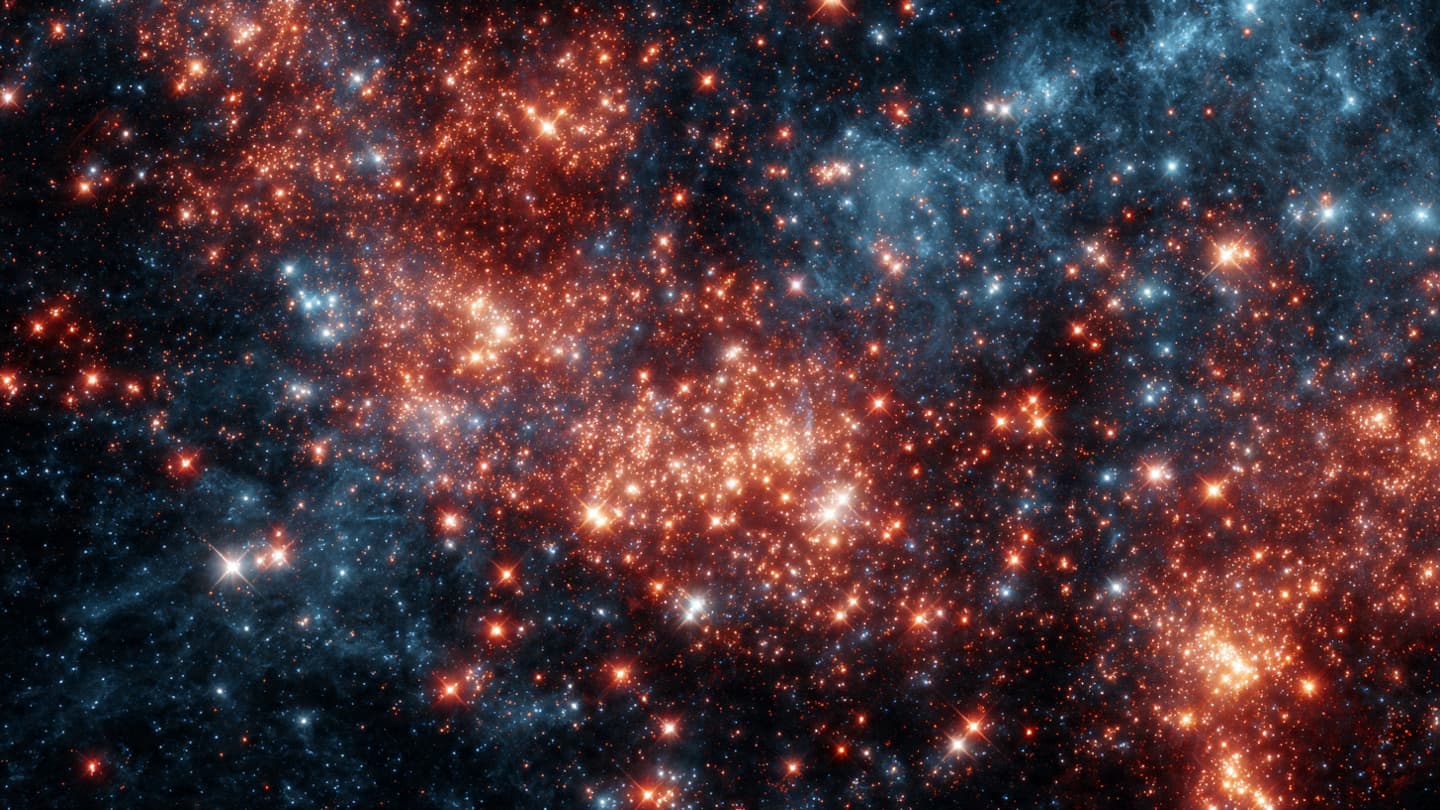
The universe has often behaved like an ancient manuscript with missing chapters, offering answers only after first deepening the mystery. Since its launch, ’s has looked farther into cosmic history than any previous observatory, revealing faint galaxies whose light began traveling toward Earth more than 13 billion years ago. Yet among those distant glimmers, astronomers have encountered a quiet surprise: several early galaxies appear far larger, brighter, and more developed than many existing cosmological models predicted.
Scientists designed Webb to explore the infant universe, particularly the era shortly after the Big Bang when the first stars and galaxies emerged from darkness. Researchers expected to find small and relatively immature galactic structures slowly assembling over time. Instead, some observations suggest that massive galaxies may have formed far earlier than anticipated.
The discovery has prompted extensive discussion within the astrophysics community. Cosmologists are now reevaluating assumptions about how quickly matter gathered into stable structures during the universe’s earliest epochs. While the findings do not necessarily overturn modern cosmology, they may require adjustments to existing models concerning star formation and galactic growth.
Researchers caution that the observations remain an evolving area of study. Determining the true age, mass, and composition of extremely distant galaxies is technically challenging, particularly because scientists are observing objects whose light has traveled across nearly the entire history of the universe. Additional spectroscopy and follow-up observations will help refine current interpretations.
Some astronomers suggest that early star formation may have occurred with unexpected efficiency, allowing galaxies to mature more rapidly than previously believed. Others propose that current estimates of galactic mass could eventually be revised downward as new data becomes available. In science, surprising observations often lead first to careful verification before broader conclusions are accepted.
The James Webb Space Telescope’s unprecedented infrared capabilities have played a central role in these discoveries. By detecting ancient light stretched into infrared wavelengths through cosmic expansion, Webb effectively acts as a time machine, allowing scientists to study eras that were previously inaccessible to human observation.
Beyond technical implications, the findings highlight how scientific understanding evolves through continuous questioning. Cosmology has long depended on the delicate balance between theory and observation, and history shows that even widely accepted frameworks are refined when new instruments reveal details hidden from earlier generations.
As Webb continues scanning the distant universe, astronomers expect additional discoveries that may either reinforce or reshape current models of cosmic evolution. For now, the telescope’s observations serve as a reminder that the universe remains larger, older, and perhaps more inventive than humanity’s best equations can fully capture.
AI Image Disclaimer: Some visual depictions connected to this article may be AI-generated interpretations inspired by astronomical observation data.
Sources: NASA, Nature, Scientific American, Space.com, BBC Science
Published by Banx Network. This article is part of the Banx decentralized media programme, powered by the BXE token on the XRP Ledger.



