There is a particular morality that seems to exist among friends—an unspoken understanding that some things are simply not done, that restraint is a form of respect, that the bond between two individuals imposes limits on what one will do to the other. For humans, this is intuitive. But a new study suggests that chimpanzees, our closest living relatives, may share something like it: a tendency to steal less from friends than from strangers, and to show different emotional responses when theft occurs.
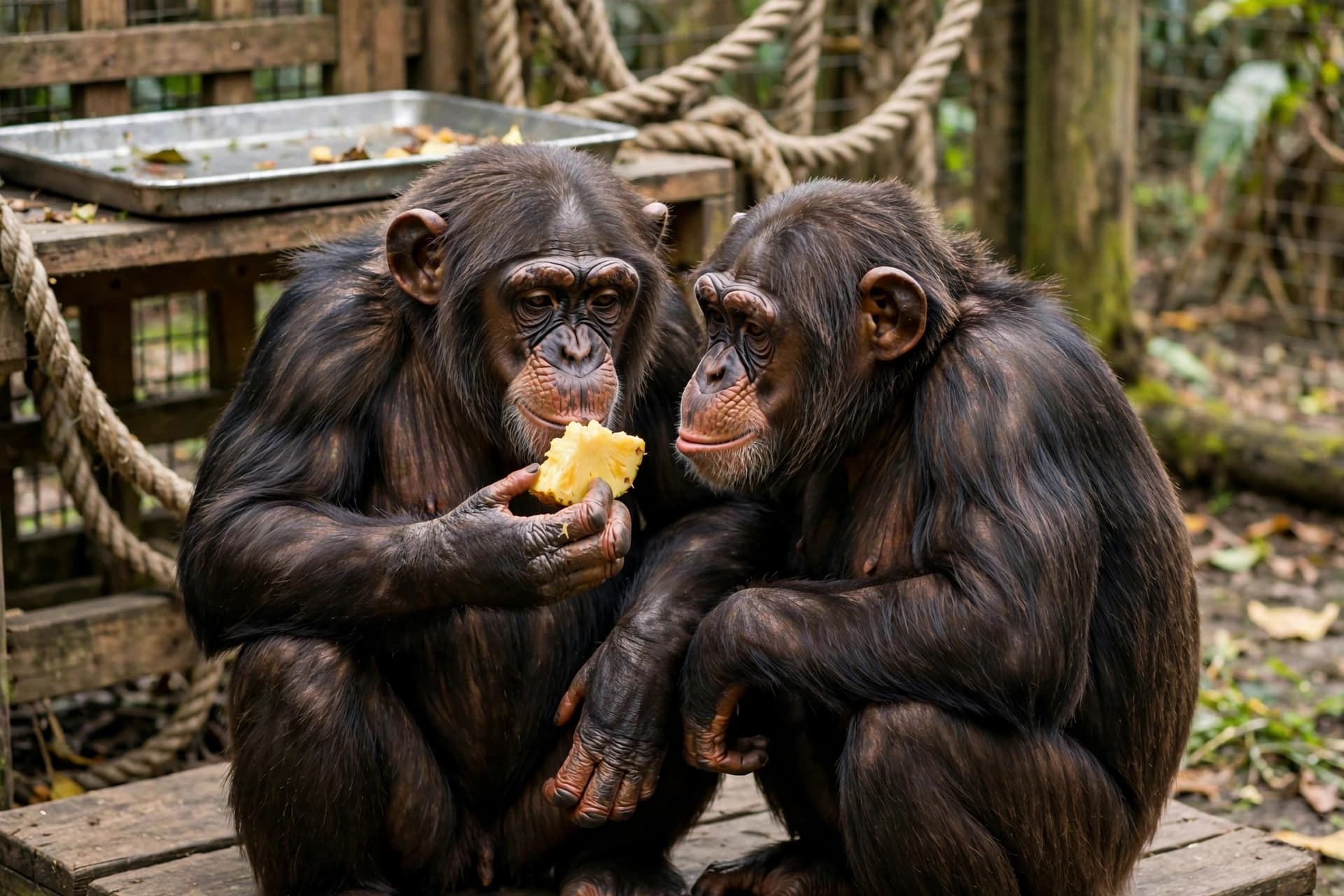
The research, published in Evolution and Human Behavior, studied 26 chimpanzees at the Ngamba Island Chimpanzee Sanctuary in Uganda . Over 800 hours of observation, researchers identified each chimpanzee's closest social partner using measures including grooming, physical contact, co-feeding, and proximity. They then paired each chimpanzee with both a friend and a non-friend of similar dominance rank, and presented them with a simple test: a tray holding three pieces of pineapple, with one chimpanzee designated as the "victim" and another as the "thief." The thief could pull a rope to bring the tray—and the remaining pineapple—within reach .
Across 138 trials, the chimpanzees stole the tray 65 percent of the time. But the details mattered. Theft occurred in 61 percent of trials involving friends and 70 percent involving non-friends—a statistically significant difference suggesting that friendship restrained the impulse to take . When no victim was present, every thief pulled the rope, demonstrating that the food itself was always desirable. The lower theft rate among friends was not about disinterest in the pineapple; it was about the relationship.
The emotional responses were equally revealing. Victims of theft showed a decline in signs of negative emotion—scratching, screaming, banging—across repeated trials when the thief was a friend. No such change occurred when the thief was a non-friend. The thieves themselves also displayed more negative affect when stealing from non-friends than from friends, with higher rates of screaming in the non-friend condition . The researchers caution that the results do not establish exactly why these patterns emerged, and that further research is needed to distinguish between possible explanations.
What the study adds to is a growing body of evidence that chimpanzee friendships are not merely about cooperation—about grooming, sharing food, and offering consolation—but also about restraint. Friendship appears to shape anti-social behavior as well as prosocial behavior, imposing limits on what one chimpanzee will do to another even when the opportunity for personal gain is present . The unwritten rule, if there is one, may be simple: take less from a friend, and feel differently about it when you do.
AI Image Disclaimer: All images in this article are AI-generated and are intended for illustrative purposes only.
Sources: CTV News, Evolution and Human Behavior, ScienceDirect
Published by Banx Network. This article is part of the Banx decentralized media programme, powered by the BXE token on the XRP Ledger.