
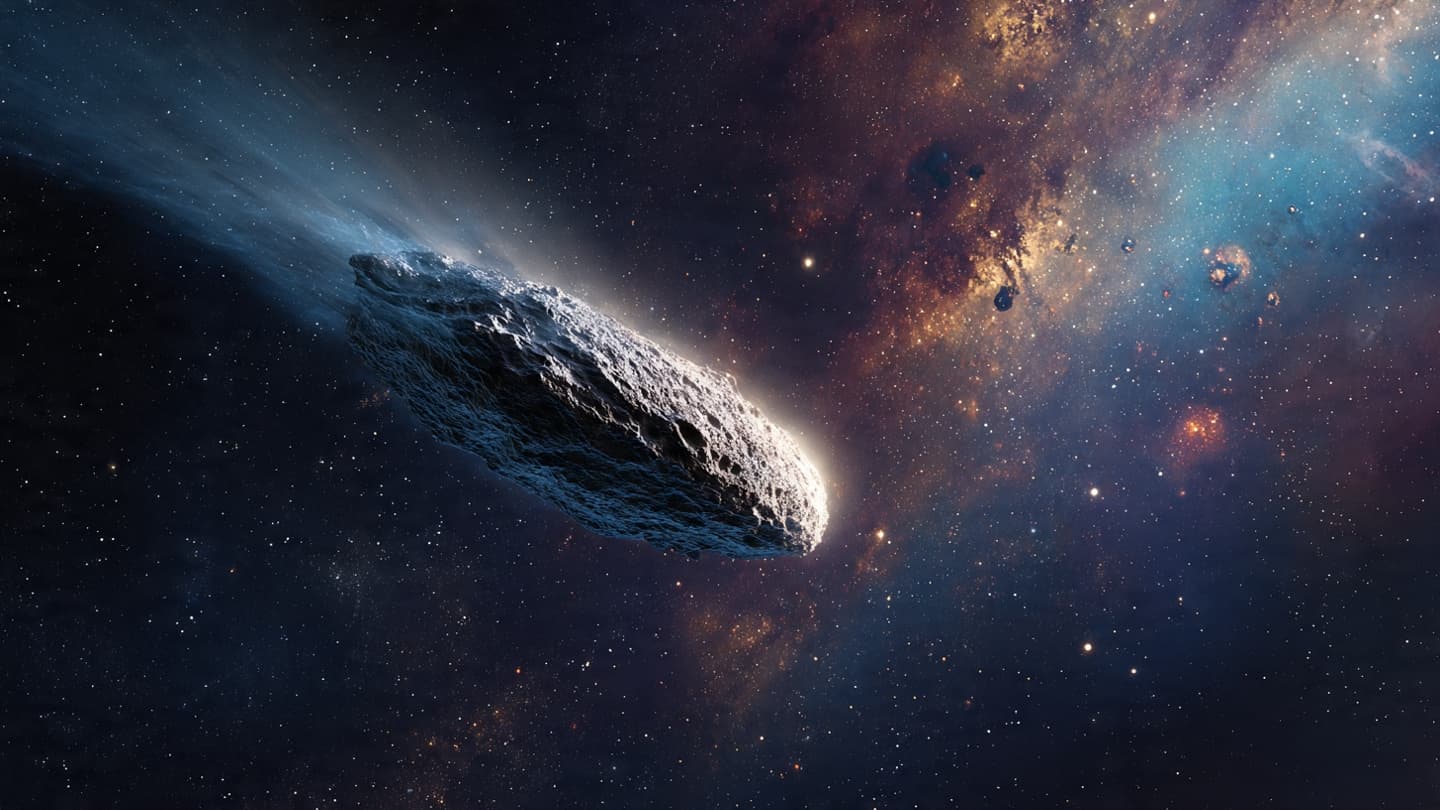
The universe occasionally sends visitors from distant realms, wandering travelers that carry stories written long before Earth itself existed. Like bottles cast into a cosmic ocean, these objects drift silently through space, preserving memories from eras beyond human imagination.
Astronomers studying an interstellar comet passing through our cosmic neighborhood have concluded that the object is likely significantly older than the Solar System itself. Preliminary analyses suggest the comet may have formed billions of years before the Sun and planets emerged approximately 4.6 billion years ago.
Interstellar objects originate beyond our Solar System and travel through the galaxy independently. Only a handful have ever been conclusively identified, making each new discovery scientifically valuable.
Researchers used observational data and computer modeling to estimate the object's age and trajectory. Its unusual orbital characteristics and chemical properties suggest that it may have formed around an ancient population of stars in the Milky Way.
Scientists believe such ancient objects can offer rare insight into conditions that existed during the early history of the galaxy. Unlike material within our Solar System, interstellar visitors may preserve evidence from environments that no longer exist.
The first confirmed interstellar object, known as 'Oumuamua, was detected in 2017, followed by comet Borisov in 2019. These discoveries have fueled growing interest in understanding how material moves between star systems.
Although many questions remain unanswered, astronomers emphasize that studying these objects could improve understanding of planetary formation, galactic evolution, and the distribution of matter throughout space.
Future observatories, including the Vera C. Rubin Observatory, are expected to detect more interstellar visitors, potentially allowing researchers to build a larger scientific sample.
As telescopes continue to scan the skies, these ancient travelers may offer glimpses into chapters of cosmic history that predate the birth of our own Solar System.
AI Image Disclaimer: Images included with this story are AI-generated artistic interpretations intended for illustrative purposes only.
Source Verification Check: Nature, Reuters, New Scientist, Live Science
Published by Banx Network. This article is part of the Banx decentralized media programme, powered by the BXE token on the XRP Ledger.



