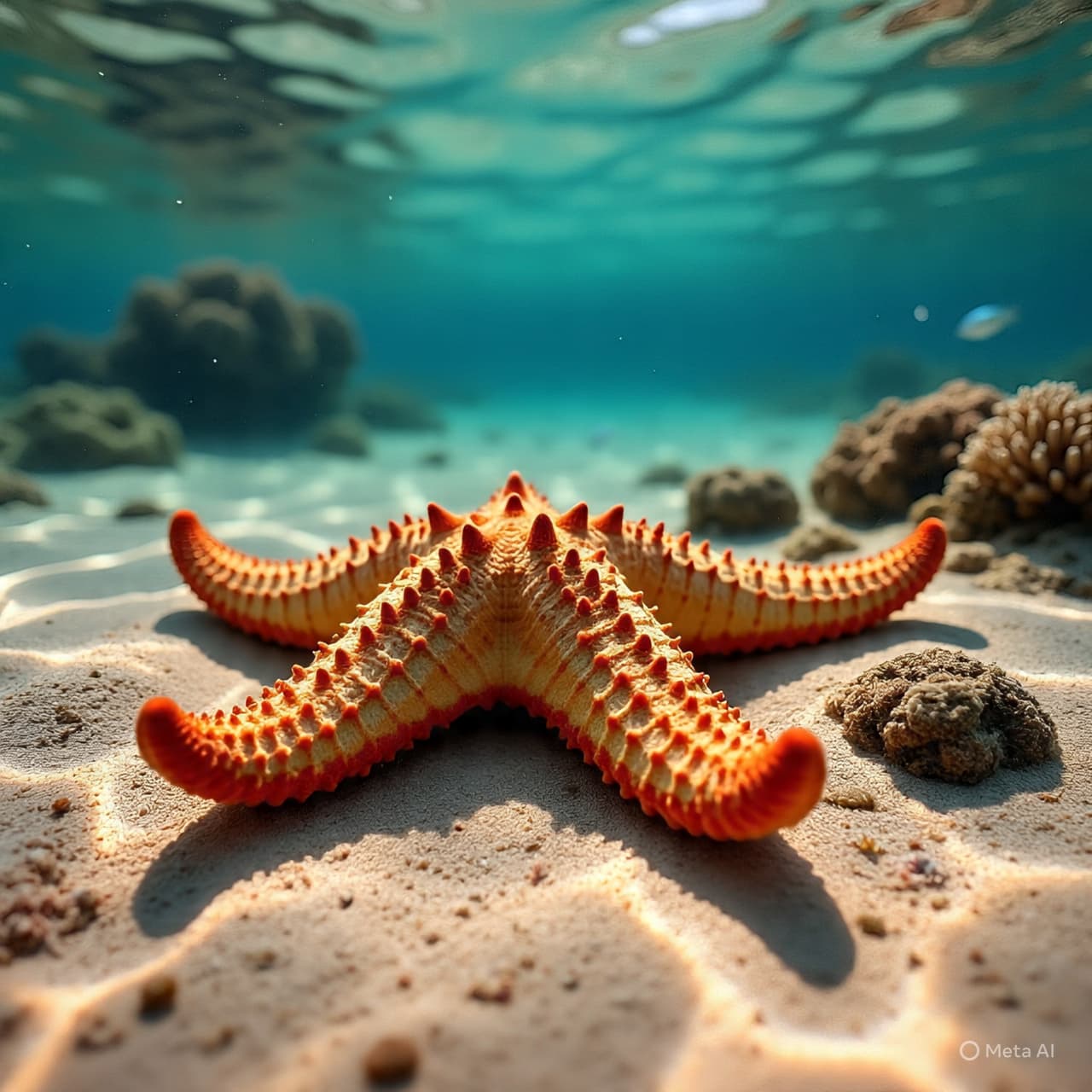
At low tide, when the water thins and the seabed briefly shows its geometry, starfish lie scattered like deliberate shapes placed by a careful hand. They appear still, almost ornamental. Yet beneath that calm geometry is a system quietly in motion—signals traveling, decisions unfolding—without anything we would recognize as a brain.
For decades, biologists have known that starfish lack a centralized nervous system. What has remained less clear is how these animals manage coordination across bodies that can span hundreds of feet in some species, or regenerate entire limbs without losing behavioral control. New research is beginning to show that the answer lies not in a missing brain, but in a different idea of intelligence altogether.
Starfish operate through a decentralized nerve network that runs through each arm and connects in a ring around the body. There is no command center issuing orders. Instead, each arm contains its own neural circuitry, capable of sensing the environment, initiating movement, and responding to threats. When a starfish moves, no single part leads. Direction emerges through local decisions that ripple outward, arm by arm, until the whole body follows.
In experiments observing movement and feeding behavior, researchers found that starfish arms can independently detect food, initiate grasping, and coordinate with neighboring arms without centralized oversight. If one arm encounters resistance, others adjust. If an arm is damaged or removed, the remaining limbs reorganize their signaling, compensating without confusion. Control is not rerouted; it is already everywhere.
This distributed system allows starfish to scale coordination across remarkable distances. In species with long, flexible arms, neural signals can travel locally rather than crossing the entire body, reducing delay and failure. Each segment responds to immediate conditions—pressure, chemical cues, texture—while staying loosely synchronized with the whole. It is less like a conductor leading an orchestra, and more like musicians listening closely to one another.
The implications extend beyond marine biology. Engineers studying swarm robotics and distributed computing have taken interest in how starfish solve problems without hierarchy. Systems designed this way are resilient. There is no single point of failure, no central node whose loss collapses the whole. Starfish demonstrate that coordination does not require control in the traditional sense—only communication and responsiveness.
Regeneration adds another layer to this quiet intelligence. When a starfish loses an arm, the regrowth process does not need instructions from a brain that no longer exists. Local nerve networks guide rebuilding, reconnecting structure and function simultaneously. Movement returns gradually, seamlessly integrated, as if the system simply expanded back into itself.
Seen this way, starfish challenge the assumption that intelligence must be centralized, fast, or visibly complex. Their decisions are slow, distributed, and silent. They do not think in moments, but in gradients—chemical, mechanical, electrical—spreading through tissue rather than firing from a single point.
On the ocean floor, where waves pass overhead and time moves differently, this kind of control makes sense. It is patient. It is durable. And it suggests that minds, like bodies, do not always need a center to hold.
AI Image Disclaimer
Illustrations were created using AI tools and are conceptual representations, not real photographs.
Sources
Smithsonian Magazine Nature Science Proceedings of the Royal Society B Marine Biological Laboratory
Published by Banx Network. This article is part of the Banx decentralized media programme, powered by the BXE token on the XRP Ledger.