Along the northern coast of West Java, the landscape can change with the weather in ways that are both ordinary and profound. Shallow ponds stretch beneath the open sky, seawater rests under the heat, and time gradually leaves behind small white crystals. For salt farmers, sunlight is not simply part of the scenery. It is part of the harvest.
This year, prolonged dry conditions associated with an intensifying El Niño climate pattern have given Indonesia’s salt producers an unusually favorable season. In Cirebon, July production reached nearly 600 metric tons, dramatically higher than the approximately 25 to 30 tons recorded during the same period a year earlier, according to Reuters.
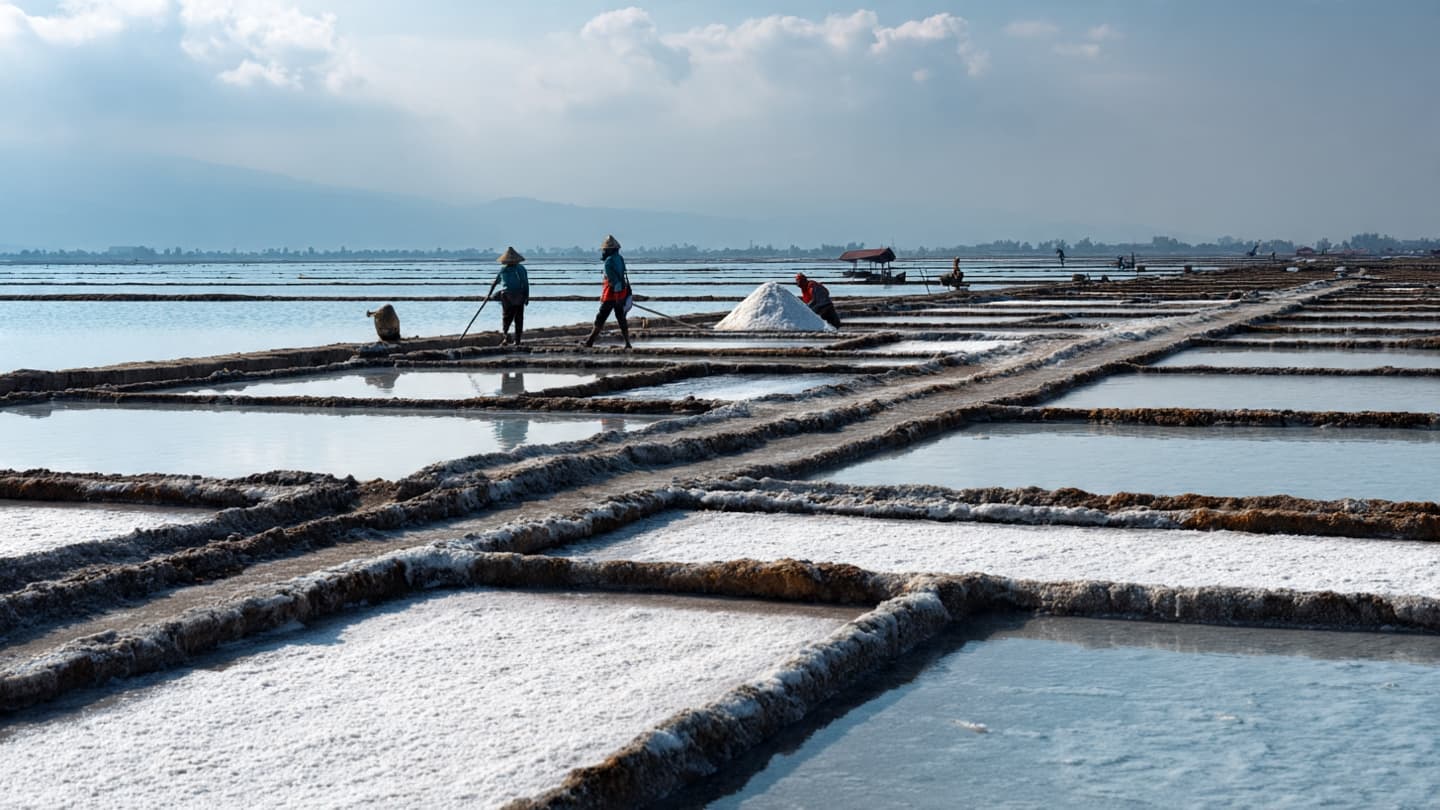
The method remains relatively simple. Seawater is directed into shallow evaporation ponds, where heat and wind gradually remove moisture. What remains is salt. Unlike many modern industrial processes, traditional salt farming depends heavily on weather, making an uninterrupted dry period especially valuable.
For Cirebon’s producers, the extended sunshine has therefore become an unexpected advantage. Fields that might struggle under excessive rain can perform well when the sky remains clear for long stretches. The same weather that brings difficulties to other agricultural communities can, in these coastal ponds, accelerate production.
The contrast is particularly visible when the current season is compared with the previous year. Indonesia produced around 1 million tons of salt last year, when a shorter dry season and wetter conditions associated with La Niña reduced production. During the 2023 El Niño period, national salt output reached approximately 2.5 million tons, according to Reuters.
The weather is not expected to change immediately. Forecasts cited by Reuters indicate that the dry season in affected parts of Indonesia could extend into October. For salt farmers, a longer dry period provides more time for evaporation and harvesting, although actual production will still depend on local weather and field conditions.
Elsewhere, however, the prolonged dryness presents a different reality. Crop farmers are facing greater pressure as water becomes less available and planting schedules become harder to manage. Agricultural authorities have encouraged adjustments to planting times as communities respond to the possibility of an extended dry spell.
That difference illustrates the uneven character of climate patterns. A single shift in rainfall can create opportunity for one livelihood while increasing uncertainty for another. Along the coast, salt ponds can become more productive under stronger sunshine, while inland agricultural fields may require additional water management and careful timing.
The story of Cirebon’s salt fields is therefore not simply one of higher production. It is also a small window into the relationship between weather and livelihood, where the same sky can carry different meanings depending on what lies beneath it. For now, the salt harvest is benefiting from the long dry season, while farmers elsewhere continue watching the weather closely.
AI Image Disclaimer: The illustrations were created using AI tools and are not real photographs.
Sources: Reuters Reuters Connect Statistics Indonesia (BPS) Indonesian Meteorology, Climatology and Geophysical Agency (BMKG)
Published by Banx Network. This article is part of the Banx decentralized media programme, powered by the BXE token on the XRP Ledger.