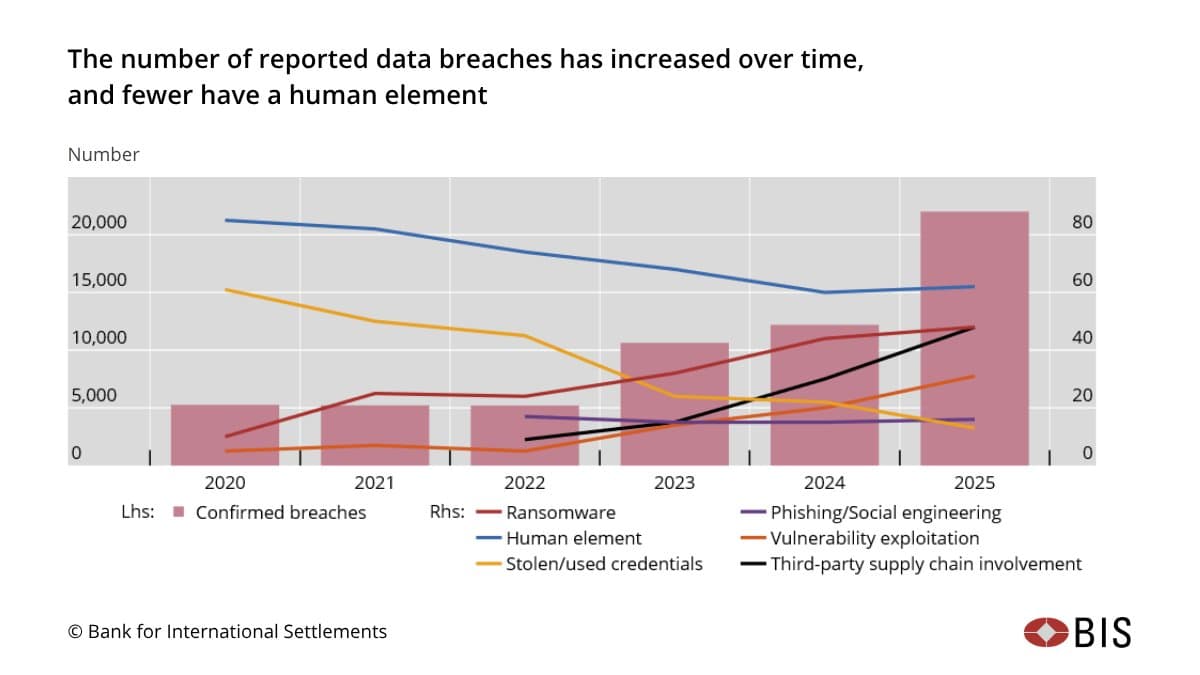
Artificial intelligence is rapidly reshaping the cybersecurity landscape, enabling attackers to launch increasingly sophisticated and automated cyberattacks. According to the Bank for International Settlements (BIS), frontier AI models are making cyber operations faster, more scalable, and capable of identifying vulnerabilities with greater precision than ever before. Recent data shows that reported data breaches have climbed significantly over the past several years, while incidents requiring direct human involvement have steadily declined. This trend suggests that attackers are relying more heavily on automation, AI-assisted phishing campaigns, credential theft, ransomware deployment, and software vulnerability exploitation. Cybersecurity experts warn that advanced AI can generate convincing phishing emails, create malicious code, automate reconnaissance, and rapidly adapt attacks based on a target's defenses. These capabilities lower the technical barrier for cybercriminals while increasing the speed at which attacks can spread across organizations. Businesses, governments, and financial institutions face growing pressure to strengthen cyber resilience. Defensive strategies now include AI-powered threat detection, continuous network monitoring, zero-trust security architectures, employee awareness training, and rapid incident response capabilities. Supply-chain attacks remain another major concern, as compromising one trusted vendor can provide attackers access to hundreds or even thousands of downstream organizations. AI further amplifies these risks by identifying weak links more efficiently. Financial regulators increasingly view cybersecurity as a systemic risk capable of disrupting payment systems, banking operations, and critical infrastructure. As digital transformation accelerates globally, organizations are expected to invest more heavily in cyber defenses and regulatory compliance. While artificial intelligence offers tremendous opportunities for improving productivity and innovation, it also creates powerful tools that malicious actors can exploit. Governments and technology companies continue working on frameworks to encourage responsible AI development while reducing security risks. The cybersecurity arms race is likely to intensify as both defenders and attackers leverage increasingly capable AI systems, making continuous adaptation essential for organizations worldwide.
Published by Banx Network. This article is part of the Banx decentralized media programme, powered by the BXE token on the XRP Ledger.