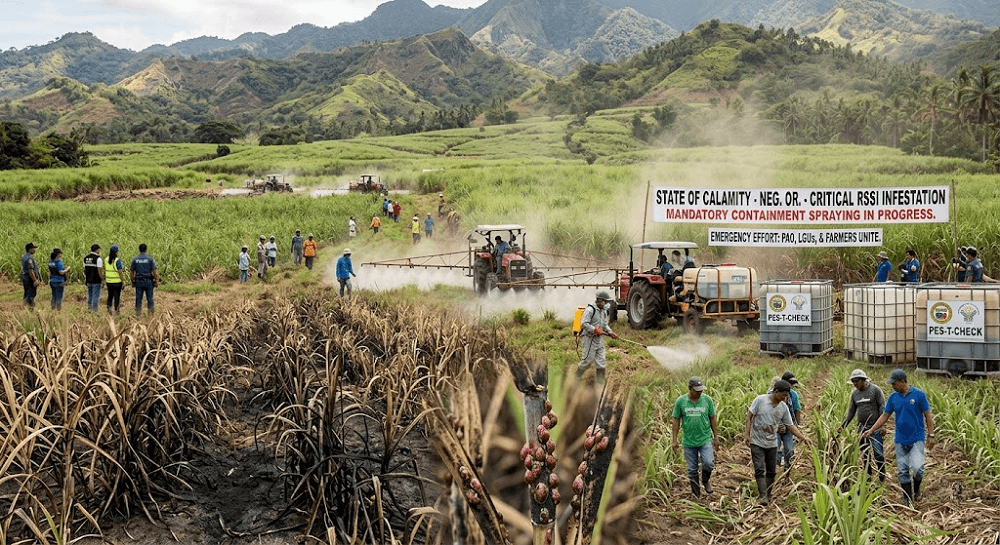
NEGROS ORIENTAL, PHILIPPINES — The provincial government of Negros Oriental has officially placed the entire province under a state of calamity following a severe and rapidly expanding pest outbreak. An estimated 17,125 hectares of sugarcane plantations have been ravaged by an aggressive infestation of the red-striped soft scale insect (RSSI), threatening local sugar production and the livelihoods of thousands of farmers.
The crisis escalated as the sap-sucking pests spread across multiple areas, including Mabinay, Bais, Bayawan, Guihulngan, Canlaon, and Tanjay, alongside neighboring municipalities. According to data from the Sugar Regulatory Administration (SRA), the affected zone spans roughly 17,125 hectares out of the province's total 48,901 hectares of sugarcane lands.
The red-striped soft scale insect severely damages crops by feeding on plant sap. Furthermore, the insects excrete a sticky honeydew substance that promotes black mold growth, which blocks sunlight and halts photosynthesis, ultimately causing the sugarcane plants to wither and die.
To combat the crisis, the Sangguniang Panlalawigan approved a resolution on July 20, 2026, acting on a recommendation by the Provincial Disaster Risk Reduction and Management Council (PDRRMC). The declaration allows the provincial administration to tap its Quick Response Fund (QRF), with an initial PHP 15 million earmarked to bankroll immediate containment operations and procure necessary equipment.
Provincial Agriculture Office (PAO) Chief Emmanuel Caduyac announced that a massive, mandatory chemical spraying initiative will be rolled out across the province. Crucially, the spraying will target not only infested fields but healthy plantations as well.
"The spraying must be done in all the sugarcane fields to make sure that there are no insects left to reproduce in nearby untreated farms," Caduyac explained.
Because the PAO lacks the manpower for an undertaking of this scale, the office is partnering directly with local government units (LGUs), barangay officials, and local farmers. Authorities noted that aerial crop-dusting will not be utilized due to the high risks posed by the region's rugged, mountainous terrain.
Beyond immediate chemical interventions, the provincial Task Force RSSI is exploring sustainable, long-term strategies to eradicate the pest and prevent future outbreaks. Proposals include establishing a local bio-control laboratory—estimated to cost around PHP 1.4 million—to study the insect's biology and develop natural biological control measures, such as fungi cultures.
As the province grapples with the fallout of the infestation, local leaders and agricultural bodies are also coordinating financial assistance and support programs to aid the hundreds of validated sugarcane farmers whose livelihoods hang in the balance.
Published by Banx Network. This article is part of the Banx decentralized media programme, powered by the BXE token on the XRP Ledger.