The highway usually carries its own quiet logic—lanes stretching forward, engines humming, the shared agreement to keep moving. On this stretch of road, that rhythm fractured in an instant. Sirens cut through the air, shots followed, and the clean geometry of traffic gave way to smoke and confusion.
Police say an armed gang fleeing in an armored vehicle exchanged gunfire with officers during a pursuit that unfolded at speed. What followed was not a single moment but a sequence: vehicles braking hard, officers taking cover, the armored car forcing its way forward as though momentum itself might be protection.
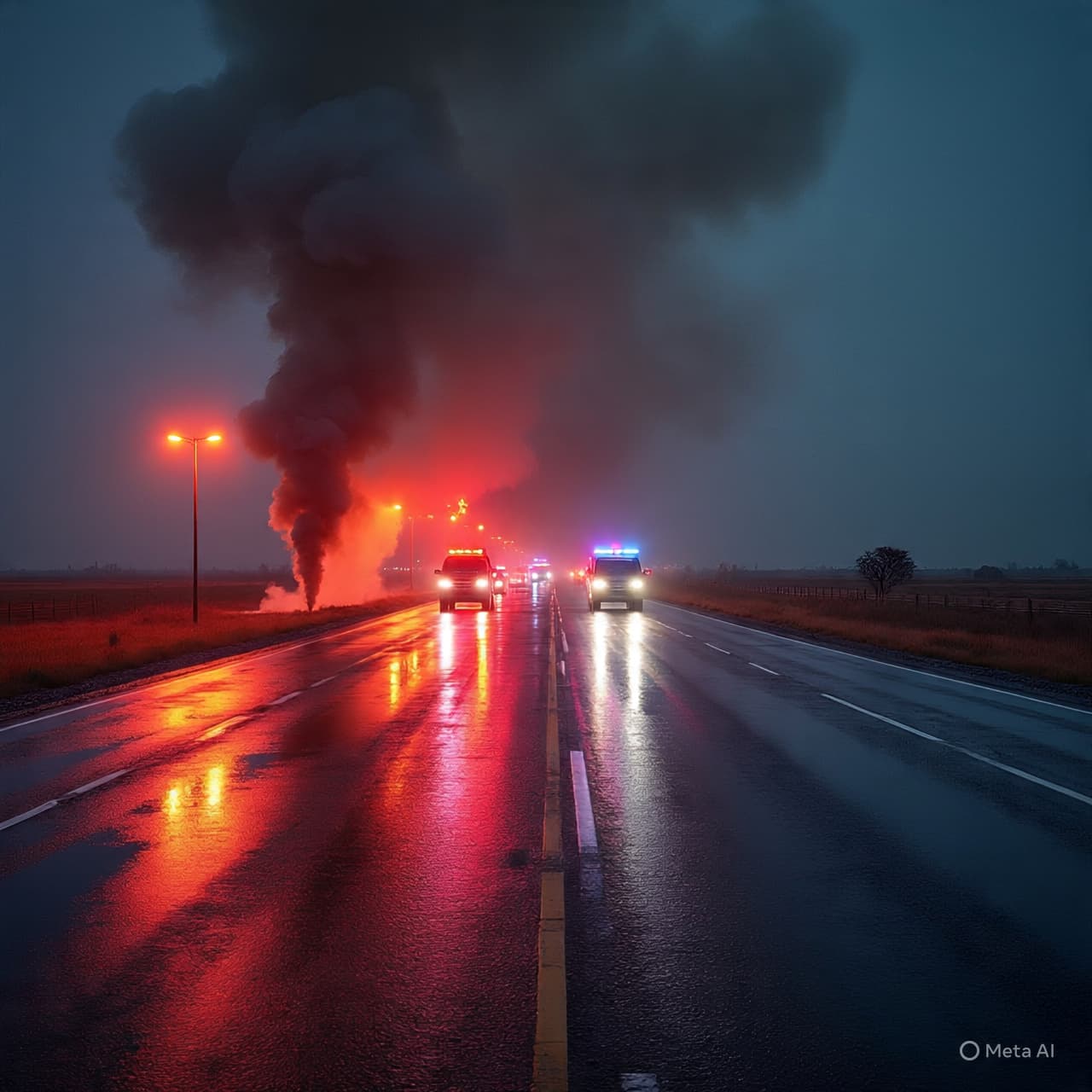
Then came the explosion. Investigators said the suspects detonated the armored vehicle after the shootout, sending debris across the roadway and halting traffic in both directions. The blast ended the chase but deepened the danger, turning a public thoroughfare into a scene of scorched metal and scattered evidence.
Authorities moved quickly to secure the area. Lanes were closed, motorists diverted, and bomb disposal teams checked for secondary devices. The aftermath was controlled and procedural—cordons, measurements, documentation—yet the violence lingered in the air, carried by the smell of smoke and the stunned stillness of those who had been passing through moments earlier.
Details emerged slowly. The gang’s motives remain under investigation, as does the source of the explosives used to destroy the vehicle. Police said no bystanders were injured, a fact repeated with emphasis, as if to reassure a public unsettled by how close ordinary movement came to extraordinary risk.
Armored vehicles are designed to resist force, to endure impact and gunfire. That one was deliberately destroyed speaks to a calculation beyond escape—a willingness to escalate, to transform pursuit into spectacle. For law enforcement, it raises familiar questions about preparedness and proportion. For everyone else, it redraws the boundary between routine travel and sudden peril.
As traffic eventually resumed, the road reclaimed its function. Tires passed over repaired asphalt. The marks were cleared. Yet highways remember in subtler ways. The incident sits now as a reminder that speed magnifies everything—fear, decision, consequence—and that order on the open road depends on more than lines and signs.
By nightfall, the smoke had lifted. The sirens were gone. What remained was a quiet reckoning with how quickly movement can become confrontation, and how thin the margin is between passing through and being caught inside the moment when violence interrupts the flow.
AI image disclaimer
Illustrations were created using AI tools and are not real photographs.
Sources Reuters Associated Press Local Police Department Public Safety Authority
Published by Banx Network. This article is part of the Banx decentralized media programme, powered by the BXE token on the XRP Ledger.