In orbit, where gravity loosens its hold and objects drift with a kind of quiet independence, even the most familiar forms can take on a different character. Light falls differently, shadows soften, and perspective—freed from the usual cues of weight and scale—becomes something less certain. It is a place where the ordinary, viewed from the right angle, can briefly resemble something entirely unknown.
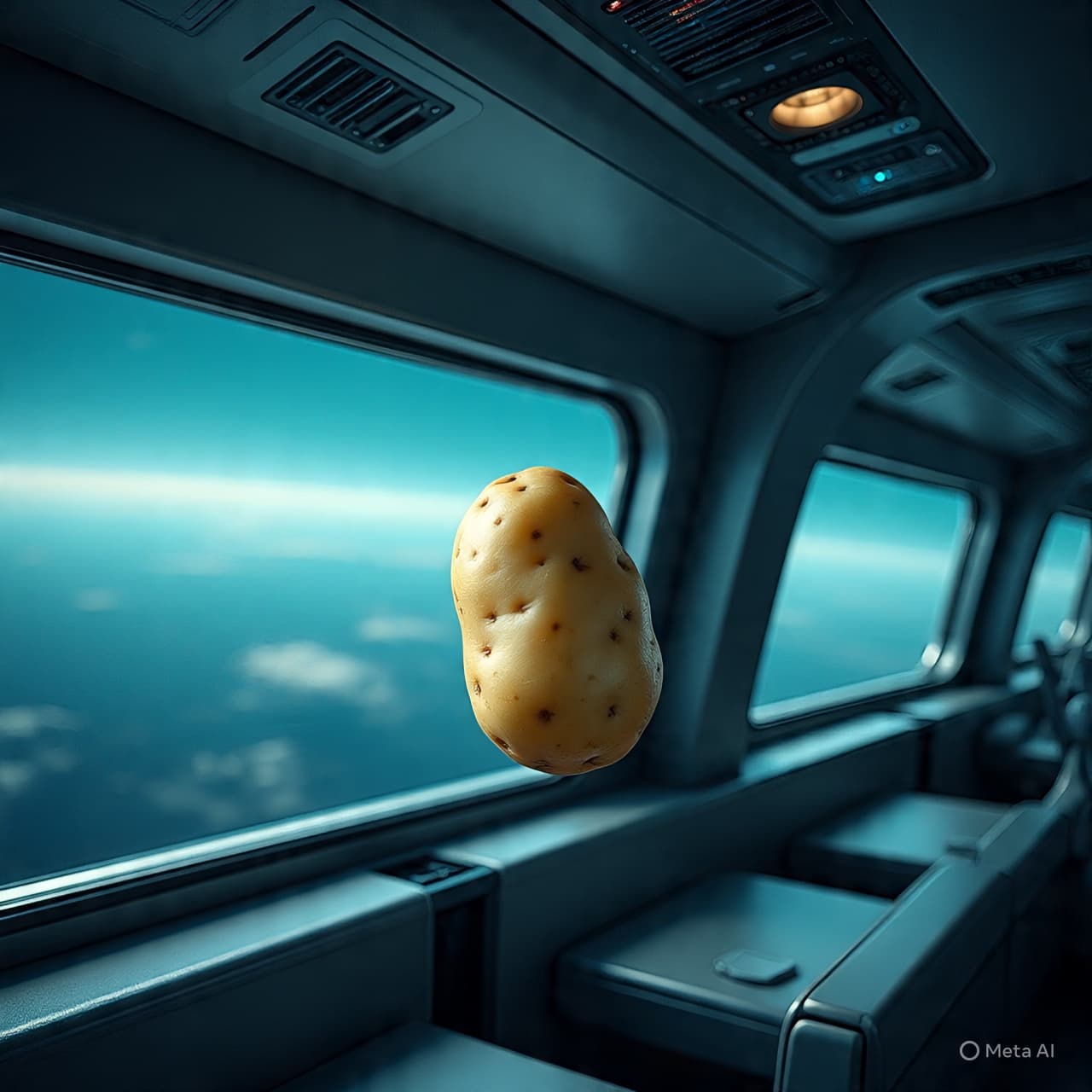
Such was the case in a recent image shared by NASA astronaut Don Pettit, whose photographs from space often linger between documentation and quiet observation. The image in question, at first glance, appeared to show a small, irregular object suspended in the darkness beyond a spacecraft window. Its contours were uneven, its surface textured in a way that invited speculation. To some viewers, it suggested something organic—an unfamiliar form, perhaps even a hint of life adrift in the void.
Yet the explanation, once offered, returned the image to a more grounded reality.
The object was, in fact, a simple potato, photographed in microgravity aboard the International Space Station. Freed from the downward pull that defines life on Earth, the potato floated in place, its shape and shadow creating an impression that, when framed against the vast blackness of space, became something momentarily ambiguous. The illusion was not in the object itself, but in the context that surrounded it.
This kind of visual misreading is not uncommon in space imagery. Without the reference points of horizon, scale, or familiar orientation, the human eye searches for meaning, often projecting patterns or associations onto what it sees. In this case, the interplay of lighting and isolation transformed an everyday item into something that seemed to belong to a different category altogether.
For Pettit, whose work often captures the quieter, more reflective aspects of life in orbit, the image fits within a broader practice of observation. Space photography is not only about distant galaxies or planetary views; it also includes the small, immediate moments within the spacecraft itself—objects drifting, light passing through windows, the subtle shifts that define daily life in microgravity.
There is a certain gentleness in this kind of image. It does not seek to astonish through scale or distance, but through perception—through the way it momentarily unsettles the boundary between what is known and what is imagined. A potato becomes something else, not because it has changed, but because the conditions of viewing have.
And then, just as quietly, the moment resolves. The unfamiliar returns to the familiar, the question gives way to understanding, and the object settles back into its ordinary identity, even as it continues to float.
NASA astronaut Don Pettit shared an image from the International Space Station that appeared unusual but was later identified as a floating potato photographed in microgravity. The image highlights how perspective and lighting in space can alter the appearance of everyday objects.
AI Image Disclaimer
Illustrations are AI-generated for visual interpretation and do not represent actual photographs.
Source Check (verified coverage exists): BBC News, Reuters, The Guardian, NASA, Space.com
Published by Banx Network. This article is part of the Banx decentralized media programme, powered by the BXE token on the XRP Ledger.