
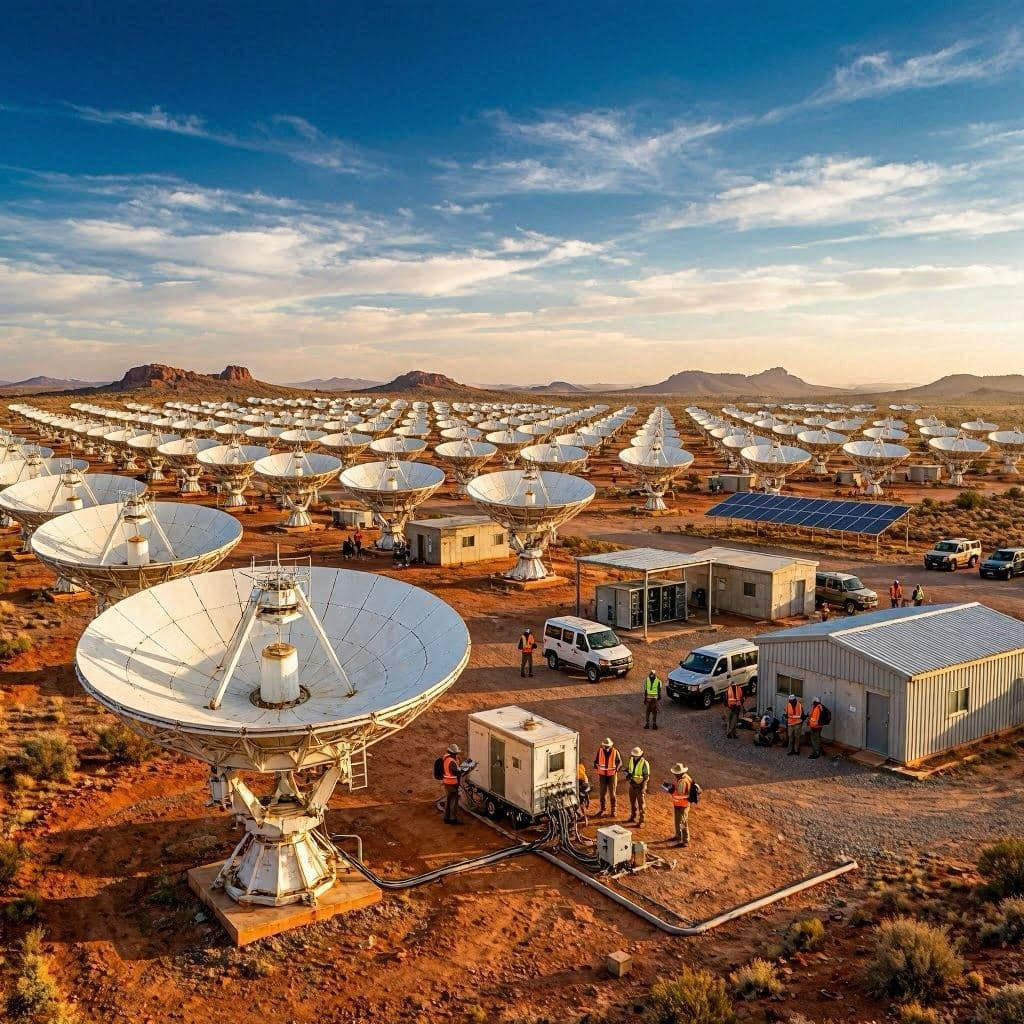
Across deserts in Australia and vast landscapes in South Africa, an ambitious scientific endeavor is quietly taking shape. The Square Kilometre Array, widely known as SKA, promises to become one of the most powerful radio astronomy facilities ever constructed, offering humanity a new lens through which to observe the universe.
Scientists involved in the Square Kilometre Array Observatory have outlined an updated scientific vision for the project, emphasizing its potential to transform modern astronomy. Once fully operational, SKA is expected to provide unprecedented sensitivity in radio observations.
The observatory is being developed across two continents, with low-frequency antennas located in Australia and mid-frequency dishes situated in South Africa. Together, these facilities will function as a single, highly capable scientific instrument.
Researchers anticipate that SKA will address some of astronomy's most fundamental questions. Planned investigations include studies of galaxy formation, cosmic magnetism, dark energy, gravitational phenomena, and the evolution of the early universe.
One of the observatory's major goals is to examine the period known as the Cosmic Dawn, when the first stars and galaxies began to illuminate the universe after the Big Bang. Observations from SKA may provide unprecedented insight into this transformative era.
The facility is also expected to advance the search for extraterrestrial signals and improve understanding of extreme astrophysical environments, including pulsars and black holes.
Because SKA will generate enormous quantities of observational data, researchers are simultaneously developing sophisticated computing infrastructure capable of processing and analyzing information at extraordinary scales.
As construction progresses, astronomers around the world are preparing for an era in which radio astronomy may reveal phenomena previously beyond humanity's observational reach.
AI-generated image disclaimer: Visual representations accompanying this article were generated using artificial intelligence and are intended solely for illustrative purposes.
Source Verification Check: SKAO, arXiv, Nature Astronomy, European Southern Observatory
Published by Banx Network. This article is part of the Banx decentralized media programme, powered by the BXE token on the XRP Ledger.



