On a canvas painted with ancient light and shimmering galaxies, there are stories so vast they stretch the limits of our imagination. One such tale has now been etched into cosmic history by the James Webb Space Telescope (JWST): the first confirmed observation of a runaway supermassive black hole, careening through intergalactic space at an astonishing speed of about 2.2 million miles per hour — nearly 3,000 times the speed of sound.
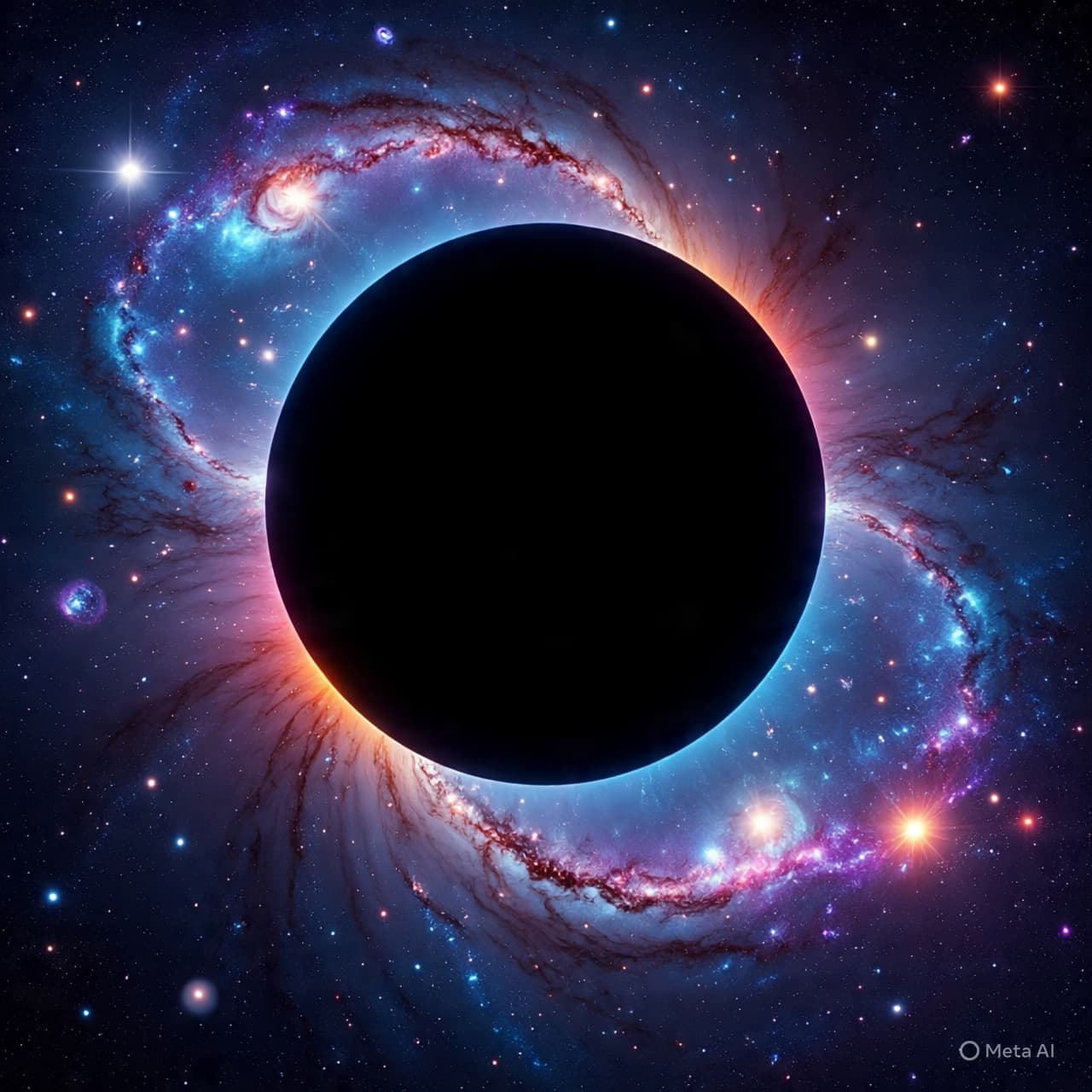
Supermassive black holes — objects millions to billions of times more massive than our Sun — are normally anchored deep within the hearts of galaxies, their gravity holding sway over stars and gas alike. Yet here, in the vast expanse around a pair of colliding galaxies nicknamed the Cosmic Owl, Webb’s infrared gaze has revealed something extraordinary: a black hole that has broken free of its cosmic home and now races through the void, trailing a wake of disrupted gas and newly forming stars.
This wandering giant was first suspected in 2023, when images from the Hubble Space Telescope showed a long, thin streak extending from the Cosmic Owl’s core. That streak hinted at some massive object barging through gas and dust — but confirmation eluded astronomers until Webb’s unparalleled sensitivity captured clear shock signatures at the tip of the streak. These shocks are the cosmic equivalent of a supersonic bow wave, created as the black hole plows through its surroundings, pushing material aside at incredible velocity.
The discovery offers compelling evidence for theories long predicted by astrophysicists: that in rare but dramatic events — such as when galaxies merge and their central black holes collide — gravitational forces can give the newly formed black hole a powerful “kick,” sending it hurtling into space. Alternative scenarios involve complex three‑body interactions, but in this case the evidence points most strongly toward the gravitational recoil from a merger.
What makes this find more than just a cosmic curiosity is its impact on our understanding of galaxy evolution. As this lone black hole tears through its environment, it leaves behind a trail hundreds of thousands of light‑years long where gas compresses and stars ignite. These shocked regions demonstrate that even a vanquished giant continues to shape its surroundings, stirring star formation and redistributing matter far beyond the confines of any single galaxy.
For astronomers, this moment is both a confirmation and an invitation — a confirmation that runaway supermassive black holes truly exist, and an invitation to search for others. With future instruments like the Roman Space Telescope and Euclid poised to survey the heavens in greater detail, the age of discovering the universe’s most elusive wanderers may just be beginning.
AI Image Disclaimer Visuals are created with AI tools and are not real photographs.
Sources Space.com; HotHardware; Daily Galaxy; MoneyControl reports.
Published by Banx Network. This article is part of the Banx decentralized media programme, powered by the BXE token on the XRP Ledger.